Rob and I have now visited the Upper Peninsula. Someone from the U.P. is called a Yooper. We traveled from Mackinac Island across the Straits of Mackinac by ferry to St. Ignace on the Upper Peninsula.

The Mackinac Bridge is currently the longest suspension bridge in the western hemisphere and fifth longest in the world! Affectionately known as “Mighty Mac,” it spans nearly five miles across the Straits of Mackinac to connect Michigan’s Upper and Lower Peninsulas. This engineering marvel opened to traffic on November 1, 1957.

All suspension bridges are designed to move to accommodate wind, change in temperature, and weight. It is possible that the deck at center span could move as much as 35 feet (east or west) due to high winds. This would only happen under severe wind conditions. The deck would not swing or “sway” but rather move slowly in one direction based on the force and direction of the wind. After the wind subsides, the weight of the vehicles crossing would slowly move it back into center position.
We have walked across the Golden Gate Bridge in the past, but we could not see where one could walk over the Mighty Mac bridge. An Internet search revealed that on the morning of Labor Day, it is closed to traffic and open to walkers.
Petoskey is a cute little town. We had lunch at a Mexican restaurant and ordered in Spanish. The owner seemed pleased. He had the TV on the World Cup (Copa Mundial), and it was in Spanish. The score ended in a 0-0 tie. And I remembered why I don’t like soccer!!
Young Ernest Hemingway spent 22 summers with his family in Petoskey. Later, he returned to nearby Horton Bay with his wife, Hadley Richardson.

Perched high on a bluff overlooking Lake Michigan, The Stafford’s Perry Hotel stands as a proud symbol of the early 1900’s when northern Michigan tourism was in its infancy.

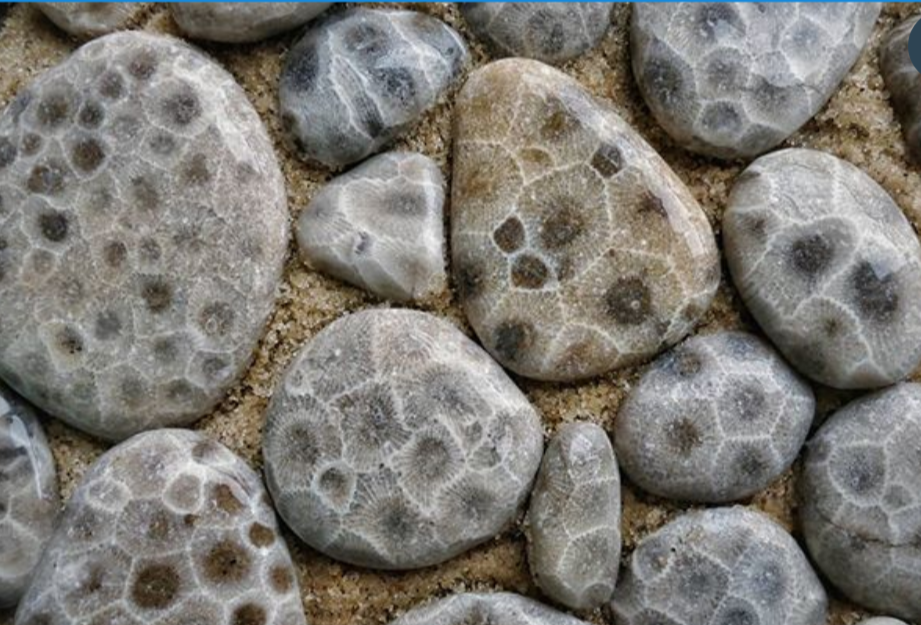
What is a Petoskey Stone?
The Petoskey stone is fossilized pre-historic coral. Distinguishable by its unique exoskeleton structure, a Petoskey stone consists of tightly packed, six-sided corallites, which are the skeletons of the once-living coral polyps. The center of each polyp was the mouth and contained tentacles that reached out for food. The hexagon shape of each cell and thin lines radiating out from the dark “eye” in the center are distinguishing features unique to this fossil.


Several of us went to Lavender Hill Farm which is a 38-acre farm with 14,000 lavender plants of 30 varieties.

Lavender plants like it hot and dry and need good drainage. The plants can last for 30 years. They are perennial woody shrubs and bloom by the end of June. The blooms are harvested by hand and are separated into craft grade and culinary grade.
The oil is concentrated in the buds and the bouquets are dried upside down to keep the oils in the bud. Then it is distilled.

I learned that deer and mosquitoes don’t like lavender so they don’t have pest problems. In fact the dried stems and dead heads are sold as mulch to gardeners who put it around trees and under decks.

Leave a Reply