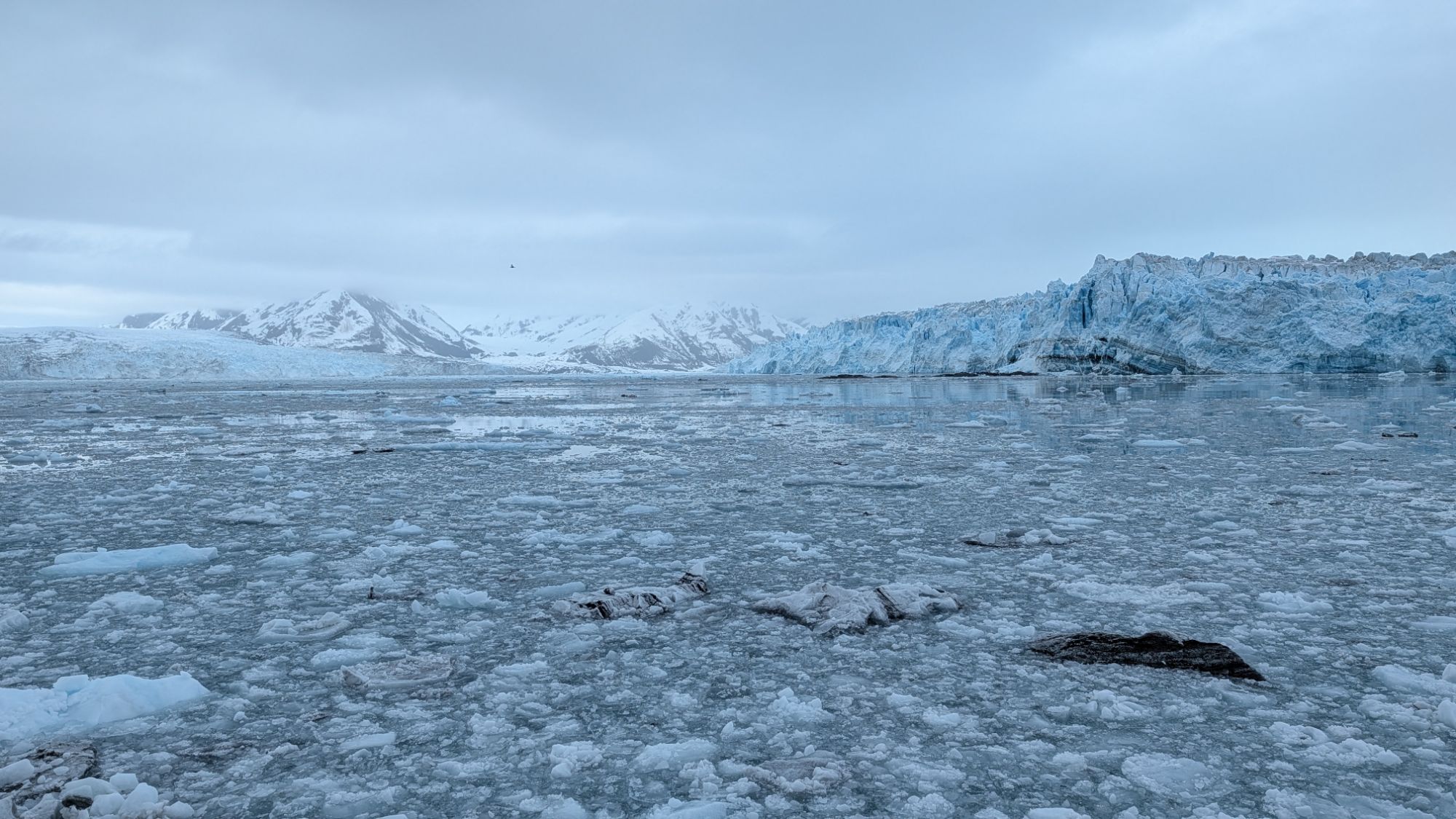

Hubbard is over 76 miles long, nearly 6 miles wide where it meets the sea, with a face up to 400 feet tall (250 feet above water, 150 feet below). It advances 80 feet per year. The ice that calves is around 400 years old.


Hubbard Glacier was named in 1890 after the first president of the National Geographic Society, Gardiner Greene Hubbard. (I am sure that it had an indigenous name way before that!)


Glacial ice pushes the oxygen out of the water. This gives it the blue color.


The glaciers become heavy from snow and ice accumulation and start down the mountain.
Glaciers can grow and become larger. In the past, nine out of ten glaciers were growing. Now it is in reverse. One out of ten is growing.

A hanging glacier stops before the water’s edge. These do not calve. Once a tidewater glacier retreats from the waters edge and becomes a hanging glacier, it will never return to being a tidewater glacier.

Wildlife
Ice floes are prevalent and seals have their pups on them.
Transient orcas eat anything and everything whereas the resident orcas eat only fish.
Otters float on their backs and eat fish and shellfish. Otters have a pouch in their armpit to carry their favorite rock. Some keep it for their entire lives. Eagles come by and grab the fish.
Black legged kittiwakes are a common sight and nest on a specific island called Egg Island.
Bears are waking up and coming down to the waters edge. They are really hungry. They turn over rocks and eat what they find until the salmon arrive.
The heaviest snowfall ever occurred this winter. It greatly affects the natural world so scientists are studying its effect. For example, berries are late so bears are hungrier while searching for food.
Grizzly bears and brown bears are the same genetically. Grizzly bears are inland. Brown coastal bears are bigger due to their diet.
On board
We started the day with Tai Chi but didn’t really think that it was worth getting up early. At the end of the day, we warmed up with a sauna followed by the hot tub. Now THAT was worth it!
Leave a Reply