Modern day Bonaire is a diver’s dream for its pristine marine ecosystems and oceanic wildlife. Although it’s the “B” in the “ABC” islands, Bonaire has a charm and charisma decidedly different from its Dutch siblings. Bonaire’s natural wonders and laid-back ambiance are the main attractions here.

The north is mountainous with lagoons of shorebirds, especially the pink flamingo which is the symbol of the island. Flamingos need brackish inland waters. There are 245 types of avifauna (that was a new word for me) on the island.

The flamingo is white but turns pink by eating brine shrimp that has carotene. The shrimp are in the mud so they use their bill to scrape them up. The pinker the flamingo, the older the flamingo. They fly to Venezuela if they aren’t finding what they need, but beware. They still eat flamingo in Venezuela.

Flamingos mate for life and if one dies, they will stay alone until they die. The knees go backwards. They fly in vee formation, and their wings are black wings on the underside.
Washington Slagbaai National Park was one of the first to protect wildlife in 1962.
The south is at sea level and contains the salt pans. Reefs surround a smaller nearby island called Klein Bonaire. The coral reef has been pushed up and exposed. The natural coral reef system starts at the shoreline. The tide at no more than two feet is more affected by the wind and pressure systems than the moon.


The first inhabitants were tribes of Arawok 400 years before Christ. The Spanish took the Arawok to be slaves in South America. Some descendants of the original inhabitants returned and display their proud ancestry outside their homes today.
In 1499 the Spanish looked for gold and silver. They found none and named it Useless Island. Then came the Dutch.
Dutch is the official language, but most people speak Papiamento which is a type of creole. Each ABC island speaks it differently.
- Aruba – singing
- Bonaire – slow
- Curaçao – speak very well but fast like a machine gun.
Bonaire is a polyglot society with most people able to converse in at least two languages.
Bonaire has the oldest marine park. After my Aquafari fiasco in Curaçao, we will not be exploring that!!
Internment camps during WWII housed Germans and Austrians. The barracks became Bonaire’s first hotel called Zeebad. German U-boats were interested in obtaining oil in Venezuela.
This island is committed to recycling and trash disposal. Wind makes up 45% of total energy generation. They are striving for 100%.
The majority religion is Catholic, but there are 18 different religions on the island. Buildings cannot be higher than the Catholic Church.
Most buildings are two story with the business downstairs and living area upstairs. One is not allowed to dry laundry outside.
The main industry is diving, especially shore diving. No anchors are allowed because it will damage the reefs. One can only tie up. Turquoise water is shallow and dark water is deep. There are 85 dive sites, and stone markers are painted yellow to locate.
Sea turtles are protected. They used to be eaten. One can swim with the turtles but can’t touch them. Most are tagged. At night, the hatchlings head to the light of the airport. Only 3 turtles out of 100 survive.
North Africa Nubian Donkeys are not native. The donkeys will go through the trash cans. They were used for transportation. Now there are 1,000 wild donkeys, and they are protected. The highest speed limit on the island is 45 miles per hour, but no one obeys it, and there are lots of accidents. If you hit a donkey, it is not covered by insurance.
Today the minimum wage is $5.45 per hour. Most people have 2 to 3 jobs because everything is imported, and it is expensive.

Our guide drives a school bus, tourist bus on the weekends, and airport shuttle. Many college students don’t return to the island after graduating.


April 30 in Bonaire is Rincon Day, the island’s largest annual cultural festival and an official public holiday celebrating the heritage of the oldest town, Rincon, and the sorghum harvest.
There is a large Chinese population on the island. The first person arrived in 1960 with many family and friends to follow.
Bonairean highway aka Dead Man’s Road is as bad as all the other roads. People drive too fast, and alcohol and donkeys are problems. Until six years ago, there were no laws about driving. They are now under Dutch driving laws.
They have bus stops all over the island but there are no buses. You must call for a “bus” to pick you up.

In 1936 the first airplane landed at Flamingo International Airport. At first they thought that it was a big bird until people stepped off of the plane. There are no high-rise hotels.

Bonaire was once a salt-producing outpost of the Dutch Trading Company. Slave trade was used in the salt pans. The men would walk long distances to work in the salt pans in the north and women would work with the aloe plants in the south. They were only together on Sunday on their day off, and the distance walked was over 8 hours.

The slave men who worked in the salt pans would be blind by age 35 and had sores on their skin from the corrosive salt. Since they were no longer able to work, they were sent off to a nearby island.

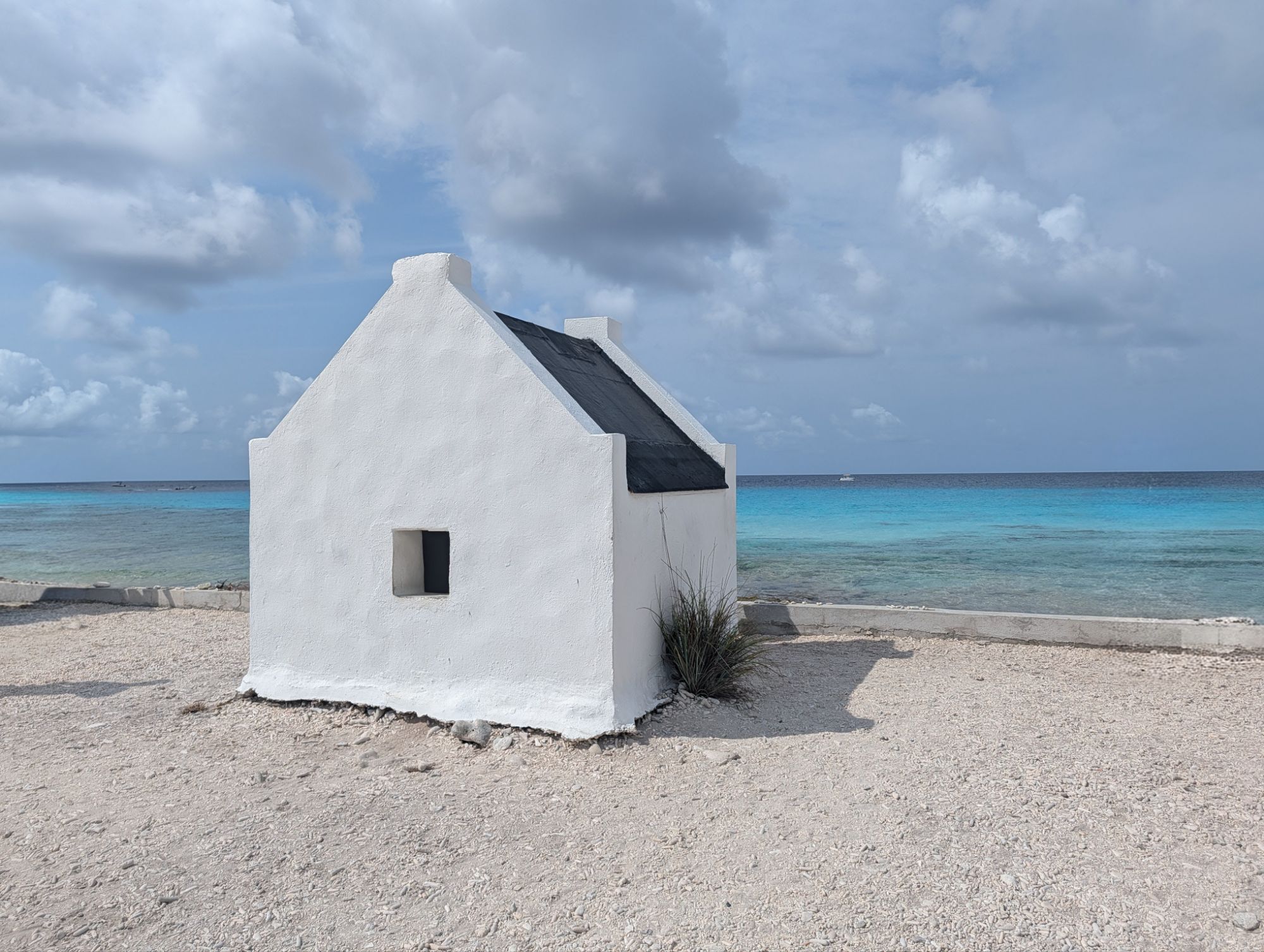
The slave huts were built in 1850 to show the world how well the slaves were treated. Prior to that, they had to build their own huts to shelter from the sun and rain. In 1863, slavery was abolished.

It would take them five days to load ship. Today it is mechanized and produces 50,000 tons/year and provides industrial salt to the USA. Cargill only rents the land.
They don’t grow vegetables. Due to the salt, it has no taste, and it takes a lot of expensive water. The corrosive air means one has to replace air conditioning units often. Our bus will need to be washed at the end of the day.

Bonaire in the Know
- Crime rate is low. If you steal something, it is too hard to hide it on this small island. Everyone knows.
- The only fast food on the island is KFC which stands for Kitchen For Cholesterol
- There is one traffic light and four gas stations.
- There are no short term rentals.
- There are no predators on Bonaire.
- Lionfish are not native to this island. One can get a lionfish burger for $35.
- The conch is gone from this island. However, it is protected.
- Palm trees are not native to the ABC islands.
- If one finds a parrot and takes it home and it doesn’t have a tag, the noisy bird can be heard by an official there is a huge fine.
Trans World Radio broadcasts Christian programming all over the world in many different languages. There are 17 transmitters worldwide and the highest wattage AM transmitter in the Western Hemisphere is Shine 800 AM. It reaches a potential audience of 100 million across Latin America and the Caribbean. The first broadcasts from the island of Bonaire occured in 1964.
Here is their “mission” statement from Psalm 107:24-28
They see the works of the Lord,
And His wonders in the deep.
For He commands and raises the stormy wind, which lifts up the waves of the sea. They mount up to the heavens, they go down again to the depths; their soul melts because of trouble. They reel to and fro, and stagger like a drunken man, and are at their wits’ end. Then they cry out to the Lord in their trouble, and He brings them out of their distresses.
Leave a Reply