Both of us have a blog and we know that our posts will be different and emphasize different things.
Rob, Amy, and I are up early much to Rob’s disappointment due to our late night arrival. We had a city tour scheduled at 9:00am with Uncle J.

Puerto Rico is a territory of the USA so when you say that you are from the USA, they respond, “so are we.” Hmmm. True. A better response is “from the mainland” or your state.
The people that we met really don’t want to be a state. They like how things are. In 1917, Puerto Ricans became citizens and are called nationals. Nationals can’t vote for the president, and they don’t pay federal income tax, BUT they have a US passport. No ICE agents are trolling Puerto Ricans.
The Ottoman Empire closed off the Silk Road following their conquest of Constantinople in 1453 so Europe had to go west to trade. Going around Africa took about three years which was too long.
In 1492, Spain was building an empire. The English were plunderers. Portugal had the strongest navy.
When Christopher Columbus “discovered” America, his crew of 50 criminals was starving and about to mutiny. He did not use the trade winds. It was a long voyage of 36 days. I guess the trade winds hadn’t been discovered either. On his second voyage, he caught the trade winds and arrived at the Bay of San Juan in 21 days. This made Puerto Rico ground zero of the new world trade and was attributed to its location on the trade winds.

San Juan Bautista was the original name of the island. However, the indigenous Taíno people called the island Borikén. People from Puerto Rican are called Puertorriqueños or Boricua. There are three million Puerto Ricans on the island and six million living in the US, mostly in New York.
Christopher Columbus was looking for trade but found gold. He went to his death bed thinking that he had landed in the East Indies. His ship was caught in the reef, and the indigenous people called Taíno thought that the white-skinned people were gods.

In 1508, the first Spanish colony was established on the island and after eight years was relocated to the city of San Juan which was called City of Puerto Rico back then. Now the whole island is called Puerto Rico.
Queen Isabella was fourth in line to the throne. No one thought that she would be the ruler of Spain. She married her first cousin Ferdinand. The Pope had to sign off on the marriage.
Isabella was ambitious. She directed troops to invade the last Muslim stronghold, Granada. Then she kicked out all the Muslims and Jews. They were told to convert to Catholicism or leave. This was called the Spanish Inquisition.
Spain used the gold and silver from the New World to build their empire.
Henry VIII of England became king at an early age. He was Catholic. He wanted to divorce his wife, but that was not allowed so he started his own church. His actions encouraged Catholic Christians to come to America.
Sir Frances Drake was a pirate but also a hero by defeating the Spanish Armada in 1588. They were the underdogs with 25 ships to the Spanish 140 ships. (However, the next ten battles were won by the Spanish.)
Queen Elizabeth sent Drake to plunder the Spanish along the West Coast of South America. He started with seven ships. At the turbulent tip of South America where the Atlantic, Pacific and Southern Oceans meet, four ships turned back and headed home, and two ships were destroyed by the rough seas. Only Drake made it through. (It is now called the Drake Passage.)
Drake was referred to as The Ghost. He took the gold and sailed all the way up the West Coast to Vancouver. He arrived back in Plymouth, England, as a hero.
By 1850, America was starting to grow, and Spain was declining. They couldn’t handle all the land that they controlled throughout the world. Spain was at war with England. Spain abandoned their holdings in the New World except for Cuba and Puerto Rico.
The Monroe Doctrine brought the USA into the Spanish American War in 1898. Then Puerto Rico became a territory of the USA. Puerto Rico is actually an archipelago of 143 islands. However, only four are inhabited full time.
There was more silver than gold in the New World. Twenty percent of plunder went to the king. The US dollar is based on the Spanish real.


The island was invaded 6 times during Spanish occupation. They were never successful.
- Mid 1500’s – French
- 1595 British – Sir Francis Drake
- 1598 British
- 1625 Dutch – They were able to enter the city because not all the walls were completed. However, they were not successful in conquering.
- 1797 British
- 1898 USA – Puerto Rico was a spoils of war with Spain.


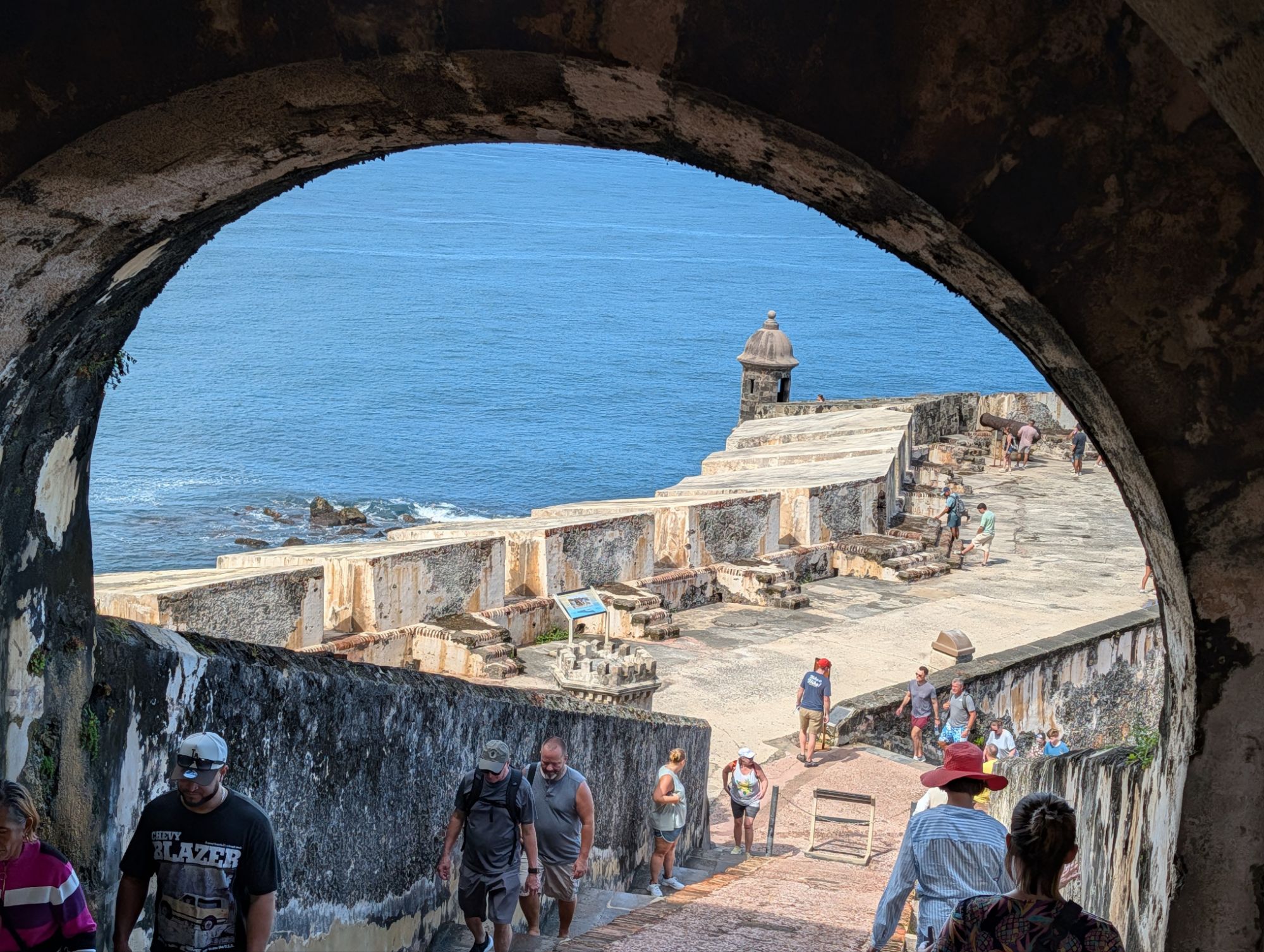
Tunnels run under both castles. At one time, there was a golf course with two sand traps, Olympic pool, movie theater, tennis court, and even an air strip.

During their agricultural era in the 1700’s, trade was for coffee, tobacco, and sugar cane. This is when slavery began. First were the indigenous people called Taíno. However, they needed more slaves so African slaves were transported here by the Spaniards. Today’s people of Puerto Rico are a mixture of the three people groups: Spaniards, African slaves, and indigenous natives.
In 1810 there was the Mexican revolution. After that only Cuba and Puerto Rico remained as part of the Spanish empire.
Puerto Ricans and residents of the Canary Islands share a similar accent primarily because of massive migration from the Spanish archipelago to Puerto Rico during the 18th and 19th centuries. Canary Islanders were encouraged to settle in the Caribbean, bringing their Andalusian-influenced dialect, believing they would adapt better to island life than mainlanders, making them the largest group of European settlers in some regions of Puerto Rico.
Shared common traits are:
- soft pronunciation of consonants and distinct rhythm
- seseo (pronouncing ‘s’, ‘c’, and ‘z’ the same)
- yeísmo (not distinguishing between ‘ll’ and ‘y’)
- lambdacism (replacing an ‘r’ sound with an ‘l’ at the end of syllables, e.g., “puelto” for “puerto”).
Streets in San Juan were designed to look like Cádiz, Spain. Originally all the houses were white. Then they decided to add color. However, there are lots of rules: specific colors, not the same as a neighbor, etc.

Originally the houses were one story of neoclassical architecture. There are high ceilings on the first floor to allow the hot air to rise and cooler air stays low. There were no air conditioning or fans.

On the Calle de San Sebastian is the Plaza de Armas. The City Hall is a smaller version of Madrid’s City Hall. In 1793 a document was signed here that ended slavery.
The largest and most iconic celebration in Puerto Rico is the Fiestas de la Calle San Sebastián (often called “La SanSe”). It started as a small religious festival and now is a massive four-day street festival in Old San Juan held annually on the third weekend of January featuring vibrant parades, artisan crafts, live music, and over a million attendees.
Uniquely Puerto Rico
- Guiro is a traditional musical instrument made by hollowed out fruit.
- Mofongo is a 100% Puerto Rican dish made from plantain. The recipe came from Africa.
- The Piña Colada originated here.
- Salsa and reggaeton originated here and have African roots. Bad Bunny rules this genre. He just finished 30 concerts JUST in Puerto Rico.
- 600,000 liters of rum per day are made on the island, Bacardi is a main distillery.
Puerto Rico has the oldest coat of arms in the Americas. It has been used since 1511. On it is the lamb which is a symbol of John the Baptist. That signifies his role in identifying Jesus as the Lamb of God.


Leave a Reply