We ventured out this morning for breakfast. There are so many 7-Eleven’s. However, I am in search of a …wait for it … Danish. Of course!!
An extra treat was a hot chocolate. They brought a teacup of hot milk with three balls of chocolate that one is supposed to throw into the hot milk. One can choose one, two or three. I chose … wait for it … all three!!!
In the center city is the City Hall with a beautiful garden behind the building.
We had an architectural design city tour of Nordhavn that starts at the Danish Architecture Center (DAC). The tour gave us access to the DAC, and we decided to have lunch at their rooftop cafe.
DAC was built from 2008 to 2018. The building spans a road with traffic consisting of 20,000 people every day. Traffic flowed through even during the construction process.
DAC uses 25% of the building. The rest has apartments, a fitness center, offices etc. The entrepreneurial designer took inspiration from New York City.
The space was an old brewery that had burned down and then became a parking lot. There are five floors above and then five below for parking.
Our tour guide, Matilda, called the subway control center through the pad on the wall of the tram and asked them to hold the doors open for longer since we were a big group. Cool.
In the 1960’s, there were container ships and the water industry which caused lots of pollution in Copenhagen. In the 1990’s, the city began to make a decision to clean things up. By the 2000’s, development advanced, the waters were clean, and bathing zones established.
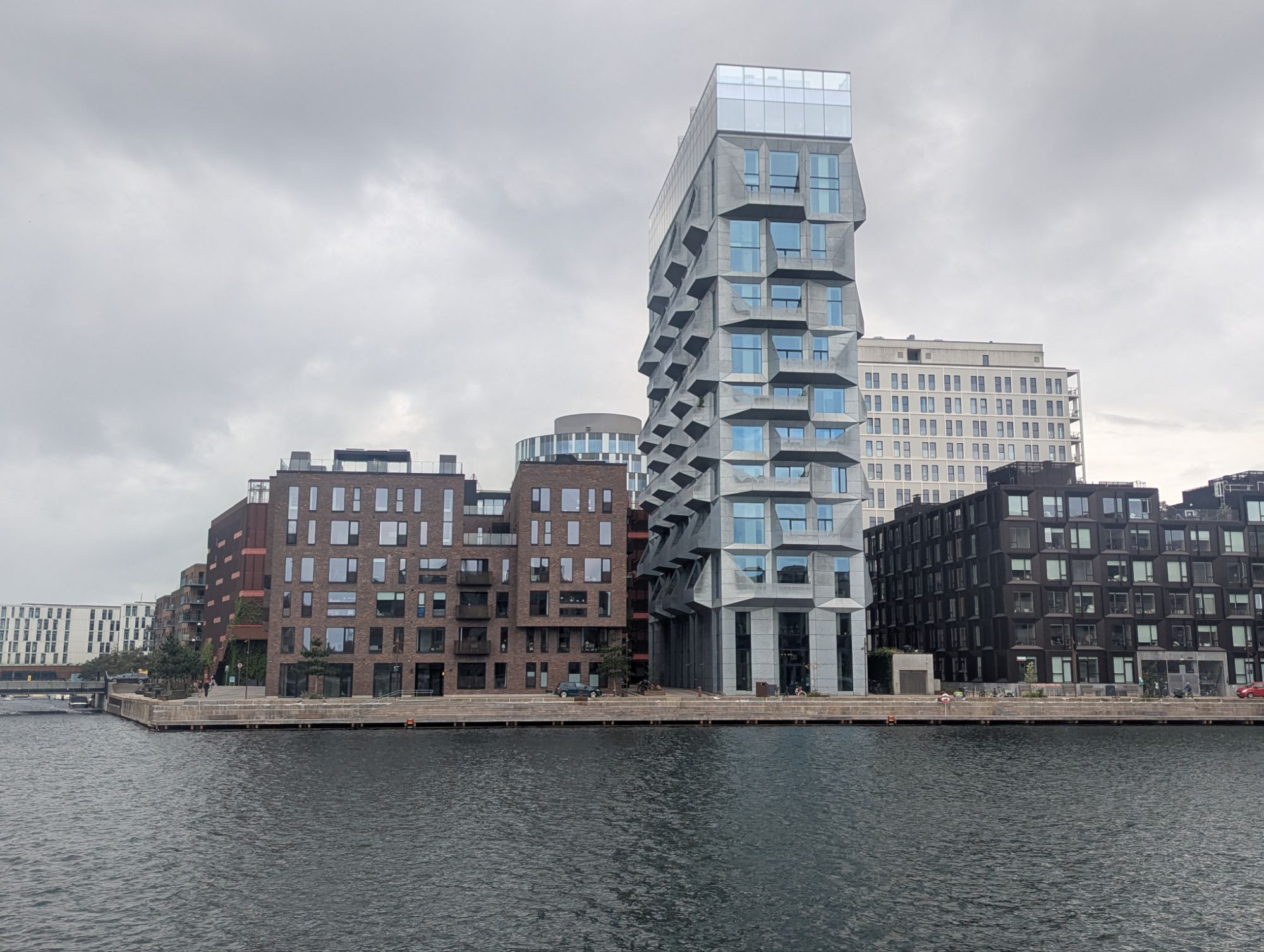
The Red City in Nordhavn is so named for all the red bricks that were used to build housing units for 4,000 people. Nordhavn is a newly-developing waterfront area of Copenhagen with the first building in 2016. By 2050 the Red City wants to have 40,000 people living here with 40,000 offices.
The harbor and other city lands are owned by the municipality, and they lend the property to developers with requirements. Today they are allowed to add things to older buildings but must keep to the soul of the area.
Currently, the largest demographic of this area is young families, and they seek to provide housing to encourage a diversification of people living here.
This building used to be for storage and was transformed. Beauty is in the eye of the beholder. I thought it was a beautiful building whereas another person in the tour thought that it was ugly.This building has the local name of the “roll of toilet paper”. The windows in the office building have different sizes to maximize light during the day. There is a restaurant on top.Here is a sturdy, large cement grain silo. Instead of demolishing it, they built offices and apartments around it. The inside houses the elevator, ducts, electric lines, and technological cables.
Five principals for development:
City by the water. Water access must remain open to the public, although rules can be posted about noise, fishing, etc. It costs a lot of money to live right along the water, but the city and its waterways are for everyone.
No more than five minutes to the nearest public transportation, grocery, etc. They have learned from the past when they developed buildings without this thought.
Liveable. They are committed to having lower buildings with open courtyards and not high rises.
Dynamic activities. There are multipurpose buildings with rooms, community kitchens, gathering spaces, and gardens.
City for everyone. Twenty-five percent of the housing must be not-for-profit. This allows for affordable housing.
Although it is called the Green City, I didn’t see many green spaces.
Here is a building with a sunken playground for children that is inspired by the sea. This innovation keeps little ones from wandering off.Along the outside are stairs to reach the top of the building. Rob is rewarded with a trampoline on this exercise roof.This is the Lidl supermarket without its traditional blue and yellow. Also, the building houses a cinema, and the red outside is the red curtain of a theatre. The outside is meant to simulate what is inside.
Underground parking garages are common as they are safer and keep the noise down.
Copenhagen International School has an enrollment of 1,200 from 89 countries with 200 teachers. In keeping with the area, it has container-shaped buildings. There are 11.000 solar panels which supply half of the energy. Classrooms are on the top, and activities are on the lower levels. Tuition is more than $30,000 per year.There are recycle centers in every neighborhood. People bring clothes, furniture, and other things that they cannot use, and anyone can take them. I wanted to get a sweater but didn’t want to hold up the group.Hans J. Wegner simply referred to his chair, as “The Round One”. When John F. Kennedy and Richard Nixon met in 1960 for the world’s first televised presidential debate, they sat in Wegner’s chair. After the TV debate, it became popularly known in the U.S. as “The Chair”. And when Barack Obama attended the climate summit in Copenhagen in 2009, he asked for The Chair to be provided so he could also be seated in the Danish icon.For nine years a photographer sat at 42nd Street and Vanderbilt outside Grand Central Terminal in New York City. Every morning between 8:30 and 9:30 he took pictures of people as they were commuting. Many people were captured many times doing the same thing as they did on previous days.I love this picture. What are the odds of this photographer catching all of these people yawning at the same time?Oh to be a kid again and slide down three floors.Circular is a big buzz word in architecture. Even DAC reuses materials from previous exhibits. We all need to be sustainable, not just the architect.


Leave a Reply