At our home church in the USA, our pastor told this fascinating story about the town of St. Maurice, Switzerland. I wanted to learn more.
Not only is it a charming little town with nary a tourism problem, it has an amazing story.First, we dropped our bags at the monastery. The Hôtellerie Franciscaine is still used by six Franciscan monks, but they have converted much of it to a hotel. We are not sure why there were three beds!! Were we expecting company?
The Setting
Around 290 AD, there was an intermediate military camp along the Roman road that was well traveled.
The origin of the Via Francigena which links Canterbury to Rome, crosses England, France, Switzerland, and Italy. The Romans used this road when they were en route to conquer Britain in 43 AD. The route also facilitated the spread of Christian culture, with churches, monasteries, and other religious sites established along its path.
The Story
A Theban Legion of the Roman Empire was sent to end a revolt in the Alps. Agaune was the name of the city during Roman times. There was even a temple dedicated to water nymphs for the Romans to worship on this site. There is a constant flowing freshwater spring at this location.
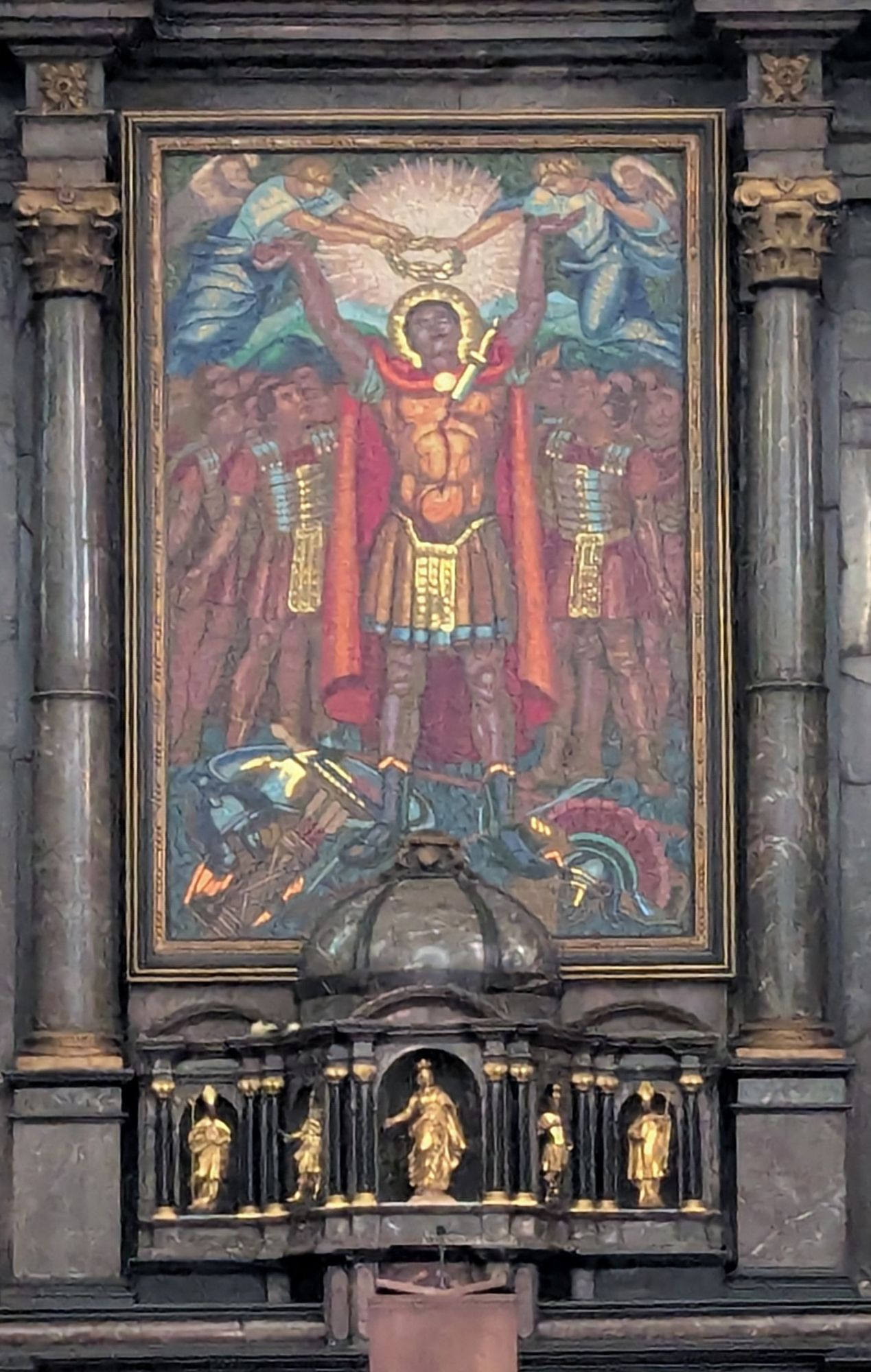
Mauritius was the commander from Thebes in Africa. He is often depicted with black skin although earlier renditions did not. The change came in the 13th century.
The Roman Emperor Maximian was leading the legions and told the Theban Legion to kill Christians and sacrifice to the pagan gods.
The entire Theban Legion was made up of Christians. Along with their leader, Mauritius, they refused to obey the order.
First and foremost, they were Christ servants. They could not and would not persecute other Christians.Decimation took place when a legion did not follow orders. One tenth of the soldiers were killed which is where the word comes from. This action was to provide motivation to the remaining soldiers.The Emperor gave the order for a second time expecting obedience. However, again the Theban Legion refused. Again, decimation was ordered.
The Emperor made the order for the last time. This time he killed all of the remaining soldiers.
People retrieved the bones of many of the nameless martyrs. The cult of St. Maurice was soon established. Theophilus collected the remains in 380AD.In 515AD, an Abbey was built, and prayer has taken place everyday since that time. For the first 300 years it was a 24-hour prayer.Many times the church was destroyed by rock falls. I can see why. In 1523, Sigismund built the Abbey nearby but further from the rock face. The impressive front door to the basilica of the Abbey has the names of all types of martyrs on the inside, not just Christian martyrs. Basilica means that the church is a dedicated pilgrimage site.This is the foundation of the original church near the rock face.Those rocks are mighty close.This interesting roof protects the archeological site. It shows the light but is weighed down with rocks so it doesn’t blow away. On the ends was fine netting to keep the leaves and birds out.
Epilogue
The remains of St. Maurice were placed where there is now a red box that marks the spot. It was said that there were so many visitors day and night that the bones had to be removed to a better place.
Today the bones are housed in a highly decorative silver reliquary box in the treasury.Some of the bones of the martyrs have been sold or traded to other Christian churches. For example, the transparent reliquary displays a thorn from Christ’s crown, a gift from King Louis IX to Abbott Girold in thanks for sending relics of Saint Mauritius.In retrospect, I needed to look closer at the church of San Maurizio, “Milan’s Sistine Chapel”. Of course, it contains some of his relics. Look at the left and right panel from the front of the church.
We learned that the actual site of the massacre was a short walk away, and a chapel marks the spot. There are five markers along the way commemorating the martyrdom of the Theban Legion.
The Path has five stained glass markers. Some were easy to locate; others were more challenging.Is this the path of the less traveled? We reached a cross with the chapel in the background.St. Sigismund, founder of the Abbey in 1523.St. AugustineSt. Theophilus, builder of the basilicaRiderless White HorseMaurice, leader of the Theban Legion, martyred at Verolliez which means “the real place”.This was in the chapel at Verolliez.
Translated: We are soldiers, O emperor, but above all, servants of God. We owe you military obedience. We owe Him innocence.


Leave a Reply