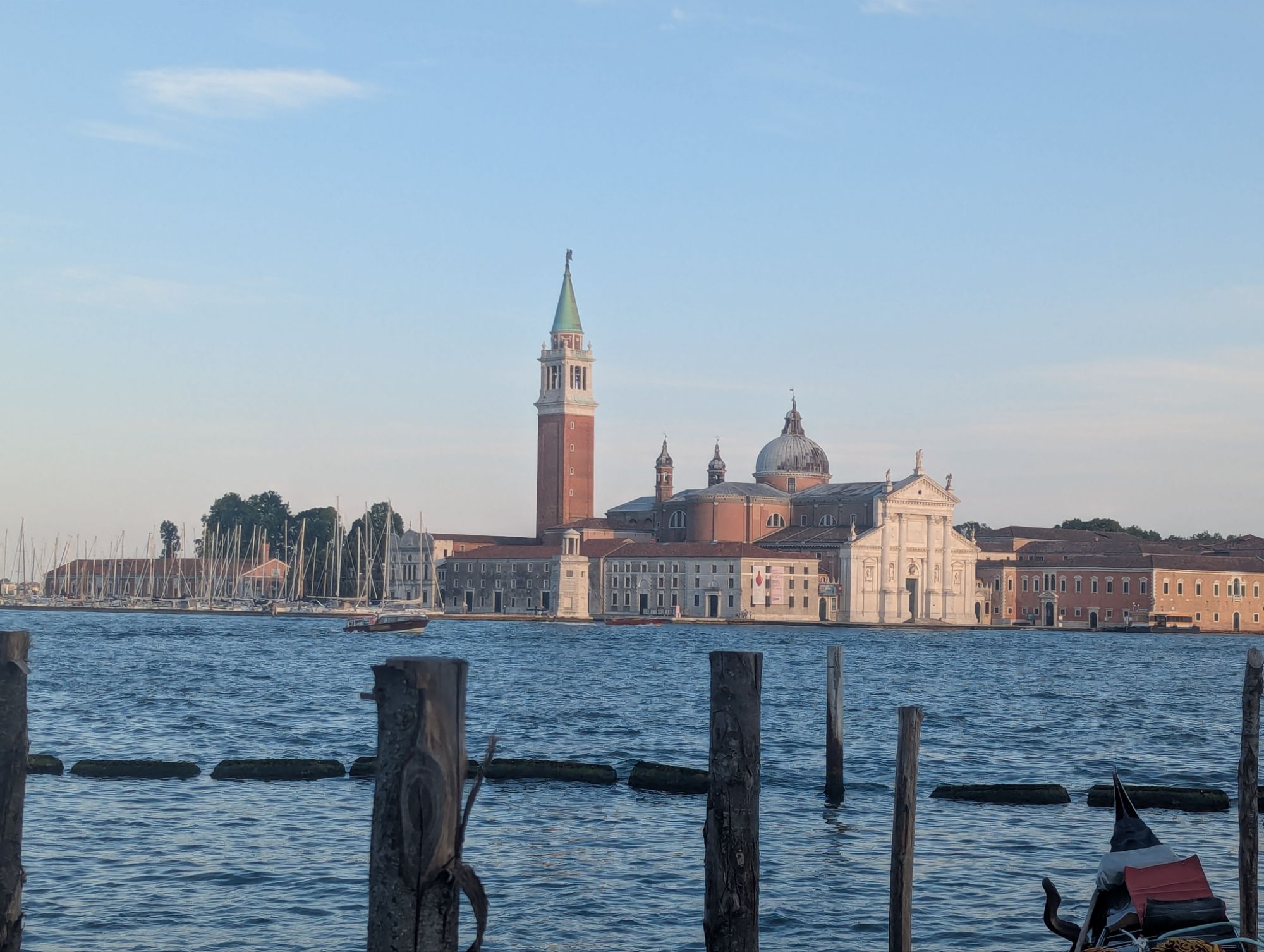
Today we explored Venice.

Both Rob and I have been here before but never together. So we headed out to explore the magic of Venice. (Post Bezos-Sanchez wedding).

The first stop has to be San Marco Square.

However, everyone else has the same idea. We didn’t feel compelled to go into the buildings or tower since each one would have required hours of standing in line. We have seen them before.

We snapped a few pictures and walked toward the canal … hand in sweaty hand.


We found our way to the The Biennale, an artistic showcase that happens every two years. During our visit, architecture was being displayed.
Architecture has always been a response to climate-an act of shelter, survival, and optimism. From the first primitive huts to the submerged foundations of Venice, human design has evolved in dialogue with nature. Today, that evolution is no longer a choice but a necessity: climate change is not a future scenario, but a present reality. We must adapt. Adaptation demands every form of intelligence-natural, artificial, collective. Not individual genius, but collaborative insight. Not rigid solutions, but flexible ecosystems. In the face of an altered world, architecture must adapt itself-venturing into uncharted terrain.
The future of architecture lies not in control over nature, but in partnership with it. As temperatures rise, we turn to greenery as infrastructure-cooling cities, purifying air, restoring balance. Natural materials offer circular possibilities, constantly reused and renewed, proving that low-tech can be high-impact. Biomimicry reminds us that the most intelligent designs are those shaped over millennia. In this new era, we must ask: can we design a building as smart as a tree?

Participation in this “Olympics of the architecture world” is a prestigious honor for the selected participants. Hundreds of ideas were on display in gigantic warehouses. Most of the focus was on housing.
Here are just a few ideas that we observed:


Epidermitecture shifts maintenance from erasing dirt to fostering coexistence. This biopatina is a microbial layer of cyanobacteria, fungi, algae, and lichen that naturally grow on surfaces.


We saw one display where a house grew its own living green outer covering.

Quotable Quotes
- “A good person is one who has maintained a sense of listening.”
- “Climate comfort becomes a source of social equity.”
- “Don’t set sail using someone else’s compass.”
- “Stealing a drum is easy, but finding a place to beat it is not.”
- “Not anyone but everyone.”
- “Architecture is an earth practice. Every building is an intervention of the earth’s geology, it’s materials deriving from the ground and underground.”

We need to rethink our understanding of the world and to place water as an agent of change, an active cultural, political, and ecological principle. What once flowed freely in the hydrological cycle is now controlled, negotiated, and depleted. In the geopolitical dimension, water has been commodified and turned into an object of speculation by governments and corporations competing for control. These dynamics create tensions that transform economies, territories, and the built environment, degrading and challenging democracies and sovereignties.
Where do our building materials come from? Are they made with fair labour? The laws enshrined in many countries to protect against forced and child labour are not always implemented, and abuse remains hidden and profitable. Globally, 28 million people are held in forced labor, and 160 million children aged 5-17 are child laborers. Construction is one of the largest industries at the highest risk of forced labor.

As populations decline, this project proposes degradable, prefabricated school buildings with 30-year lifespans. Designed for reuse as ecological infrastructure, they align demographic flexibility with environmental stewardship and evolving community needs.


There was an exhibit where one touches sensors on a pebble path to communicate with plants. One could observe the decibels made by the plant and by the person. Maybe communication is more than talking to your plants??
ASSEMBLY IS AT THE HEART OF THE ARCHITECTURAL PROCESS.
Responding to the most urgent problems of our time demands people coming together freely to pool knowledge, exchange ideas, and openly debate proposals for our collective future. Yet in recent years the right to assemble has come under threat. The pandemic exposed the necessity and the fragility of public space. Public discourse has been captured by privatized social media platforms. Many states around the world are imposing new restrictions on public gatherings and democratic participation. In 2016 Ireland proposed one response to these challenges by establishing its first Citizens’ Assembly. 99 demographically representative Irish residents are brought together to deliberate controversial issues ranging from marriage equality to biodiversity loss, collectively producing recommendations for the government. Against the polarization, manufactured outrage, and relentless speed of digital life, this format encourages the slower temporality necessary for reflection, deliberation, and consensus building.
Could Citizens’ Assemblies be realized at more local scales? Might their principles expand into the spaces of everyday life? What can architecture contribute to, and learn from, this political experiment?
There was much more to see of what other countries were proposing, but we only had today so we walked to the second part in the nearby National Pavilion of the Gardens where thirty countries maintain their buildings year round and also participate in the Biennale.
Great Britain focused on making reparations for colonialism, Germany focused on an increasingly hot climate, and Uruguay on the importance of water.
But Serbia won our award for the greatest impact. When one first walks in, one sees white, billowy fabric hanging from the ceiling. Hmm.

Then I read the small sign at the end and here is the mind-blowing concept.

A team of architects, knit designers, and electrical engineers created a spatial form. By hand, then by machine, and then by hand again, tracing the visibility of the boundary between natural and artificial intelligence.
The installed structure will be unraveled from May 10th to November 23rd, powered by solar energy. After 6 months, the structure will return to its original material form in 125 balls of wool.
The circularity of form and materiality, as well as the idea of temporality, seek to open up new perspectives for understanding architectural space.

This brings up the question of art installations. What happens when it is over? Thrown away more than likely. We need to do better and Serbia paved the way.
This exhibit was skillfully made, enjoyed, and then returned to its origin … wool thread which will be used by weavers to make sweaters. How cool is that!


Leave a Reply