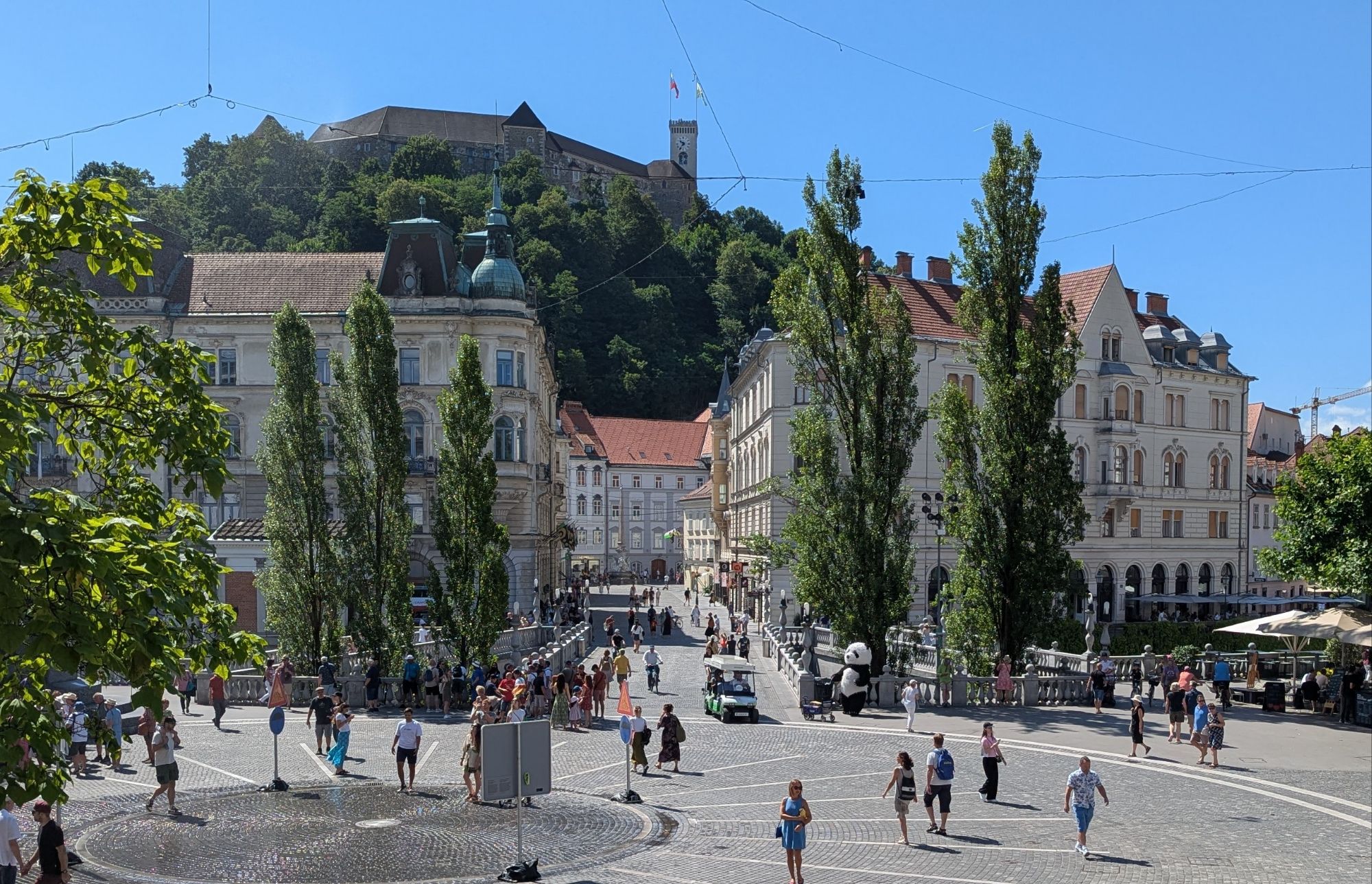
This is the only country that has the word love in its name. We are staying in the capital and largest city Ljubljana which means “loved”.
Legend has it that Ljubljana was founded by the Greek mythological hero, Jason and the Argonauts, who had stolen the golden fleece from King Aetes and fled from him across the Black Sea and up the Danube, Sava, and Ljubljanica rivers.
They stopped at a large lake in the marsh near the source of the Ljubljanica River, where they disassembled their ship, carried it to the Adriatic Sea, and put it together again to return to Greece. The lake where they made a stop was the dwelling place of a monster. Jason fought the monster, defeated it, and killed it. The monster, now referred to as the Ljubljana Dragon, found its place atop the castle tower on the Ljubljana coat of arms.


Ljubljana has the biggest pedestrian zone in the EU for only 290,000 inhabitants. It was a very walkable and bike friendly city.
History in a nutshell: There is evidence that humans were here during paleolithic times. Romans were here, Huns destroyed the city and surrounding areas in the 5th century, Slavs from Romania came in the 6th century.
From 1335 to 1918 they were ruled by either the Hapsburgs or the Austro-Hungarian empire in the 19th century. German was the spoken language for many years.
For a short time, Napoleon established Illyrian provinces and Ljubljana was a long narrow city. The French Revolution allowed the Slovenian language to flourish, and it was taught in schools for the first time.
The Austrian Southern Railway, built between 1841 and 1857, was a significant infrastructure project for the Habsburg Monarchy, connecting the capital Vienna to its major seaport, Trieste. This railway went through Ljubljana so it contributed to its growth.
In 1895, a devastating earthquake occurred and destroyed half of the city.
In WWI, one million Slovenians died. Much of the fighting was done in their country. After WWI, Slovenia joined with Serbs and Croats to form a Kingdom.
After WWII, Yugoslavia was formed and existed of six republics, three different religions, with German, Latin, and Cyrillic languages.
Tito was able to unite the people and taught Yugoslavians to be proud of their differences. They were called Yugoslavian not Serbs, Croats, etc. 95 percent were workers. In 1980, Tito died and everything totally changed. Then everything was a problem with differences being accentuated.
In 1991 there was a Ten-Day War when Slovenia broke away from Yugoslavia. They have just celebrated 34 years of independence.
Tito was a key figure in the Non-Aligned Movement, a group of states that opted not to be formally aligned with either the Soviet Union or the United States during the Cold War. This movement aimed to promote peace, cooperation, and independence among nations and had 121 nations involved.
Locals that we spoke with thought times were better under socialist Yugoslavia and Tito. They were never hungry or deprived. They could travel. Churches were open. Private businesses were allowed. Times were simple and safe. The country was connected not divided.
Youth brigades went out to do projects for 6 to 12 months without pay but were fed and housed.
In Ljubljana there are three squares: Town Square, Old Square, and New Square. This is because there were three concentric city walls.

They have free water accessed at fountains throughout the city. Having access to water is even written in their constitution. There are free public toilets which is a rarity in Europe.

There are two layers of Slovenia – the one that we see and the one underground. The longest cave is about 40 miles.
Ljubljana is a green city. Our guide used silicone muffin tins and coasters while we sampled many local foods and drinks:
- Buckwheat bread which has no gluten.
- There are so many different types of bread. They even have a bread museum.
- Salt is considered white gold since it was the most expensive item in the house.
- Olive oil is not for cooking. It has to be imported so it is too expensive. Olive oil is only used for salads.
- Bear pâté. They have an overpopulation of bears, and the bears are starting to come to the cities in search of easy food.
- Honey Liquor. Beekeeping is an integral part of Slovenia’s cultural heritage, with knowledge and practices passed down through generations.
- Blueberry Wine
- Chocolate covered figs
- Five types of nuts
- Milk.

The dairy farmers were having to throw away milk due to the markups by the middlemen so they decided in 2009 to sell raw unpasteurized milk directly to the consumer. One farmer per machine cleans and services it everyday. Each person brings their own bottle or buys a bottle at the machine.


Lipizzans, the famous horses in Vienna, come from Slovenia. The name of the breed derives from that of the village of Lipica which was part of the Habsburg empire at the time the breed was developed, now in Slovenia, and is still active.
In 1930 they built their first skyscraper. Although we took an elevator to the 12th floor, these pictures are of an amazing spiral staircase.


In 1842, one bridge was too narrow and caused a bottleneck and people couldn’t cross safely. So they built two smaller pedestrian bridges beside it, one going one direction and the other in another.
Jože Plečnik deigned buildings and significantly altered a substantial number of buildings and public spaces in Ljubljana, transforming the city into a unique architectural landscape.
Plečnik’s work in Ljubljana is considered a total work of art, shaping the city’s identity and urban planning vision.


Leave a Reply