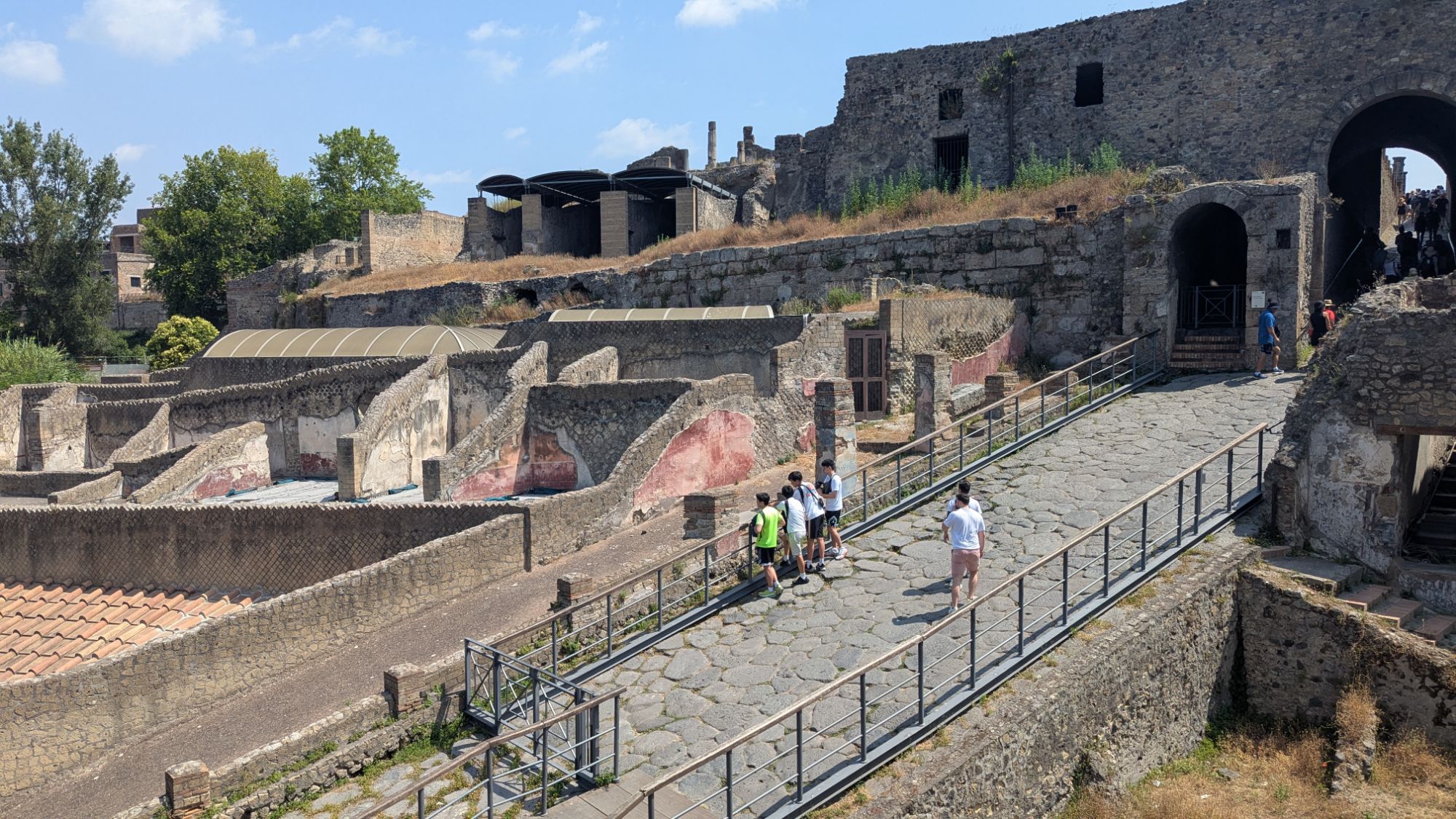
Pompei

The eruption of Mt. Vesuvius in 79 A.D. has given archeologists an opportunity to learn about daily life in ancient times. Most of the time, we learn about other cultures only from their funerary practices, but this excavation was uniquely frozen in time.
Many nearby islands are the result of volcanoes.
Pompeii was known as Roman only in the last century before Christ. It was an ancient port in the Mediterranean. In 90 B.C., Pompeii was dedicated to the goddess Venus by the Romans.

In 62 A.D., there was a devastating earthquake that had caused a lot of damage. Many of the richest families had already left the city of Pompeii before the eruption. It is hard to believe, but we were told that residents of Pompeii didn’t know that Mt. Vesuvius was a volcano.
They aren’t exactly sure if the eruption was in August or October.
Herculaneum, a nearby ancient city, was also buried by the 79 A D. eruption and remained sealed beneath a thick layer of volcanic mud until 1710 when a farmer called Ambrogio Nocerino, nicknamed Enzechetta, found precious marble fragments while digging a well to irrigate his vegetable garden.
This was the beginning of the history of the rediscovery of Herculaneum, which would be followed by that of Pompeii and other cities situated around Vesuvius.
The systematic exploration of the site began in 1738 using prisoners serving life sentences as its labor force. Much like in mining, the diggers lowered themselves on ropes down shafts and, using pick-axes, dug tunnels measuring about six feet high and three feet wide, illuminated with lamps.
The excavations using a series of tunnels continued for several decades until 1780 when exploratory work was brought to a halt in favor of Pompeii which, buried by a thin layer of pumice and ash, could be explored in a much more rapid and cost-effective fashion.
Excavation began in Pompeii in 1748 and still continues today.


Emperor Augustus built an aqueduct. However, they didn’t realize that lead in the water is problematic. Maybe that is why there were so many evil and erratic ancient leaders.


In 1870 Giuseppe Fiorelli, archeologist of Pompeii kept finding “holes” at the excavation site. He destroyed many of them since he didn’t know what they were. Then he decided to pour plaster into a cavity and see what it was.


Thermal baths were always a popular place in Roman cities. They came here once a day to exercise, swim in pools, and participate in the thermal shock of going from hot water, warm water, and cold water in any order. Changing rooms were a promiscuous area for sexual encounters, haircuts, and massages.
Many pipes were destroyed during the earlier earthquake and were not fully repaired at the time of the eruption. The women’s thermal bath was not functioning at all.
The rich had their own private thermal baths in their homes. They came to the public baths to make new friends.


Vesuvius
It was hot and the hike to the crater was difficult, but I had my walking sticks. Fortunately our bus driver got as close as possible.


On the hike, I saw a scurrying lizard. I noticed that when he got out of the sun, he would pump his hands up and down like “Ow. My hands are hurting from the hot volcanic soil.” I leaned over to touch the ground and it was indeed hot.


Leave a Reply