
Shopska Salad is standard restaurant fare. This salad has red tomatoes and green cucumbers topped with white cheese, and is made to resemble their flag.


I asked Rob what he would serve as a nod to our American flag. Strawberries and blueberries topped with whipped cream. Maybe that’s why we are all a little chubby!!
The influential people built on the three hills of Plovdiv although it seems like one. Here is where the richest of the richest lived. These houses are of Ottoman style yet inspired by French architecture and others. Bulgarians, Greeks, Armenians and Turks lived together here. Money has no ethnicity. Some were exempt from taxes.

There were 51 mosques yet 160 hammams. Cleanliness was a group activity. Hammams are considered the bazaars of gossip. It was the social media and networking of the day. Business was discussed.
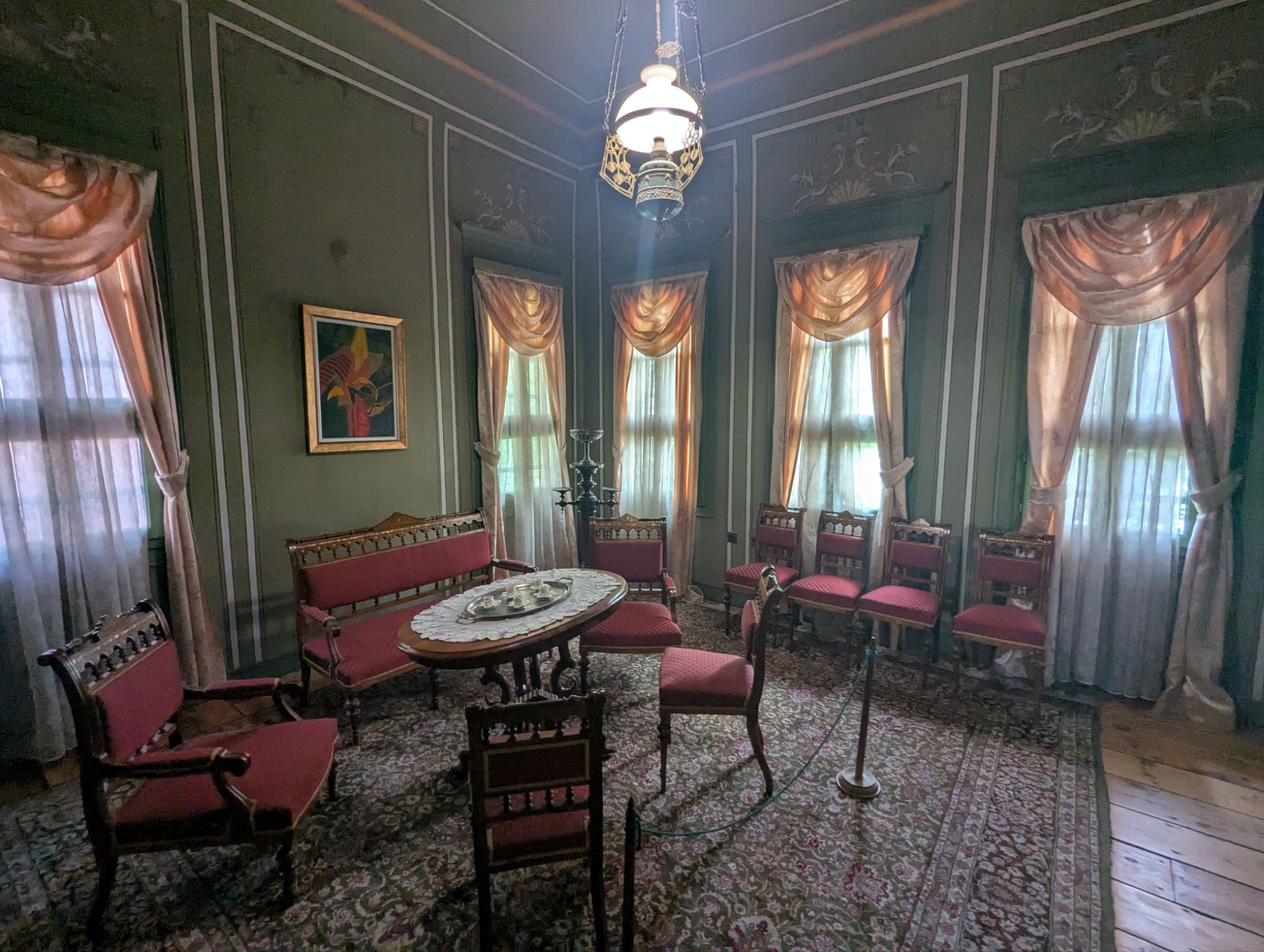
HOUSE OF STEPAN HINDLIYAN
Stepan Manuk, an Armenian, was a prominent merchant trading in spices and silks and a farmer whose business frequently sent him as far as India, which is how he earned the nickname of Hindliyan. His exquisite taste affected the construction and the decoration of the house.
The construction of the house was from 1835 to 1840 and has been restored and fitted with Bulgarian Revival period furniture. Stone was only used for mosques, police stations, and hammams. Houses were made of wood.
The Hindliyan House illustrates urban life from the middle of the 19th century.


When the Turkish persecution against the Armenians began in 1915, Hindliyan left his house and gave it as a home to Armenian refugees. In 1974, when the house was declared a cultural monument of national importance and started its restoration, there were 23 Armenian families living there.
Balabanov House
The nearby Balabanov House was built in the beginning of the 19th century by a wealthy merchant, usurer, and member of the tailors’ guild. Its last owner, Balabanov, was a merchant of wood.
The house, impressive in size, exemplifies the symmetrical houses from the 19th century, built following the model along the maritime coast of the Bosphorus in Turkey.


This was an eye catching candy store on the Pedestrian walkway called Hans and Gretel. They had every candy that you have ever heard of plus highly decorated donuts and every flavor of ice cream.


We watched a 4½ hour movie (two parts) called Time of Violence (1988) based on the novel Time of Parting by Anton Donchev. The topic was Ottomans attempting to convert the Balkan people to Islam in the Rhodope mountains near Plovdiv. They faced conversion or torturous, painful deaths. The lead Ottoman aggressor was taken by the Ottomans as a Balkan child. He killed his father and other family members who would not convert. This true story was graphic, and I had nightmares.

Wait a minute! Actually, we had a Bulgarian photo shoot. It was a lot of fun, and we learned much about Balkan clothing.


Leave a Reply