Today we left Sofia by train. Even though we have Eurailpasses, we needed seat assignments. Rob purchased a first class pass which means air conditioning and more space for legs and luggage and isn’t that much more money.

The ticket agent said there was no first class section on this train, only second class. We were assigned seats 75 and 77 on car #1. We boarded a car with a big “1” on the side and found 75, but there was no 77. This car appeared to be their version of first class because it had compartments. I went out and asked a railman about it. He spoke no English but motioned that our seats were on a car with a big “2” on it. I told him that our seats are on #1. He pointed to a little removable number on the side of the car that said that this #2 car is actually #1. I don’t speak Bulgarian but I know when I hear the word American!! The railman certainly must think that I feel entitled. I JUST WANT TO FIND MY SEAT!! Ha!


We settled in for our three-hour train ride.

Suddenly, Rob looks at me and says that he left his winter coat, hat, and gloves in the closet of our Sofia apartment. I count on Rob to do the final check of our belongings. This will now change to a group effort.
Problem solving starts. “I will have to buy a new coat since we are ending our trip in the fjords of Norway.
“Let’s wait until it gets cold since we are in the heat of summer and don’t need to lug it around.”
Wait a minute. We are coming BACK to Sofia in a few days to fly away to Naples and are staying at an airport hotel.
Rob contacted our apartment host, and she will deliver it to the front reception at our hotel. Phew!!
We arrived at our hotel in Plovdiv. It is one of the oldest buildings in Plovdiv and was previously an Ottoman bank the year before Bulgarians reestablished their independence. I wonder what happened to the money that the Ottomans had in this bank.

We decided to take an evening walking tour to get a lay of the land.


Plovdiv is the oldest city in Europe dating 8,000 years ago. During the Neolithic era, the hunter-gatherers who settled down became farmers and brought wheat to this region. We don’t know much more since this was before written language.
The Maritsa River runs through the town and is the second biggest river in the Balkans. It is referred to as the Nile of the Balkans. First, the water was good for drinking then irrigation followed by transportation.
Plovdiv is called the “City of Seven Hills” which provided a natural defense. Today there are only six hills.

Kapana is a hipster area of the old town with art galleries and restaurants. Kapana means “trap” and earlier there were lots of tented shops in the narrow streets so it was hard to find your way out. Also, there were shops made of wood that were susceptible to fire.
The largest concentration of Bulgarians outside of Bulgaria is in Chicago. The most visitors to Plovdiv are from Spain.
Geographically separated from the West Slavs and East Slavs, the South Slavs today include Bosniaks, Bulgarians, Croats, Macedonians, Montenegrins, Serbs and Slovenes. Bulgaria was never part of Yugoslavia. Many cultures inhabited Plovdiv, and the city feels very cosmopolitan. Menus offered much diversity. Rob even scored some delicious pulled pork at a restaurant called Hemingways (which is Хемингуей in Bulgarian).
In 1878, Bulgaria was back on the map. Plovdiv was the original capital. Much of the city was demolished to modernize or Europeanize. They hired Austria-Hungarian architects.
Tobacco was big business in the past. Individuals became rich and built much of the City Center. Cigarettes are cheap even today. Tobacco Town made way for affluent aristocrats.
Ancient History
Plovdiv was the biggest market in eastern Europe. People traveling the Silk Road would bring their wares here to trade. Plovdiv means ancient and eternal. Philip II established the League of Corinth in the 4th century.
Philip had no intention of besieging or conquering a city but wanted allies for his planned campaign against the Persians. He moved around Greece making peace with the states that opposed him. The terms of the agreement were that all members became allied to each other and that all members were guaranteed freedom from attack, freedom of navigation, and freedom from interference in internal affairs. The council then declared war on Persia and voted Philip to lead to the forthcoming campaign.
Sounds like an early version of NATO.

In 46 AD, Plovdiv was added to the Roman Empire by Claudius. They took it from the Thracians.
Plovdiv is not a Bulgarian word. It is Thracian. The Thracian language has not been spoken for 2,000 years. Spartacus was Thracian. The mythological Orpheus hailed from Thrace.
Thracians drank strong wine. They were war mongers and loved to fight. They would mourn birth and celebrate death. That is probably why they died out.
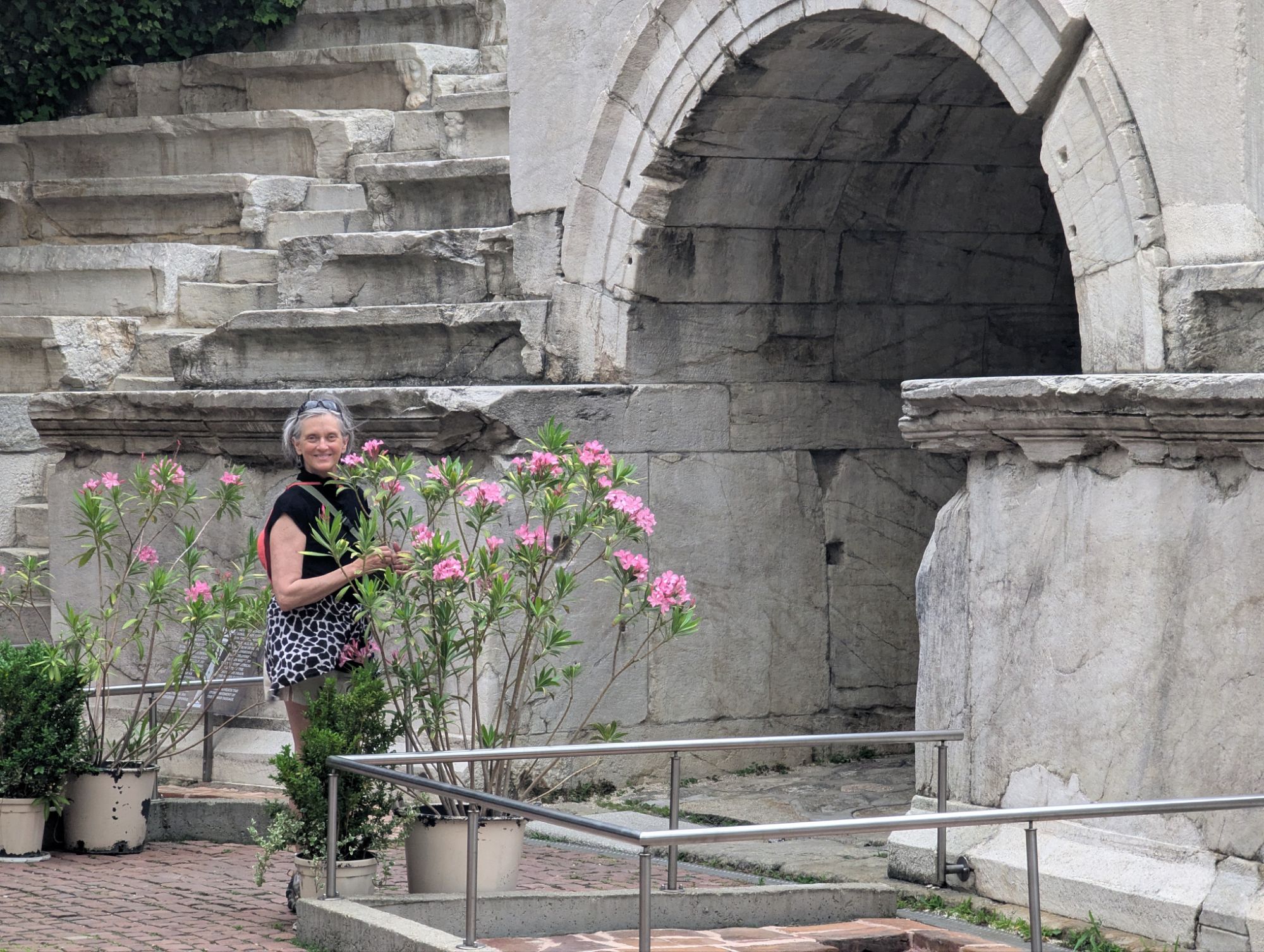
In the 1st century originally there was a Greek theatre on the side of a hill. It was destroyed by the Goths in 251. There was an earthquake in the 6th century. By the middle ages the Roman buildings were forgotten.
There were 60,000 people living in Plovdiv in the first century and the stadium could hold 30,000, half the population. There was commerce, entertainment, and sprawling housing. The town was then called Phillipopolis.
A Roman Forum has the same dimensions no matter where it is built which makes it easy to determine the location of buried ruins.


The Roman stadium provided the locals with entertainment such as sports, gladiator fights, animal shows, etc. Hadrian approved the building of a stadium in the 2nd century.
Byzantinzes fought against the Bulgarians for years with both sides suffering great loss of life. There is a saying which rings true: “When two people fight, a third one wins.” Crusaders during the 3rd and 4th crusades also affected the population in Bulgaria.
The Balkan-Ottoman Wars took place between 1364 and 1396 as the Ottomans expanded their territory on the Balkan peninsula.
Plovdiv builders were commanded to erect a mosque in the 14th century. They didn’t know how, so the interior of this mosque is similar to a church. It is the oldest building in Plovdiv. It still functions as a mosque today but the ground floor is a coffee and pastry shop.


a coffee to go.
Six percent of the population is Muslim. Most people are Bulgarian Orthodox. They live together. There are no separate neighborhoods.

A large group was waiting for the doors to open for the first of three performances by King Gizzard and the Lizard Wizard.


Leave a Reply