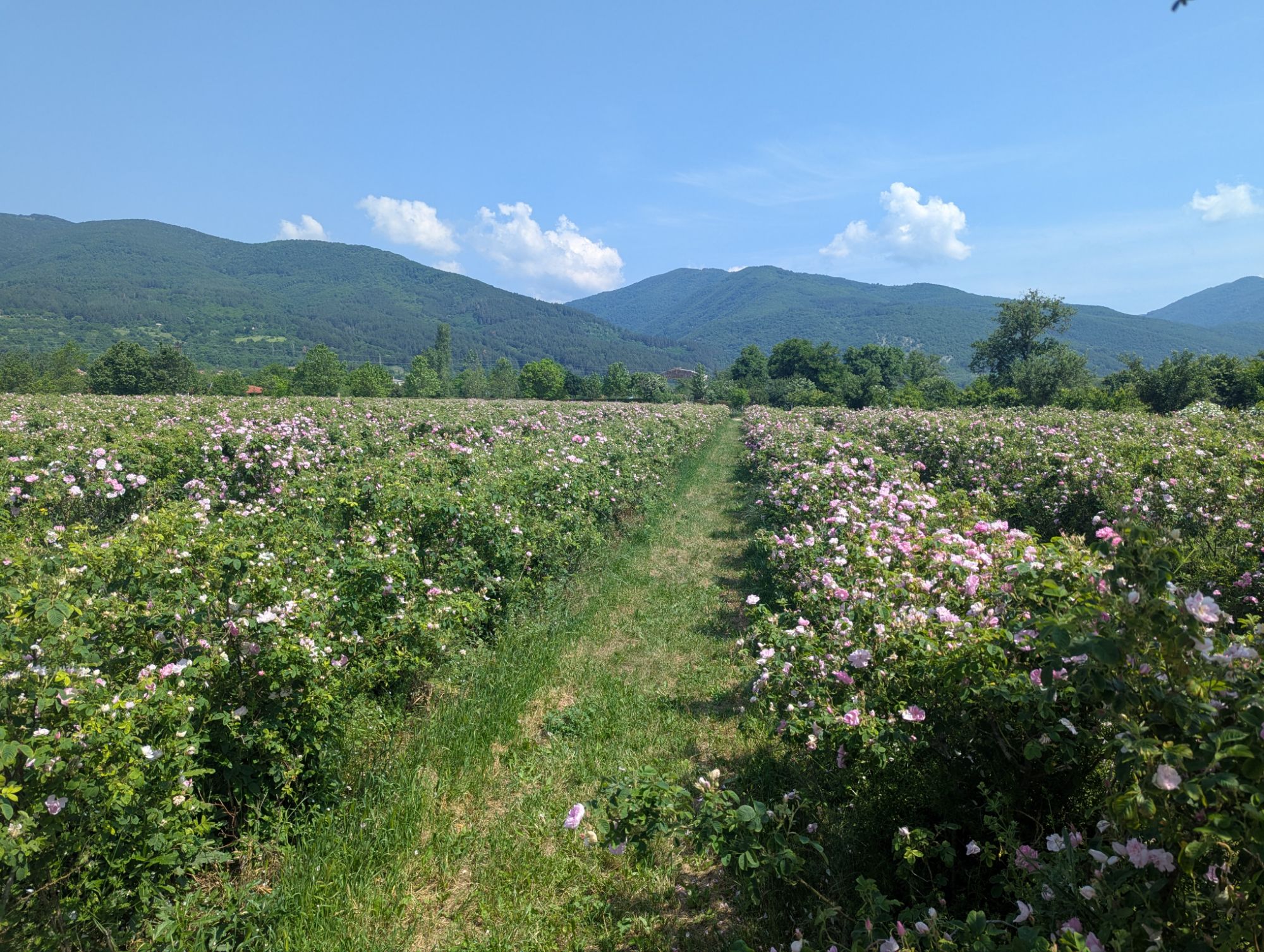
Unknowingly, we timed it just right. The harvest time for the world famous Bulgarian roses runs from the end of May to the beginning of June.
Bulgaria provides 80% of the world’s rose oil. It takes 7,300 pounds of blossoms to make 1 quart of rose oil.

The pink Damascus rose was introduced to Bulgaria by the Ottomans. The world famous rose oil is produced from this variety.
At 5am, the workers go out to pick the pink roses by hand. (Machine harvesting slashes the petals, and oil is lost.) The blossoms are immediately processed for the oils. All types of cosmetics are based on this rose oil.

Seasonal workers come to pick the blossoms. These are ethnic groups that are not well educated. They must pick before sunrise as this is when the roses have the most oil.

The roses were first planted here in the 18th century. The communists took them over. After communism, the owners were able to get their land back. It takes at least ten years to establish the rose bushes. The roses are picked when they open.


flower basket.
There are 150 varieties of roses showcased here at Damascene.


The Danube is the largest river in Europe. It forms part of the northern border of Bulgaria and drains into the Black Sea.
The Black Sea is the western border of Bulgaria. The Balkan Mountains are like the Rocky Mountains but run west to east. There is a popular 21-day hike through the Balkans that has huts and food along the way.
Roses grow well here. Mountains protect them from the cold wind. It doesn’t rain much and the soil is cinnamon colored. Wheat and sunflowers grow here.
Winters are too cold for olives so they must be imported. They use sunflower oil which is less expensive for cooking and for salad dressing. The honey that is collected is yellow because of the sunflowers. The Plains of Thrace is referred to as the Bulgarian California where many things grow.
We passed through the Gate of Trajan to descend to the Plains of Thrace. The pass is primarily known for the major medieval battle that occurred on August 17, 986, during which the forces of Byzantine Emperor Basil II were routed by Tsar Samuil of Bulgaria, effectively halting a Byzantine campaign in the Bulgarian lands.
On our way to the roses, we drove by a NATO base. An F-16 is being purchased.
We also drove by an open air market for used cars from other European countries. People come here to buy their cars.
Rails are well developed because cars were rare in Bulgaria. During communist times, if they did get on a waiting list for a car, which required a deposit, they had no choice of color or model. One would wait 10 to 15 years.
Sofia is not representative of Bulgaria. There is a lot of traffic, schools are crowded, more pollution, etc., yet the city is still growing.
Bulgaria has four seasons with a continental climate. Today the contrast between seasons is greater. The bad news is that we need more clothing to dress for extreme heat and extreme cold.
Balneotherapy is a new word for me. It is the treatment of disease by bathing in mineral springs. They have 600 balneotherapy places which is second to Iceland. The temperatures of the mineral springs range from 68ºF to 213ºF (which is above boiling). Greenhouses use the heat from the hot springs. This allows cucumbers to be produced early in the season.
Bulgaria has a demographic crisis which began 30 years ago at the end of communism. Bulgaria had a population of eight million. Today there are 6.5 million. There is a program called Bulgaria Wants You … trying to attract the Bulgarian diaspora to come back to Bulgaria.
We stopped in Kazanlak to view the Thracian tomb. The tomb is an exact replica of the nearby tomb which is falling down due to humidity. It is likely depicting the funeral of the king.


The Festival of Roses takes place on the first weekend in June in Kazanlak. The Rose Queen is selected by the online vote of all graduating seniors. The winner is crowned on the last day of the festival.
I loved these artistic AND musical lampposts!!


Next stop was the Shipka Memorial Church, built in the 17th century Russian style and completed in 1902. It commemorates the large battle between Ottomans and Russians in 1877. Around 20,000 soldiers died in the war. Veterans of that war attended the opening.

one-hour service.
Only priests and monks can go behind the iconostasis. Then they come out and bless people. Every square inch is painted walls and frescoes. The Orthodox bury their important people in churches.
Koprivshtitsa is as small as a jewelry box, but many influential people came here.
Koprivshtitsa is one of the museum towns. The affluent built their homes here. Many greats came from this town. They were well educated and brought ideas from Greece, Alexandria, etc. The homes are brightly colored and include elements of nature.


When new houses are built in Koprivshtitsa, they must be in the old style.

The Bulgarian National Movement began here to fight the Ottomans. There were 12 zones in Bulgaria, and they decided that God was too far away to help them. The Movement taught the young boys to fight because they would be called upon in the near future. They raised money for weapons.
The Ottomans allowed churches to be built, but the churches could be no higher than a man on a horse.
Ottomans would put Bulgarian necks on the blade of a knife. They were asked to convert to Islam or die. So the Bulgarians decided that a nod “yes” would mean “no” to Allah, but it would look like yes to the Ottoman and their life would be spared. To this day in Bulgaria, a nod yes means no and a shake of the head means yes.
The Bulgarian National Movement started with the historical book, Istoriya Slavyanobolgarskaya, written in 1762 by Paisius, a Bulgarian monk. This national awakening of Bulgaria to its empirical past lasted until the Liberation of Bulgaria in 1878.
Vasil the Lion walked from place to place with a gun and Bible promoting freedom or death from the Ottomans. He sounded like the American Patrick Henry and is a National Hero in Bulgaria.
A young man named Todor Kableshkov grew up here. He was planning an uprising in May, but their plan was found out and the Ottomans came for him at the house of his parents on April 20. His wise mother invited them in for tea and pastries while he escaped.


The Bulgarians lost the first skirmish to the Ottomans. However, their cruelty came to the world in the newspapers of New York and London. Alexander II of Russia declared war. All of the Balkans were involved in a one year war. March 3, 1878 is like the 4th of July for the Bulgarians.
Our guide, Maria, taught us a Bulgarian folk dance.


Leave a Reply