This morning we woke up to honking and chanting outside our apartment. There was a protest in the country about the adoption of the Euro that will probably occur on January 1, 2026.

Our guide, Dino, was born here, studied here, and lives here so he is very qualified to introduce us to the capital city.
He said that being a guide has given him a different point of view of the city. Instead of complaining about a pothole, he appreciates the history.
Sofia has 2 million people out of 6.5 million in the country.
The city is about 8,000 years old with the early people coming from Asia Minor. This was before written language so not much is known.
Thracians were a part of Bulgaria and were the northern neighbors of the ancient Greeks. However they died out probably because they had 200 holidays per year and were fans of Dionysus, the god of winemaking which might explain a lot.
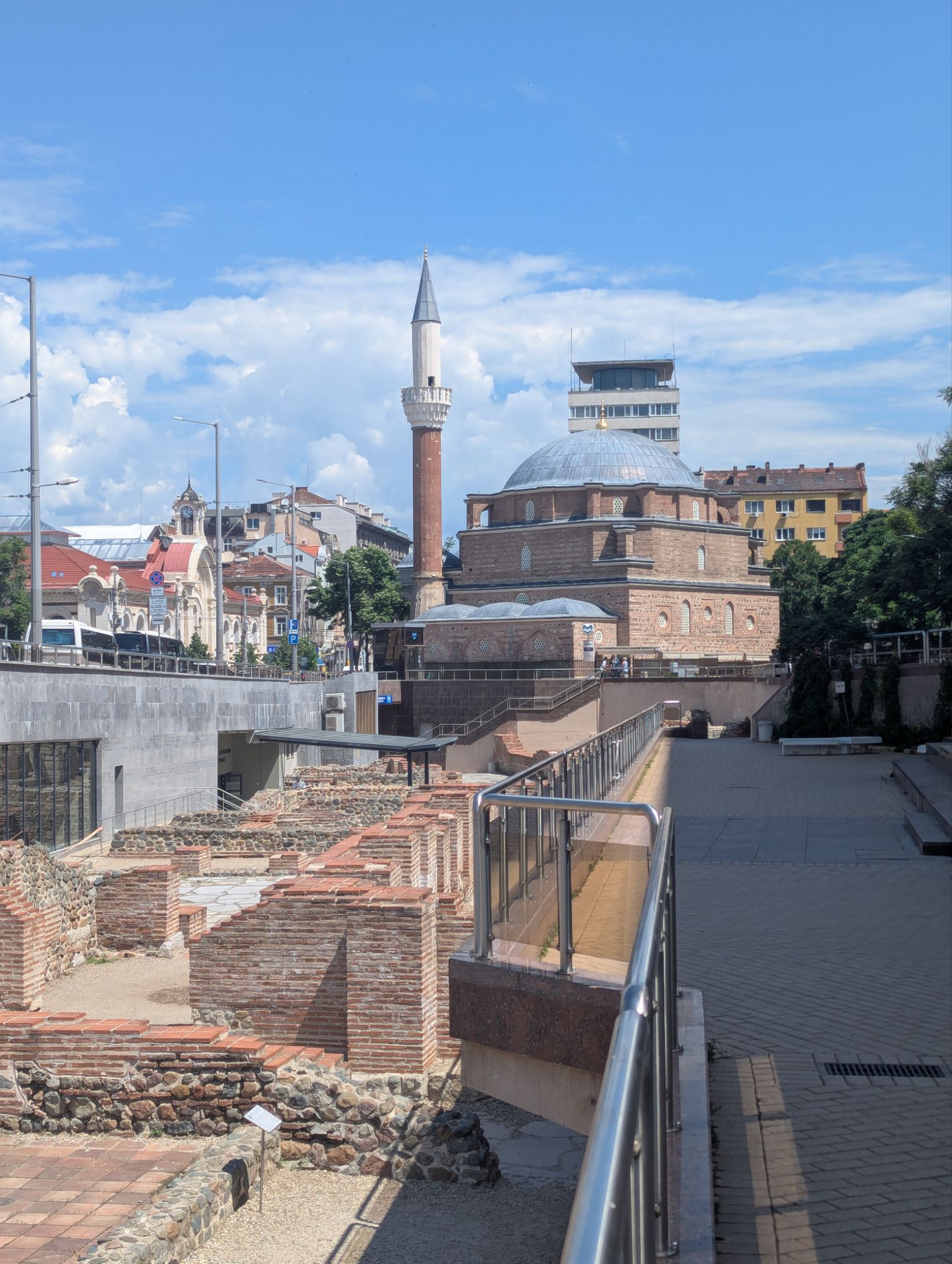
The Romans arrived in the 1st century. Serdica was the Roman name of Sofia.


The Bulgarian Empire was established in 681 and is the oldest country that never changed its name.
In the 9th century semi-nomadic people came from south central Russia.
The Christians asked the Ottomans for permission to build a church. “Next year” was their reply. The Christians had to bribe the authorities, but then they had no money left to build the church so they started collecting stones and bricks.
One hundred years ago communists tried to kill King Boris III. He was always late which is a characteristic that saved his life AND has been adopted by Bulgarians to this day.
The communists had killed a prominent general so many government officials would be at the funeral. The bomb killed 213 people and injured 500 more on April 16, 1925. Ironically, neither the king nor the government officials were killed.
The Catholic Cathedral of St. Joseph was destroyed in WWII and the communist leaders after the war were not interested in its reconstruction. It was finally rebuilt in 2006.

A mosque always faces the direction of Mecca, and the Roman streets are north, south, east, and west so the streets in this part of Sofia have strange angles.

Sephardic Jews came here during the Spanish Inquisition. During WWII, Hitler wanted Boris III to send his 50,000 Jews to concentration camps. Boris probably said “next year”. He would delay and procrastinate. The majority of Jews left in 1949 to the newly formed country of Israel.
During WWII, one third of Sofia was destroyed. It was much smaller during this time in history.
Hitler wanted Bulgaria to come to Romania to fight the Russians. Boris III delayed. Russians had been instrumental in driving out the Ottomans which helped to establish the country of Bulgaria. Boris pushed back. Within two weeks, Boris died. Heart attack? Maybe. Very suspicious.
When Boris III died, his son Simeon was only six years old. After WWII, even though he was the king, the monarchy was abolished due to communism. Simeon went to live in Spain. After the fall of communism, he came back, started a new political party, and became the new Prime Minister. What a comeback story! He is the only person in the world to have been both King and Prime Minister.

Storks migrate to north Africa in August for the winter. They are monogamous and return each March to the same nest. Their arrival is a symbol of spring and watched by farmers and shepherds.


Rob and I went to a restaurant where we ate traditional food and were serenaded by these local musicians. They asked the table next to us where they were from, and they said, “Spain”. The musicians immediately started to play and sing Besame Mucho. After they were done, they asked where we were from. We said, “America”. They kind of shrugged and played a Bulgarian song unfamiliar to us. Hmmm. What song should they have played? Yankee Doodle or perhaps Play that Funky Music, White Boy??


Leave a Reply