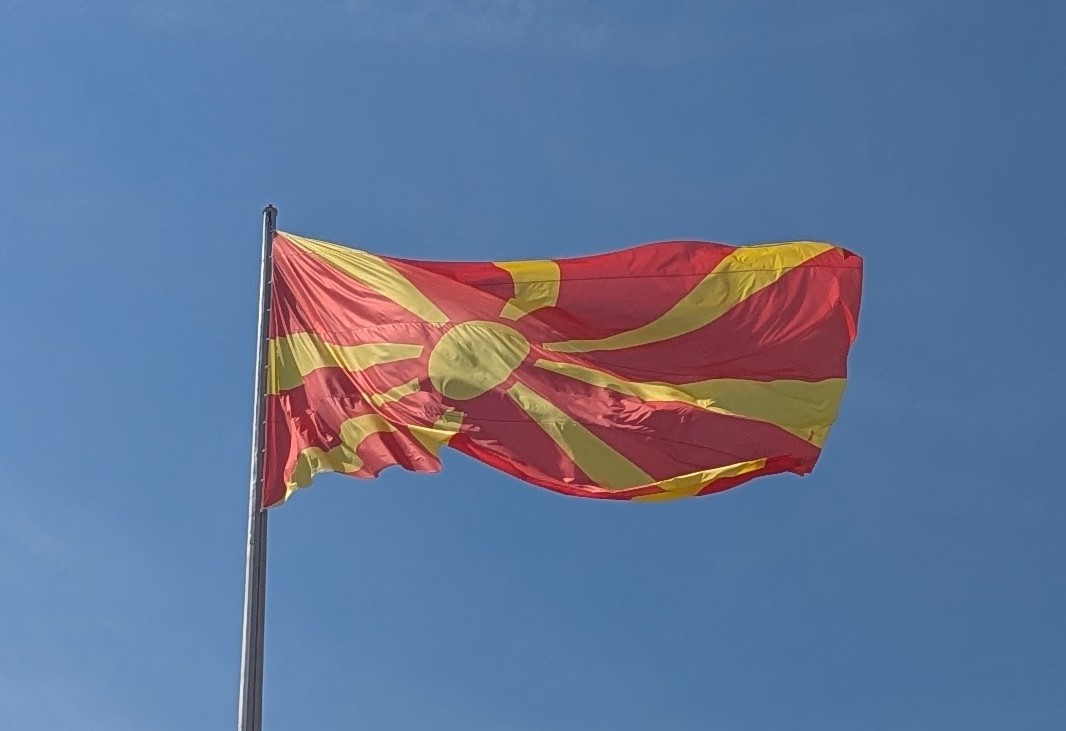
We left Pristina, Kosovo and took the bus to Skopje, North Macedonia.

The bus was packed … no, it was oversold. Rob had to sit on the jump seat in the front. Several people had to stand OR sit on the floor.

I sat with a 77-year-old lady from Ireland. She travels the world and has many interesting stories. She had walked with Mother Teresa in Calcutta in 1977. She has no technology with her. No computer, cell phone, etc. She said that she had no use for that … but she was more than willing to look at my phone.
Here were some of her sayings:
- There’s no fireplace like your own fireplace.
- Cruises are for Newlyweds and Nearly Deads.


We were excited to have an afternoon walking tour with Dario. He captivated us for three hours while we walked through the New and Old parts of town. The river is the dividing line.
Skopje means spear or something to be thrown. The weather is sunny over 300 days out of the year. The population of Skopje is 1.8 million.
History
The nearby Archeological Museum has artifacts even older than the Neolithic Age: The Paleolithic age.


6.300-4.200 BC
ALTAR, MODEL OF A GREAT MOTHER
I love how this museum makes art accessible to the visually impaired with Braille (I am sure that it is Cyrillic) and then made a raised image of the art.
In the 7th century BC, Macedon was referenced. By the 2nd century BC, the Romans had arrived and stayed for 700 years. With their military, they constructed roads, houses, and aqueducts.
In the 5th century, the Byzantine and Rome empires split. Byzantines built many churches to attract pagans. In the Middle Ages, there were many kingdoms. By the 15th century, the Ottomans came and stayed for about 500 years. There are many Turkish words in the Macedonian language.
People will fight for independence. Balkan Wars took place 1912-1913. Then Macedonia was part of Yugoslavia from 1945-1991. Today they have enjoyed 33 years of independence.


Macedonian Salad: There is no recipe. It is a whole bunch of different vegetables and/or fruit meant to celebrate their diversity.
Mother Teresa is everywhere. She wanted to make the world a better place and started Missionaries of Charity. She went to Ireland to learn to speak English. Her grave is in India.

When she won the Nobel Peace Prize in 1997, she asked how much would be spent on the recognition party. They responded $200,000. She asked them to give it to charity instead.
On July 26, 1963 at 5:19 a.m., an earthquake destroyed 80% of the city. Many countries sent aid, but it was still not enough.

Skopje is sometimes called the City of Brutalism. It is functional and looks like it sounds: dark and gloomy. However, these are the only buildings that survive earthquakes.
Philip II of Macedonia wanted to take Persia, but he died before he could accomplish it. Alexander decided to take Persia in his father’s memory. But first, he wanted to become a god so he went to Egypt. Once he conquered Egypt, he became pharaoh which Egyptians considered god. Then Alexander pursued the Persian conquest. He was NEVER defeated in battle during his 13 years of conquests.
His success was due to the Macedonian phalanx developed by his father which had a formation of 16×16 soldiers with spears at different levels.
Alexander traveled as far as India. His body is buried in Egypt. Where? No one knows.
Alexander the Great was Macedonian (or was he Greek?) In fact, Alexander is the most common name.
Cyril and Methodius were brothers, Byzantine Christian theologians, and missionaries. For their work evangelizing the Slavs, they are known as the “Apostles to the Slavs”. The people didn’t have written words. They aimed to translate the Holy Scriptures for the Slavic people, to make the Bible more accessible. However, they realized they lacked a proper alphabet to render the particular Slavic phonetics: the Glagolitic script was then born, circa 863.
St. Clement simplified the alphabet and named it Cyrillic in honor of St. Cyril. Now there are 59 Slavic languages that are based on the Cyrillic alphabet and 300 million speakers worldwide.
And today, our guide has taken the Cyrillic and changed it to latin letters so we have a chance at pronunciation! Let’s learn some Macedonian words:


In WWII there were 7,000 Jews living in Skopje who were all deported to concentration camps. They have never recovered. There are only 200 Jews living in the entire country.
In 2001, a giant cross was erected on the top of the highest hill in the city to commemorate 2,000 years of Christianity.
The religious breakdown today is 30% Muslim and 60% Christian, mostly Orthodox.
The Old Bazaar began in the 12th century, but it was transformed by the Ottomans in the 15th century and as we see it today. In the past, one street would be one craft like jewelry.
There is a church near the market. The rule is that it had to be smaller and lower than the nearest mosque so they went below ground to make it bigger.

Leave a Reply