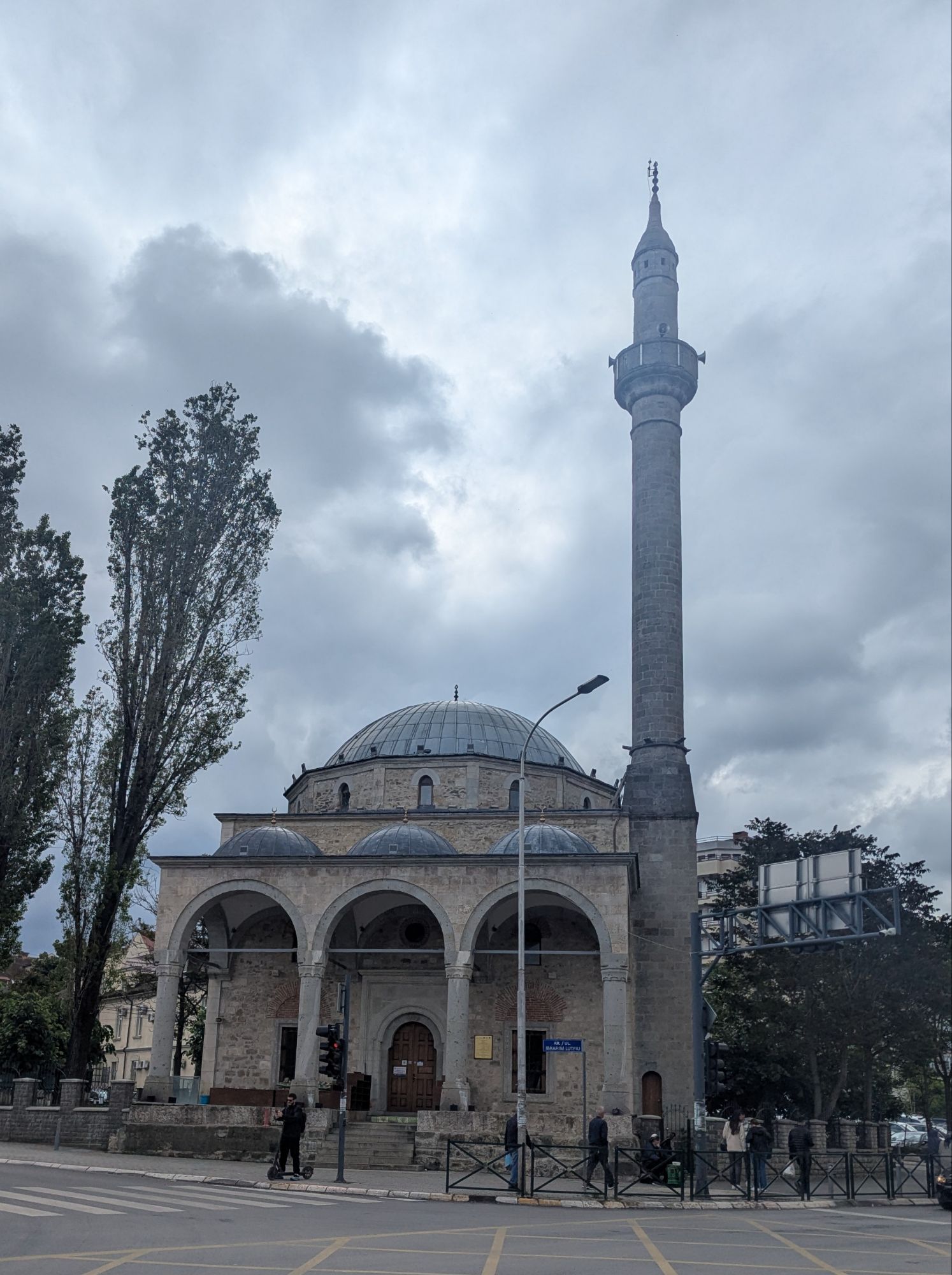
Our walking tour was attended by people from all over the world to learn more about Kosovo. One lady was from Germany, and she has been traveling for 17 years!! She doesn’t have a home but goes back to Germany once a year to pay taxes. I like long term travel, but I couldn’t do that.
Pristina is the capital, largest city, and political, historical, and cultural center of Kosovo. The population is 230,000.
Pristina has been inhabited for 4,000 years. In the second century BC, the Romans arrived, but not much is left today from that time. Next came the Byzantines. There wasn’t much development until the Ottomans arrived in the 15th century.
Much of the city has been destroyed to make way for newer buildings. The Old Town is not that old and not much remains.
The first president, Ibrahim Rugova, was a pacifist and was called “Gandhi of the Balkans.” He was the architect of independence even though he died two years prior to their independence.
After the conflict in Kosovo in 1998-1999, 1,600 are still missing. Families remain in agony.

They are so appreciative of America’s support. Pristina feels like Little America.


There is George Bush Boulevard and Beau Biden Highway. Biden worked in Kosovo after the 1998-1999 war helping train local prosecutors and judges. There was even a controversial effort to name a Trump Lake. It is an artificial lake that straddles the border of Kosovo and Serbia. It has been disputed for years as Kosovo called it Lake Ujmani. Serbia calls it Lake Gazivoda. And since Trump, the “peacemaker”, likes to rename bodies of water on the map, I guess this might be a diplomatic yet crazy idea.

The Battle of Kosovo was the largest battle in medieval times with both sides (Ottoman and Serbia) losing many men including both kings. How different war would be today if our leaders were required to be on the battlefield.
The Ottoman empire collapsed in 1912, and the Serbs moved into Kosovo.
Ethnological Museum

From 1956-1960 there were 800,000 people deported. This family that lived in this house was ousted in 1958. Fortunately, it was not destroyed during communism.

to heat the rooms.


When there was a knock on the door, all visitors were received and given food and shelter. They had a saying in regards to hospitality: the biggest and best is always for guest.
Smaller rooms were the norm since they were easier to heat in the winter and cool in the summer.
There are 140 types of clothing that indicate what region one is from and what type of event the clothing is used for such as weddings.


Seventy percent of the city was destroyed. Civilians relive those moments when they hear about Ukraine and especially Gaza.
Ilir was deported as a young boy, and the rest of the family was taken hostage. He didn’t know their whereabouts. To learn more about Ilir’s experiences, go to YouTube and search for videos: Bllacë 1999.


Teqball
Mother Teresa Cathedral


Leave a Reply