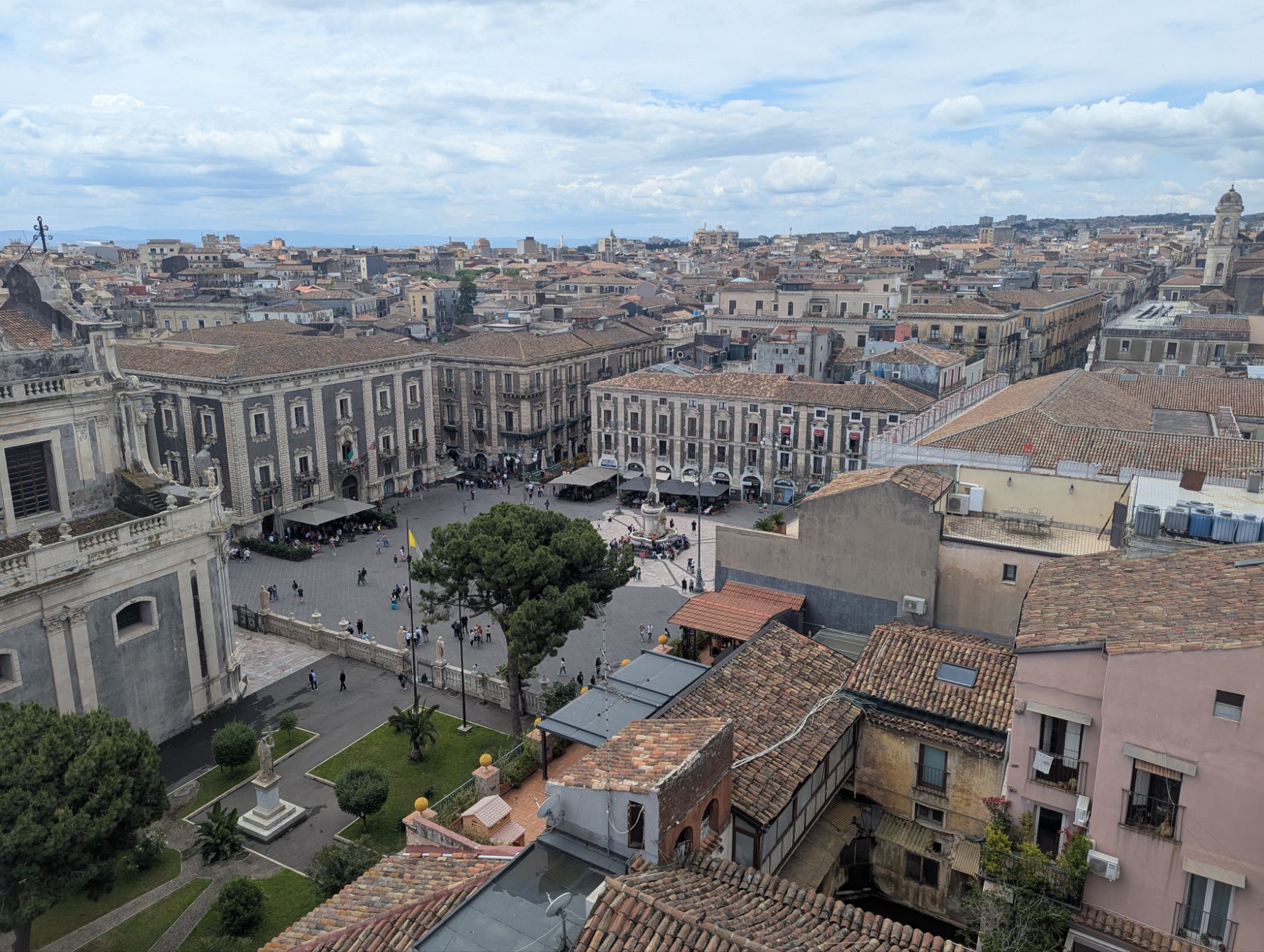
We have a walking tour in Catania. The forecast indicates rain.


Mount Etna.


The Amphitheater was built in the first century AD and expanded in the second century AD. It fell into disuse in the fifth century and was partially stripped of its blocks to build public buildings.
After the 1693 earthquake its ruins became the foundations of Baroque buildings. In the early eighteenth century the Amphitheater was completely buried or hidden by buildings, so that people doubted its real existence.
The first archaeological excavation was carried out around the year 1748.
At the end of the 1700’s the Amphitheater was sought by travelers of the Grand Tour. The famous views by printmakers Jean Houel and Jean-Claude Richard de Saint-Non were like the Internet of today. It made them want to travel and see it for themselves.

St. Agatha was martyred during Roman times. That was known as the age of Roman martyrdom. All of the patron saints of Sicily’s largest cities are woman.


The Feast of St. Agatha happens on the first days of February. It is a huge celebration up to a million in attendance.
Many people think that the 1669 eruption of Mt Etna caused the most destruction of Sicily, but it was actually the 1693 earthquake which destroyed one-third of Sicily.
Sicily and World War II

Soldiers Guide to Sicily contained information about the geography of the island, the administrative divisions, transport, the habits and customs of the population, and finally a compendium of words and phrases translated from Italian into English.
At first, Mussolini was popular because he took out the mafia. However, civilians were starving due to the needs of the Italian army taking all the food. Males were required to fight so the farms had no men to work the fields. Some soldiers could only speak Sicilian.
Lucky Luciano was in prison for his involvement in Mafia-related crimes in America. However, he was asked to help in the fight against fascists. He had ties to Sicily and his Mafia connections made sure that the military invasion of Sicily was a success by providing intelligence for landing locations and best places to cross rivers. When the navy and army arrived, it went smoothly and even Sicilians provided food for the fighting soldiers. So Italian!!
On July 22, 1943, Patton entered Palermo. They were cheering the Americans. By Sept 3, 1943, after only 39 days, Sicily was under the control of the Allies.
Salvatore Giuliano, a black market post-WWII Robin Hood, was admired by the starving Sicilians.
Luciano was able to have Sicilian prisoners released. Some of these were Mafia and soon became mayors so postwar leadership in Sicily from 1946-1948 was controlled by the Mafia.
There was a provisional government after WWII. They asked Truman if they could be part of America because they did not want to be part of Italy. Maybe we should have agreed to take control of this strategic island in the Meditteran.
To reinforce omertà, ostracism, shunning, and intimidation are often used to encourage silence and non-cooperation with authorities. Violence and retaliation against informers is what can be expected if the code of omertà is broken. “If anybody asks, you were at Grandma’s.” I love that Freshpet commercial.


On June 2, 1946, Italy became a democratic republic, equal rights for men AND women. That was because it was the first time that women could vote.


My fellow travelers questioned,”What are you doing here?” “My husband brought me!”
Leave a Reply