Trapani was pretty much a ghost town, but the Americas Cup in 2015 brought the town back, and it has become a wonderful seaside destination.
When history is being made, we are living like a character in a history book. Archeology confirms history.
Three Punic Wars were fought here between Hannibal (Cathagenians) and the Romans. Submarine Archeology was invented here as much maritime warfare history is underwater.
Marsala is the most western of point of Sicily. Grapes grown here make the famous wine of the same name.
The seafaring Phoencians originated from the Middle East and came here because the large shallow lagoon provided a natural barrier to invaders.
We took a short boat ride to the Island of Motya where they continue to uncover a Phoencian port city. North Africa is only 87 miles away.
There are many unanswered questions which produce many theories. It appears that there were two ethnic groups living here.


Carthagenians are people born in Carthage. It doesn’t matter where they came from. For example, we are now called Americans not Europeans.
In ancient history, water had to be the first thing found to support further development. When this happened, a temple was constructed to give thanks.


The symbol of Sicily has three legs radiating from a medusa head in the center.
There is nothing cuter than hearing a Italian preschooler having a tantrum.
Salt Pans
Salina means salt pan. Salt has been harvested since the beginning of time and used to preserve food or flavor food.
A Roman soldier was paid in salt. The name salary comes from this fact. Perhaps he was “not worth his salt”. Today if an Italian says something is “salty”, they mean that it is expensive.
Not long ago, the salt pans were abandoned. It is a hard job. However, they were noticing that the lack of salt pans was affecting migratory birds like flamingos. They didn’t have a place to stay.
The World Wildlife Federation (WWF) stepped in and saved some salt pans for the birds by establishing parks. They must be maintained. Many photographers come to the salt pans at sunset to take some awesome photos of the migrating birds.
The flamingo is white until he starts to eat algae and brine shrimp which contain carotenoids, and then they turn pink.
A baby flamingo is called a flaminglet and a group of flamingos is called a flamboyant.
It is very windy here so kite surfing is popular.
Museum of Salt

Alberto is the grandson of the man who started this salina.

One can harvest only at the end of the summer, September. The salt is best harvested by hand. The block is 6 inches deep. If a machine is used, it digs too deep and removes some of the clay floor which results in impurities in the salt.
The seasonal workers are paid by the bucket. There is a harvest supervisor that records the number of buckets in groups of 24. That number corresponds to the total number of finger sections (three sections on each finger) on both hands. He cannot use paper because of the wind, etc. The workers have a song that helps them keep track of the buckets of salt.

Many workers developed bad backs and/or became blind since there wore no sunglasses. They cannot use animals because they would get stuck.
Salt is very weather dependent. They use all the ancient ways to forecast. Weather apps are never right.
The salt pans are dried by wind for six months and are ready for harvest in September. If there is too much rain in August, the harvest will be ruined.

If the salt is dried in an oven, there is a bitter taste. If salt is white, the salt has been washed and the nutrients are removed.
Windmills are still prevalent along the landscape. Large windmills were used for grinding. The small windmills were used for pumping water. In 1920, American windmills arrived and were excellent due to the automatic rotation with the wind.
Archimedes invented a device used to raise water which was named after him: the Archimedes screw. Archimedes was the most famous mathematician and inventor in ancient Greece. He was born, lived and died in Syracuse, Sicily which was a Greek city-state during his life. (He also figured out the value of pi “π”.)
Grinding is done salt against salt. If the grinding machine stops, it will rust since salt is very corrosive. Salt is also used to the clean machines.
Bacalou is cod that is eaten all over the world. Cod comes from Norway and they would trade the cod for salt in Sicily.
Since salt had great value, a black market existed. Woman smuggled salt in their skirts. This was hard to investigate because it was inappropriate to search a woman. However, if a woman was going to be searched, she would jump into the water and the salt would dissolve.
Refrigeration arrived in 1917 and affected the need for salt for preservation. That was the end of the black market.
Alberto said that his sister uses the salt as a scrub on her skin similar to the Dead Sea. Her skin is beautiful, but the scrub stinks. She remains single.
Pizza the Sicilian Way


Rob forget his wallet so he ran back to get money while I stayed behind as collateral. I told him to hurry back lest they put me to work!!! And who knows what I would be asked to do!!
Gelato

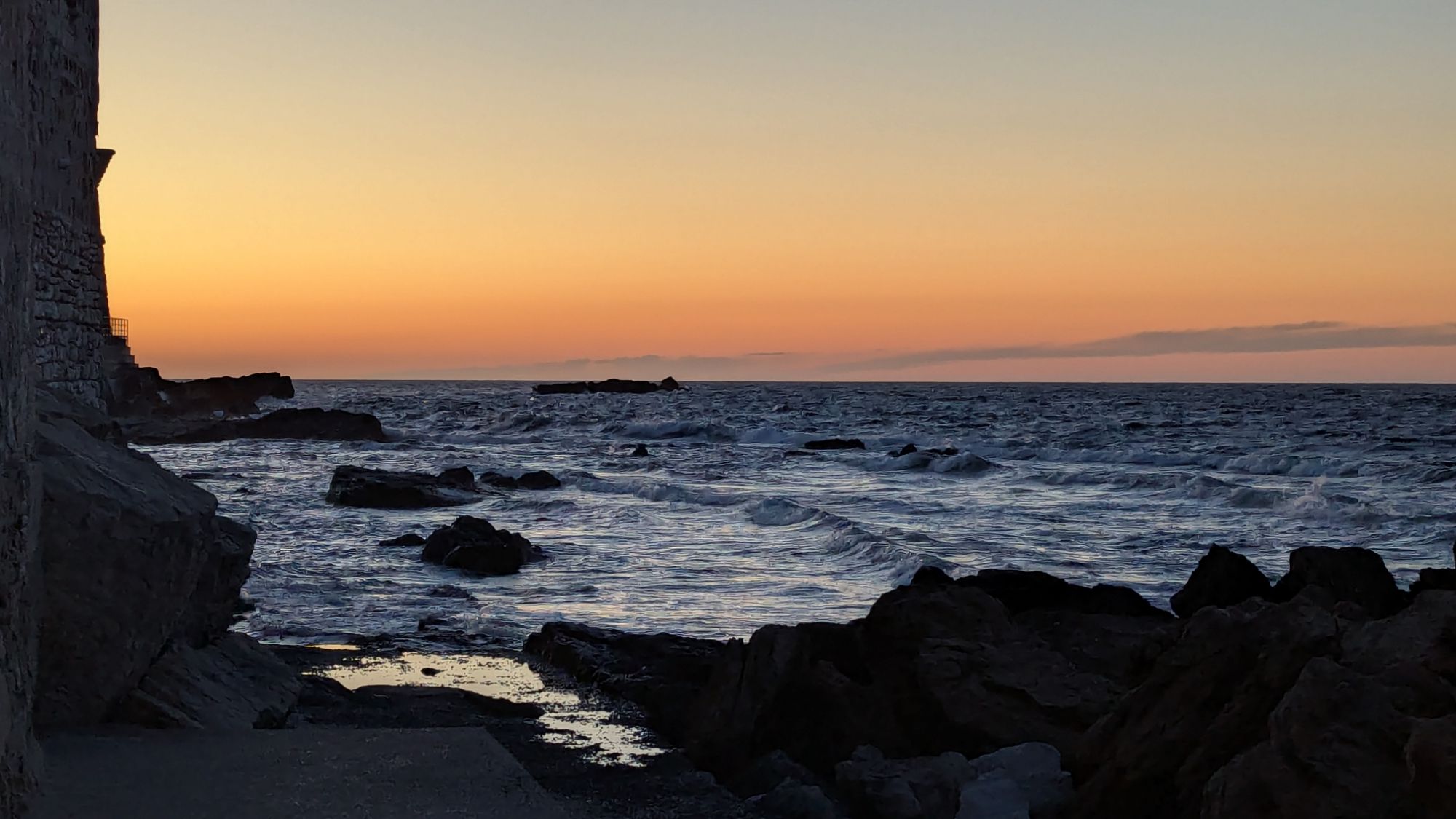
We caught the tail end of a west coast sunset, watched the waves crash along the rocks, and ate two scoops of gelato with whipped cream and strawberries on top. Can’t top that!!

Leave a Reply