Different languages, foods, cultures, and architectures were affected due to the influences of each people group in Sicily.
History is food. There are 17 main dominations that came to Sicily. It seemed like everyone that had a boat came to Sicily. This largest island in the Mediterranean Sea is centrally located. Countries wanted control over the Mediterrean.
People have been on the island of Sicily since 10000 BC. We don’t know much about them since it was before written language.
- Phoencians 8th BC in the West; seafarers liked the natural harbor
- Greeks in the East that brought olives and pistachios
- The Romans were here for 1,000 years and divided Italy into city states. At the fall of Rome in 479 AD, that was the start of the middle ages.
- Barbarian invasions by Germanic tribes who were migrating.
- Arabs arrived in 827 and were in power for 300 years
- Normans were heirs from the Vikings and “invented” Sicily in 1130. One can see their influence in several cathedrals.
- German, French, Spanish
- 1861 Italy declared a nation due to the actions of Garibaldi.
- In 1942, Italy became a Democratic Republic.
Sicily got tired of everyone telling them what to do. They wanted to rule themselves.
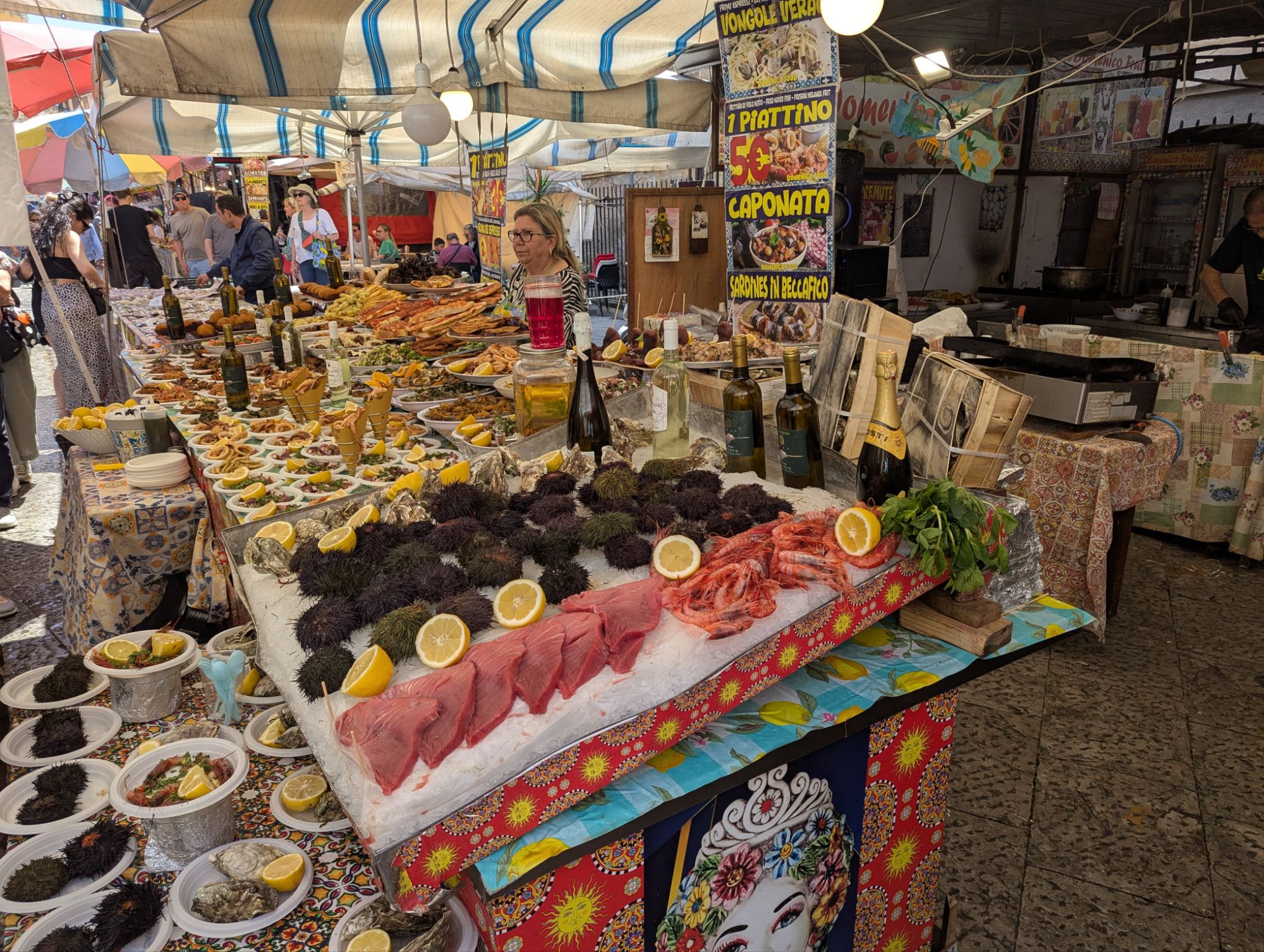
The door to the Mercado del Capo is from the 16th century however the market has been there since the 11th century. They LIVE to barter with customers, sometimes the same one for hours. Now they barter with tourists.
“We are obsessed with food. If we aren’t eating it, we are talking about it.”
They eat pasta every day. Food shows affection. The Mediterranean diet is recognized by UNESCO and consists of simple cuisine.
However, in Sicily, everything is fried … in olive oil. They squeeze lemons, which are abundant, on everything … originally because fish might not be as fresh as one would like.
Here are some of the foods that we tried:

Panella made from chickpea flour, water, salt, mint of parsley. Rob couldn’t wait and took a couple of bites out of his.

Arancini is the queen of Silician cuisine. It originated from the Arabs and is meat surrounded by rice coated bread crumbs in a yellow ball. This allowed it to be carried off. The yellow color comes from the use of saffron.

Caponata bruschetta contains chopped fried eggplant (aubergine) and other vegetables, seasoned with olive oil, tomato sauce, celery, olives, and capers, in an agrodolce (sweet and sour) sauce. The other bruschetta was topped with pesto and dried tomatoes.

Mangia e Bevi is named “eat and drink” because it exemplifies the Sicilian tradition of sharing food and enjoying good company. Panchetti is the pork belly wrapped around spring onions. Also, panchetti means what we would call a “muffin top” on a person.

Here is the Mangia e Bevi after it was cooked and cut up – deliziosa!

Pani câ meusa is a “spleen” sandwich stuffed with chopped veal lung and spleen that have been boiled and then fried in lard. It looks like Arby’s, but slimy and not much flavor, and with the consistency of liver. We were among the brave that ventured only one bite and discarded the rest.

Stigghiola are grilled veal intestines then cut into pieces and served hot, often with a squeeze of fresh lemon. Our guide told us to chew only a few times before swallowing, because after that it would begin to taste like the waste product that is contained in the intestines. Stigghiola is rubbery and difficult to chew. One bite was more than enough.

This ultra-long zucchini only grows in Sicily. We went to another market called La Vuccería Market.
In the past, when one purchased a cannolo (cannoli is plural) from the Dominican nuns, they would put their money on a wheel that rotated through the wall. The customer would turn it and send the money to the kitchen, and then the wheel would turn back and there was a cannolo. This invention was necessary so that one couldn’t see the nun.
Etiquette in many restaurants: Pay first then go to the waiter and hand him your receipt. The same person who handles money doesn’t handle your food in Italy.
A final thought: Tomatoes were not in Italy until after Columbus returned from his voyage to America.

Teatro Maximo holds 3,200 people. It is the third largest opera house in Europe behind Paris and Vienna and built in the Neoclassical style
Anything after the 15th century is called new.

This Arab Norman style church looks like a mosque. There are no stained glass windows. The windows are Arab-based inset to the building to reduce direct sunlight. Then small holes in the window itself allow for air to come through; the smaller holes allow faster air flow.

This Italian Renaissance fountain showing nude women and men was called the “Fountain of Shame” as it was put right outside the convent and the town hall. These statues were made from the same marble as “The David” in Florence.

The core of Palermo is the Quattro Canti. The four straight roads make a perfect cross that can by seen by God in the heavens. Watch The Leopard which is a Netflix series about a Sicilian family. The first 5 minutes of Episode 2 shows this famous intersection in the heart of Palermo.
Each corner has a facade, each with a statue of one of the four seasons, and above it one of four kings, and above it a different patron saint.
Many movies are made in Palermo. The latest is The Odyssey with Matt Damon. It hasn’t been released, yet but I am eager to see it.
In 1943, France started bombing Sicily followed by mostly American bombs which destroyed 42% of historic Palermo. On May 9, 1943 Palermo suffered one of the heaviest bombings of WWII. Due to the war, eventually 172,000 people in Palermo were homeless. The city people were starving. The rural areas were at least able to find food.
The Marshall Plan was so important to reconstruct Palermo after the war.
The Palazzo Conte Federico is one of the oldest and most important buildings in Palermo.
The Contessa welcomed us to her home that they have opened to visitors in order to make money to keep this remaining palace functioning. This 16th century palace was built on the city wall.


The 12th century Arab-Norman tower inside the palace is one of the few remaining parts of the old city wall. Count Federico’s family, which can be traced back to the Staufen Emperor Frederick II, has been living in this palace for centuries. The personal atmosphere makes a visit to this historic building a unique experience.
The Contessa met her Italian husband at a debutante dance. She is from Salzburg,Vienna. She was studying Chinese at the university. She traveled to China as part of her education. He showed up at her door on a bended knee and asked her to marry him. She didn’t know any Italian so she didn’t know how to say no. She learned Italian by listening to opera.
The Contessa didn’t know that she would be living in a palace. She likened it to living in a museum.
Royalty titles ended after WWII, but historically the title would pass on to the first son.

Leave a Reply