Good morning. The winds are 45 knots. Seas still feel rough. I have no first photo from our room because the windows are covered. Here is the first photo from Two Seventy Zeroº, our breakfast area.

The wind weather map looks less threatening this morning. I think we are west and a little south of the white dot.

While the wind has died down a bit, the waves still are pretty strong at 6 meters (about 20 feet high).

Overnight we turned north. We are going directly to the tip of South America rather than coming in from the southeast.

Other cruise ships have joined us making the crossing.

The captain said that some other cruise ships going north left a day or two earlier than planned so they could beat the storm. It was unfortunate for the people on those ships to have their trip cut short like that. Our ship on the other hand is fast and relatively “comfortable” in those sea conditions.
Conor, a naturalist, gave a presentation on animal sense of smell.
Many species have evolved to have two nostrils, just like they have two eyes. The farther apart a species’ nostrils are, the more easily it can locate the source of a smell. We still have a lot to learn about how animals can detect smells over long distances.
Humans can differentiate among one trillion different smells.
Killer whales have a single nostril. They can’t smell.

More than 70 Filipinos make up the crew of the ship. Sometimes they speak Tagalog to each other. Many cruise ships employ Filipinos in crew positions due to their strong work ethic, natural hospitality, fluency in English, and a long-standing maritime tradition in their culture.
Ella provides the cleanest cabins I have ever seen and the tightest sheets on the beds she made.

In fact, the entire ship was always extremely clean. Members of the crew were constantly vacuuming and dusting.

Our primary waiter, Marvin, was always friendly and courteous.

Antonio knew that I was always looking for a Coke.

The food was delicious, especially the desserts. Some meals we had a buffet, sometimes table service.


Our 11-person expedition team was composed of naturalists, photographers, and divers that grew up around the world – Ireland, Sweden, Malaysia, Falkland Islands, and the U.S. They assisted us on Zodiac tours and provided a constant flow of information. It seemed that they were out mixing with the passengers at all times.
Expedition team members stay in cabins at the front of the ship on Decks 4 and 5. Filipino crew have quarters on Decks 3 and 2.
For late morning presentation Eva discussed “Women of the Antarctic.”
Over most of maritime history, women were excluded and discriminated against. It’s only been recently that they have been welcomed into crews and on expeditions.
Jeanne Baret is recognised as the first woman to have completed a voyage of circumnavigation of the globe by ship. For the voyage she dressed as a man. A key part of her journey was as a member of Louis Antoine de Bougainville’s expedition on the ships La Boudeuse and Étoile in 1766–1769. Jeanne might have been the first woman to see the Antarctic ice. She dressed as a man.
Here is an allegorical portrait of Jeanne.

Abby Jane Morrell set sail with her husband, Benjamin Morrell, in 1829 on his fourth voyage of commerce and exploration.

She wrote the first description of the subarctic region from a woman’s perspective. The book was first published under the name of a man. Now it is available on Amazon under her name.

Caroline Mikkelsen was a Danish-Norwegian explorer who on February 20, 1935, was the first woman to set foot on Antarctica, although whether this was on the mainland or an island is a matter of dispute.

Ingrid Christensen was an early polar explorer. She was recognized posthumously as the first woman to view Antarctica in 1931 and first to land on the Antarctic mainland in 1937. The photo below (from Wikipedia) shows her on a cruise in 1931.

Edith “Jackie” Ronne was an American explorer of Antarctica and the first woman in the world to be a working member of an Antarctic expedition (1947–48). The Ronne Ice Shelf was named by her husband after her (photo from Wikipedia).

The Soviet Union, South Africa, and Argentina led the way in accepting women on expeditions. Maria Klenova was the first woman scientist to do research in Antarctica and was a contributor to the first Soviet Antarctic atlas.
However, the bias against women didn’t go away easily. Rear Admiral George Dufek of the U.S. Navy apparently said that women would join an expedition “over his dead body.” His excuse was that sanitation facilities were too primitive for them. In 1958 the navy put in place an official ban against women on Navy ships. It was not lifted until 1969.
Then we have the “powder puff explorers” as dubbed by the press.

Lois Jones, led an all-women Ohio State research team, to Antarctica. They were the first group of women to reach the South Pole on November 12, 1969 (Photo Credit: U.S. Navy).
From Wikipedia: In the lead up to the trip, the team spent hours studying maps and checking equipment lists. Their groundbreaking expedition was generating considerable media buzz, though, and they couldn’t escape the flood of reporters. In an interview years after her trip, Jones remembered the “silly questions” that reporters asked.“‘Will you wear lipstick while you work? How will you have your hair done?’” she recounted. “Can you imagine a male scientist answering a question like that?”
Upon hearing of Jones’s trip, one veteran of the Antarctic program reportedly quipped disapprovingly, “The only place left [for men] now is the moon.”
Another time a British leader said that women wouldn’t like it because “there are no shops and no hairdressers.”
Ann Bancroft became the first woman to reach the North Pole on foot and by sled. She was also the first woman to cross both polar ice caps to reach the North and South Poles. In 1992–1993, Bancroft led a four-woman expedition to the South Pole on skis; this expedition was the first all-female expedition to cross the ice to the South Pole. In 2001, Bancroft and Norwegian adventurer Liv Arnesen became the first women to ski across Antarctica.
Georgie, one of our naturalists, is from the Falkland Islands. I asked her about the Neptune Ceremony crossing the equator. She told me that crew and staff members are required to do this ceremony when they cross for the first time in their lives. The ceremony is optional for the passengers.
When she crossed, they were dressed in costumes made out of bedsheets, blindfolded, tied up into a chain, taken out on the deck, made to drink and eat various things, and had slop poured over their heads. Someone was dressed as King Neptune and Queen Neptune. After the ceremony the participants were designated as “shellbacks”, trusted subjects of Neptune. She thought it was fun.
Georgie told me that she was very sick the first time she went to sea but not anymore.
As we crossed the Drake Passage I observed various individual birds following the ship. Below is a Southern Giant Petrel. It’s wingspan is more than six feet.

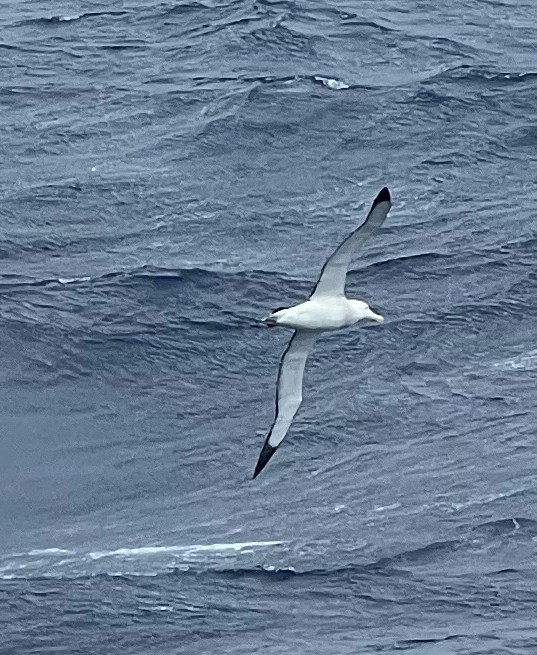
Next came a wandering albatross with a 12-foot wingspan, making it one of the largest wingspans of any bird on Earth.

The wandering albatross is also known as the snowy albatross. See its white underside. Thank you, Kurt, for the photo below.

As the ship continues to move around, my hips feel sore from the effort to keep myself upright as I navigate around the ship. My shoulders are sore from grabbing the handrails on both sides of the hallways as I stagger back and forth.
We’re scheduled to arrive in calmer waters about 9:00pm and reach the edge of the channel at 3:30am. I was told that a pilot boat would take us into Ushuaia, but I never saw one.
So how rough was the crossing. Some of the staff said a 6 out of 10. I also heard 8 out of 10. If we’d had the same rough crossing going south, we never would have made it to Lazerev Bay. The passengers would have been discouraged about the outlook for the cruise. So it’s good that we experienced the Drake “Lake” and the Drake “Shake” in that order.
The sun is setting, but here that takes a long time.

At 9:00pm we passed Cape Horn on the port side traveling at 14 knots. Sea depth is only about 100 meters (330 feet here). The seas have calmed. All of the ship areas and services are back to normal. The outside walkways are open. The spa is functioning. They removed the covers from our cabin windows.
Here is a view of Cape Horn.


Here is the final daily expedition report from our cruise line – https://www.expeditions.com/expedition-stories/daily-expedition-reports/the-drake-passage-to-cape-horn-ed-2025-02-20?email_md5=323649af63a8215a85f9923f6a86435f&hmc_lid=3&mi_u=323649af63a8215a85f9923f6a86435f&utm_campaign=DER.SELF&utm_medium=email&utm_source=Triggered
Leave a Reply