We have arrived at the Berthelot Islands.

The weather is overcast with a 33º F temperature. They are expecting it to warm a little during the day. It is slightly foggy, and there is moisture on our window. This is the first view from our room.

We went out on Zodiacs in the morning looking for penguins, birds, and whales.
Wind and rain sculpt the glaciers. Sometimes a big rock or other factors cause an arch to form.

Our Zodiac driver navigated us around to the other side for a photo with another Zodiac in the background for scale..

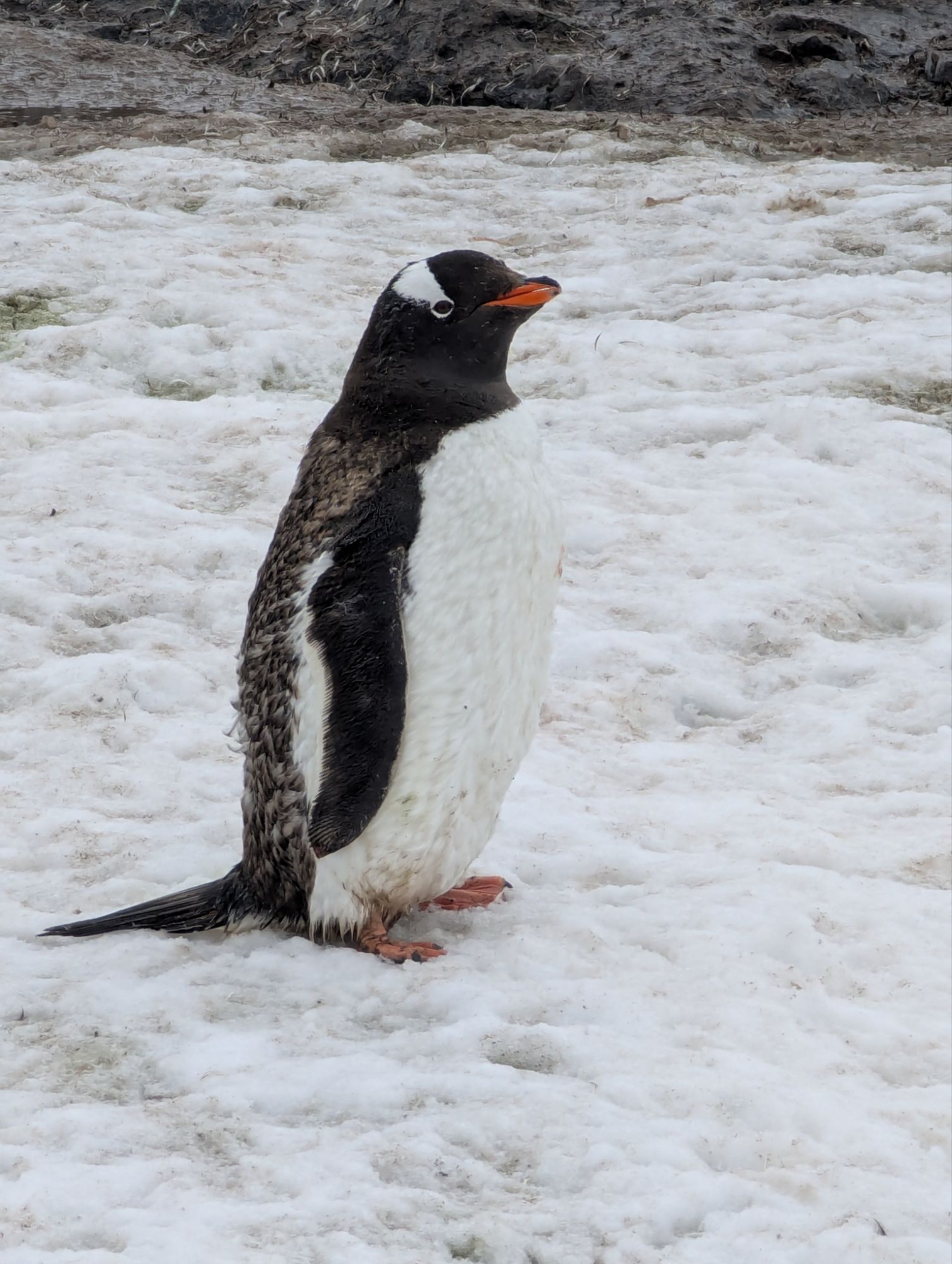
We admired the southernmost Gentoo penguin colony in the world. As there is less and less sea ice, they are slowly moving south. Researchers think that the 1-to-2 year olds are leading the way.

In other places it is hard to identify types of gulls because there are so many types. Down here there is only one species, the Kelp Gull.


The term iceblink refers to a white light seen near the horizon, especially on the underside of low clouds, resulting from reflection of light off an ice field immediately beyond. Our Zodiac guide said that it could increase the distance you can see by up to twenty miles. The iceblink was used by both the Inuit and explorers looking for the Northwest Passage to help them navigate safely.
We saw a lot of low clouds and gaps in clouds, but I can’t say that I saw an iceblink.

The water is clearer here, and we can see the bottom, maybe ten feet below.

We spotted a group of mostly juvenile Adelié penguins.


See how these penguins are still molting. I like their furry caps.

Some green marks on the rocks show bile which says that these juvenile penguins are close to going on their own. They probably have already been abandoned. The penguins can’t swim to feed themselves until they have fully molted. Penguins go through a “catastrophic” molt once a year.
Marine mammals and birds need to be able to see clearly on both land and underwater. The corneas of marine birds like penguins are very flat and the bird does not use them for focusing. All the focusing is done by the lens. To see sharply underwater, the penguin’s eye changes the shape of its lens to a more spherical shape. Penguins’ lenses are soft and the muscles can squeeze them up against the opening of the pupil making them bulge outwards like the eyes of fish.
There is mist in the air. We got a bit of snow last night. We can see it on the tops of the brash ice.

Gentoo penguins have a pink underside to their feet which are highly vascularized. That is how they sweat.
Gentoos are mellow birds. Adeliés are feisty. They talk a lot and smack each other with their flippers.
Gentoos are climate change winners. They need open water to feed in the winter. Adeliés are moving south, too, but they’re trying to find more ice. They live on the edge of the ice. This area has been sea ice free in the summer for the past 3 years, favoring Gentoos.
It is unclear how Gentoo penguins got their name. One theory: Early whalers thought the white patch on the head of Gentoos looked like a turban so they called them Hindus. Eventually that morphed to Gentoo.

Gentoos lay 3 eggs. The are the only penguins that if they lose their eggs early enough in the season, they will lay another set.
Gentoo penguins only range 20 to 30 miles, not very far from where they were born. Adeliés follow the edge of the ice so they go farther. Gentoos can dive 600 feet and stay down 5 minutes.
Average snowfall on the Antarctic peninsula reaches about 9 feet versus only 2 inches at the pole. Layers of stripes in the snow below are annual snowfalls like tree rings.

Water moving over the ice creates a washboard effect. See this block of ice that floated by our Zodiac.

When Zodiacs go out in the water, guides wear a safety tracker in case someone falls in the water. Russ, our expedition team leader, manned the safety boat.

During lunch we passed by a Ukrainian research station. We saw groups of penguins swimming and on the icebergs, and an occasional whale. Two ships sailed by including our sister ship, National Geographic Explorer. This area seems to be overcrowded with tourists. Ha!


After lunch our ship was positioned by Booth Island. As we left on a Zodiac it was snowing big flakes. We got off of the Zodiac onto the island. There were lots of Gentoo penguins.

The green color on the rocks and snow is is photosynthesizing algae. The red is penguin poop.

We found a Chinstrap penguin. Their populations are plummeting on the peninsula. Chinstraps live in the same area but eat in different “grocery stores”. Chinstraps eat only krill. Adeliés eat “everything’.

Brush-tailed is a group that includes Emperor, Adelié, and Chinstrap penguins. Their tails look like brushes. Emperor and Adelié are the only two penguins endemic to Antarctica.
Gentoos build nests of rocks. The nests must have good drainage and can’t be on snow. We saw a parent feeding a chick.
Penguins, particularly when they’re molting, will eat snow for liquid. They may also consume snow to cool themselves down.

On a warm, sunny day penguins will stick their wings out to regulate their temperature. They also spread them for balance while walking.
We hiked up a hill to get a closer look at the colony.


We could see penguins scattered more than halfway up this snow hill beyond where we could go.

Portuguese scientists were drilling into the rocks to install temperature sensors.

After our hike we rode around on a Zodiac. Our first animal sighting was a Leopard seal pursuing a Gentoo penguin. It did not end well for the penguin. I will spare you the videos. This is the Antarctic version of “The Circle of Life.”

Once a Leopard seal catches a penguin he has to throw it around and rip a hole in the skin so he can tear off pieces to eat. A Leopard seal can open his mouth and he can bite, but can’t chew. Even after he dies, the penguin will float for quite a while. Then birds will come and consume the remains. This seems analogous to me to the role vultures play in Africa.
We saw humpback whales swimming near the ship.

The ship can stay within 30 centimeters (one foot) of where the captain tells it to stop. They don’t use an anchor.
We saw scores of penguins swimming together in groups.

With everyone back on the ship, we are headed north. Our ship navigated easily through an area of brash ice.
As we approach the opening of the Lemaire Channel, it doesn’t look favorable for our passage. A big iceberg got trapped in the center of the entrance a few weeks ago, and it has pivoted. There are smaller icebergs on the side. We will wait a while to see if they drift clear.

One of the icebergs has moved, and the Dutch ship has decided to go through. We are following.

Safely past the Lemaire Channel (lower left on the map below), we have reached the Gerlache Channel (in the upper right).

Adrien de Gerlache captained a ship he named Belgica, which is a combination of Belgium, where he is from, and Antarctica. The second mate on the ship was Roald Amundsen, who later led the first successful expedition to reach the South Pole. Belgica was the first ship to get stuck and overwinter in Antarctica in 1898, 17 years before Shackleton’s debacle and triumph. Needless to say, the crew of the Bélgica survived.
Here are some last iceberg vistas.


The ride of the ship feels smooth right now, as smooth as it has felt all trip. I can hardly tell that it’s moving. We have been fortunate. Some cruises have trouble finding a day to put out the Zodiacs. Snow and rain aren’t a problem, but wind can be.
Tomorrow we plan to start across the Drake Passage going north. Our captain told us that there is a storm in the northern part of the passage. We’re going to hang south to let that storm hopefully pass before crossing.
I found this weather map at 10:30pm at https://www.antarcticatravelgroup.com/drake-passage-live. It shows a storm about to cross the southern tip of South America.

The captain said to expect higher swells tomorrow night. Longer swells occur in the open ocean than near the Antarctic Peninsula. These swells repeat every two or three hundred feet. The ship might roll more side to side. They’re taking chairs off the decks. Shutters and steel plates will be put over some windows of the Bridge and Base Camp where the Zodiacs and kayaks were launched. This wasn’t done on the way south.
The captain said to buckle up. We’ll get some Drake “Shake.” So will I really be glad that I sailed across the Drake Passage? Ask me tomorrow.
Here is the summary of today’s activities by the cruise ship – https://www.expeditions.com/expedition-stories/daily-expedition-reports/berthelot-islands-and-booth-island-ed-2025-02-18?hmc_lid=3&utm_source=Triggered&utm_medium=email&utm_campaign=DER.SELF&email_md5=323649af63a8215a85f9923f6a86435f&mi_u=323649af63a8215a85f9923f6a86435f
Leave a Reply