Last night they posted the planned schedule for today. But, nevermind.

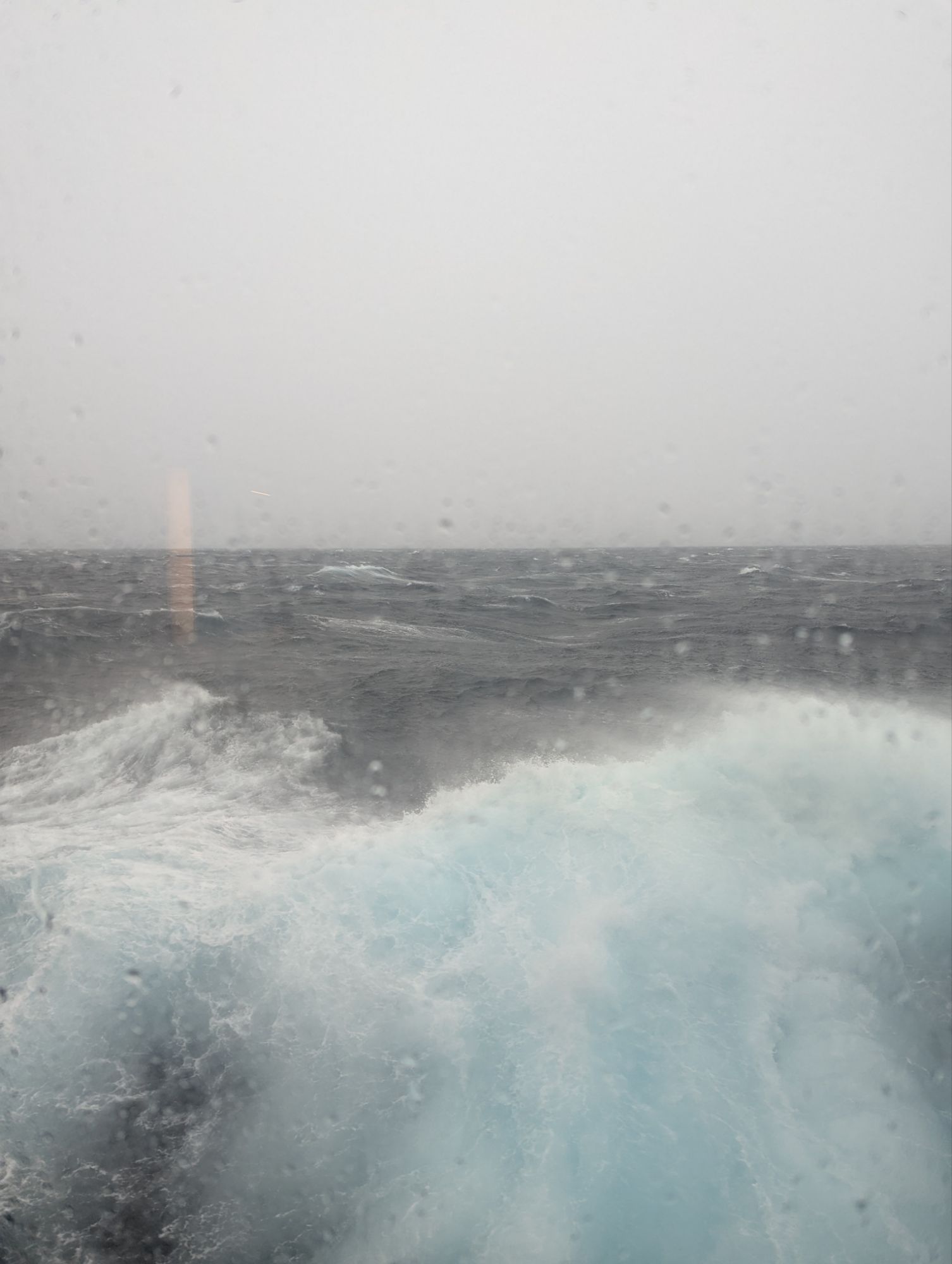
This is the first view from our cabin. I see scattered floating icebergs. The seas are rough, but we’re traveling smoothly.

The wind is four times what was expected. We have “used up our good weather tokens.” We might not be able to do much outside today.

We planned to go through the half-mile wide Gullet shown at the top of the map above. Some of the red lines were the ship going back and forth overnight waiting for the morning. However, after assessing the conditions, the ship has turned south again, and we will go around Adelaide Island before heading north.

Where we turned back, the wind was blowing 50 to 60 knots (about 55 to 65 miles per hour) north-northeasterly. And the wind would be even stronger in The Gullet.
It was looking like the wind was going to push the ice southward into the northern entrance of The Gullet. The icebergs would be blown around there. It would be a danger to the ship and uncomfortable for the passengers. On its last cruise the Endurance was the first ship to pass through The Gullet this year, and this is the last Antarctic voyage of the season for this ship.
Instead of waiting to see if we could pass through The Gullet later today, the captain made the decision to go around to guarantee that we will be able to do a full day of off-ship activities tomorrow.
After lunch the ship is rocking and rolling. The four-to-five meter swells (12 to 15 feet) are fairly close together, and we’re going directly into them. The wind is blowing at 45 knots (50 miles per hour). The ship is moving around a lot more now, rolling a bit side to side, pitching up and down in the waves especially at the front of the ship.

We are on the west side of Adelaide Island now. The captain is watching ahead intently.

Walking around on the top, front part of the ship inside on Deck 8 is difficult. They have closed the outside area on that deck. Edward told me that he stumbled and broke one of the tables off of its pedestal. I felt a little queasy so I retreated to our cabin midship on Deck 4 and put on the wristbands as an addition to Dramamine.
The seas appeared ever more furious outside of our cabin window.


A half hour has passed. Surprisingly, I feel better now. I can think of only one thing to do now – go to the sauna.
National Geographic Society
Founded Jan 13, 1888, National Geographic Society started as an informal gathering of 33 geologists, scientists. and explorers.

Alexander Graham Bell was the second society president and first editor and chief of the magazine.
The first magazine, words only, came out in Oct, 1888. Adding photos was controversial. Some members thought that people might not take it seriously. The first image was a map in 1890.

Eventually photos caused magazine interest to take off.
The familiar gold and oak leaf design appeared in 1910.

George Shiras, the father of wildlife photography, would float quietly in a canoe after dark, his camera mounted on the front, intently listening until he heard noise or detected movement. Then he would use a flashlight to illuminate the scene and get action shots, capturing the images on glass plates. Shiras was the first to use camera traps to startle the wildlife.

Magazine readership peaked at 12 million in the late 1980’s. Digital viewership exceeded print by 2013.
In 2017 National Geographic sold to Fox Entertainment, probably because they saw declining print sales and wanted to continue the magazine and grow TV. In 2022 Fox sold it to Disney.
In 2023 National Geographic stopped sending out hard copy magazines except to subscribers.

Now the company is referred to as NatGeo. There is no doubt that digital is the future. The orientation has shifted from horizontal to vertical because of cell phone screens.
The photographer speaking to us said that one year a photo of his was the most “liked”. He had taken the photo with an iPhone. That’s when he realized that the type of camera didn’t matter, nobody cares. Only the image matters. The biggest contracts come from cell phone companies to show what good photos their phones take, rather from Sony, Nikon, etc.
The First Endurance
Ernest Shackleton’s ship was originally built to be a luxury polar bear hunting ship.

He set off on an expedition across the Antarctic continent. No one had done that before.

The bow of Shackleton’s Endurance looks a little like ours.

Their ship ended up trapped in the ice and eventually sunk.

That ship was was found recently.

Instead of crossing the continent, Shackleton ended up tracing this path by ship, dogsled, foot, and small boat starting and ending at South Georgia Island. His expedition lasted from 1914 to 1917 when his crew returned to South America.

Which expedition would you rather be on, theirs or ours?
Special Dinner
This dinner is called “Shackleton’s Culinary Journey.” It has a special degustation (sample a variety of foods in small portions) menu. Chef Omar or a member of his team introduced each course.

Our group of about 25 people was served at a long table on Deck 8. Fortunately the seas have calmed down from earlier today.

The meal is an homage to Charlie Green who was the chef on Shackleton’s voyage.

Lamb pie was Charlie Green’s favorite dish.

Shackleton used the compass and the stars. He liked chocolate and whiskey.

Overnight we are headed toward the Berthelot Islands and will do an assessment when we get there. The winds are expected to be less.
In the afternoon we’ll go to Port Charcot Island to look for Gentoo penguins, and then sail up through the Lemaire Channel.
Here is the daily report from our ship – https://www.expeditions.com/expedition-stories/daily-expedition-reports/at-sea-ed-2025-02-17?hmc_lid=3&utm_source=Triggered&utm_medium=email&utm_campaign=DER.SELF&email_md5=323649af63a8215a85f9923f6a86435f&mi_u=323649af63a8215a85f9923f6a86435f
Leave a Reply