Happy anniversary, Brenda. I love you! Thank you for letting me go on this adventure!
Today’s starting temperature is 28º F, with light winds at 6 to 8 knots (7 to 9 mph).
Here was the first view from our cabin this morning, a bright sunny day.

The moon was still up. Edward brought a star map. It was useless because the sky didn’t get very dark overnight.

We have sailed back north toward Horseshoe Island.

More specifically we are headed toward Red Rock Island.

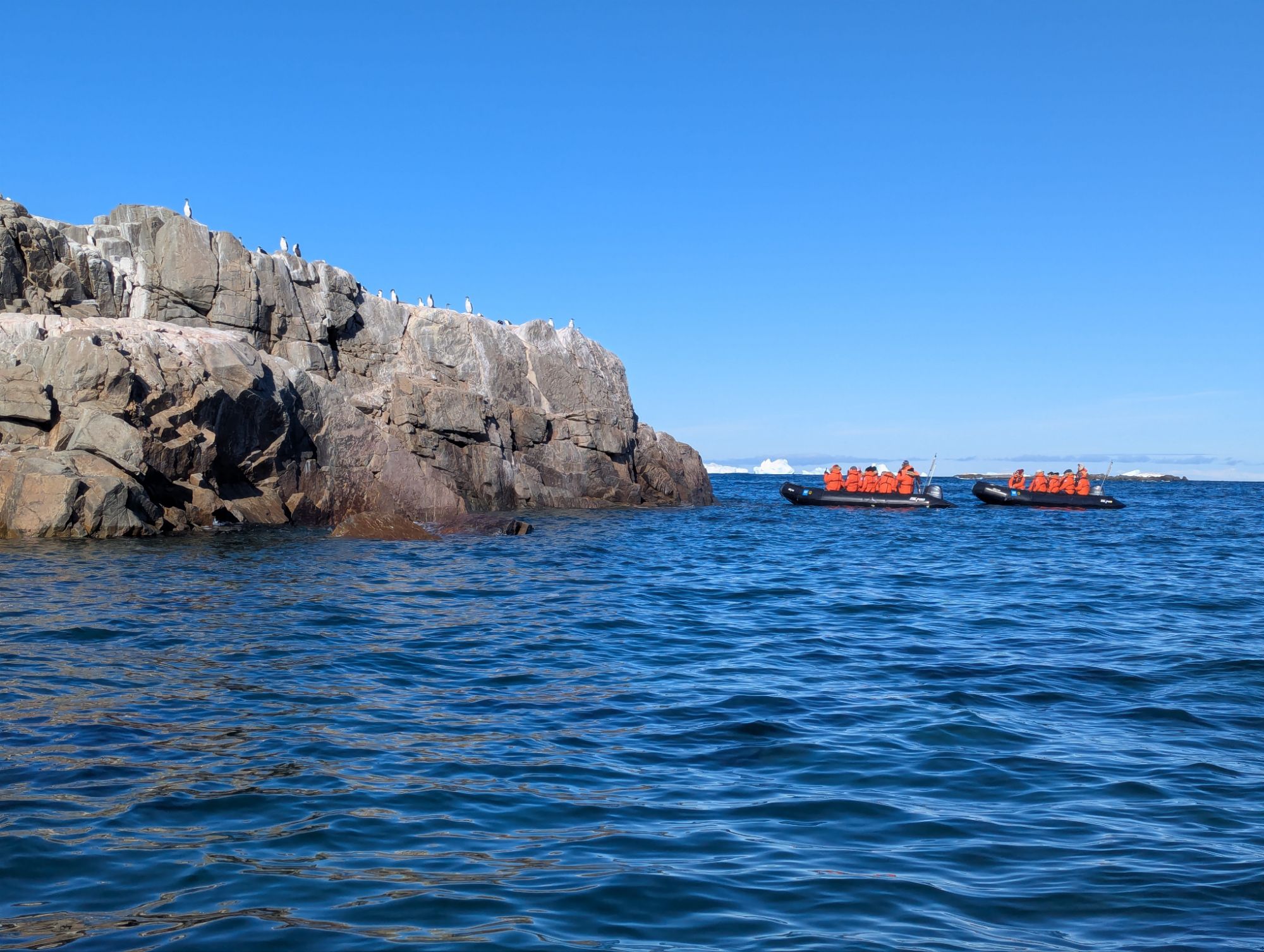
We are preparing for a Zodiac ride to the island followed by a half-mile hike around an area filled with a lot of penguins.
I’m surprised how comfortable the rubber boots are. I always wear two pairs of socks.
As always, we scan out and in when we leave and return to the ship. Everything on the ship is so organized.

Yesterday my sunglasses fogged up. I am trying a new procedure of putting soapy water on the lens and letting it dry. Then I will polish it.
As we loaded the Zodiac, it shifted suddenly. Our guide, Lila, was standing up but didn’t stumble at all. She said it was due to years of riding the New York City subway where she grew up.

Ten of us were on the Zodiac. Lila memorized our names by associating a word with each name. We were Research Rob and Easy Ed.
Lila is also a diver. Yesterday she showed a time-lapse video of the process from putting on a dry suit through diving and returning all of the diving items to storage. It takes about three hours total with fifty minutes underwater. She was taking photos of the plants and animals that live underwater.
A dry suit is designed to keep the wearer completely dry by creating a waterproof seal, while a wetsuit allows water to enter and is warmed by the body’s heat. The dry suit divers go 20 to 80 feet below the surface. Going down they equalize their ears and put more air in the suits.
Red Rock Ridge is notoriously reefy and shallow. Phil was on the lookout for rocks.

We went through a field of brash ice. We heard snap, crackle, and pop as air bubbles were released from the ice.

Light can make it through these small ice pieces so our eyes see them as white. We can stand up on the Zodiacs as long as we ask permission first.
This heart-shaped formation on an enormous iceberg is appropriate for this anniversary day. The formation began to form underwater and then was eroded by waves and splashing. I could see water pouring off of it.

The lateral glacial moraine below has rocks on top of ice carried by the glacier. The rocks are not part of the ground, and there probably is no ground below.

The red color on the land is caused by poop from penguins, birds, and seals. It is possible to tell from satellite images what species are involved and how far apart their colonies are.

Two leopard seals were sleeping on the rocks.

Here we were landing on Red Rock Island.


The next three videos show penguin activity on Red Rock Island. You might have to go to our blog site, rtwstreets.com, to see the videos.
These penguins got spooked and ran back up the hill.
There are a lot of penguins in the photo below. The orange ones are invasive.

See the ship below on the horizon to the left.

As we cruised toward Blaiklock Island, we saw a pod of about twenty B2 killer whales, one of the smallest killer whales. They are looking for food. These whales are particularly yellow, covered in diatoms. That means they have been down in Antarctica for a long time. They will have to travel north to renew their skin. The males have a large fin about six feet high.

There are humpback whales around here, too. See the tail in the photo below. Humpbacks and killer whales are usually amicable.

Here are some seascape scenes that we passed today.


Now we are in Dogs Leg Fjord, so named because of its shape.
We rode a Zodiac to the shore and walked over 500 yards of loose rocks and stones, then up a snow hill.


Antarctic terns were flying overhead. It seemed like they were upset with us.
We found this sea urchin as we boarded a Zodiac to go back to the ship

As we were leaving the island, our guide asked us to bounce up and down to help move the bow of the boat off of the rocky shore.

The deck team checks and services each Zodiac every time they return to the ship.
We always wash our boots when we return to the ship after a hike.

Snow is forecast tomorrow with slightly “fresher” winds.
National Geographic Endurance
This amazing ship was built in Norway and Poland. The contract was signed in 2017. NG/Lindblad paid $135 million, including $10 million for post contract modifications. The Endurance measures 12,700 metric tons. Ship tonnage is calculated using formulas that measure the volume of a ship’s enclosed spaces.

Bathroom suites came made as complete units and installed.

Lindblad received the finished ship in March, 2020, the month that the world closed due to COVID.
The crew had to test the ship and simulate cruises. They would sail on mock week-long cruises, then switch roles and cabins and go out again. With no passengers onboard, the crew had a lot of parties. Eventually most of the crew was sent home and only a few essential people remained.
In July, 2021, the vessel was named and launched. Then the crew got sick. Finally they got in full operation.
The Endurance, the first of two of the same design, was essentially a prototype. The sister ship, National Geographic Resolution, was finished a year and a half later.
The front of the ship has the X-Bow design. This idea came from the Viking longship. About 100 ships with this bow have been built in the world . The Chinese now own the patent. They say that it is possible for us to go quite comfortably through heavy seas. You can go at full speed, and the ship sounds and feels the same as it does with one engine running at rest. We’ll see …

National Geographic Endurance was the first X-Bow vessel to go to a polar region. It is a combo cruise ship and ice breaker. In ice it works almost like an ax.

The Endurance has two engine rooms for fire safety. Two bridges. Two switchboard rooms. The idea is that the ship will always be able to get back to port while maintaining services. The General Electric engines burn the highest grade fuel available.

The ship can direct the same amount of power forward as they can sideways. It can rotate in a circle and maneuver in port without a tug.
Stabilizers near the bottom on the sides are designed like airplane wings to prevent the ship from rolling. They fold back into the hull when not in use. It is possible to use one stabilizer at a time. A gyro-based system automatically senses the roll and adjusts the stabilizers.

All of the external components of the ship including cranes, fire extinguishers, etc., are certified to -25º C/ -13º F.
We have enough items on board to survive on ice a minimum of six days – tents, sleeping bags, food, additional equipment, etc.
Ice radar can tell you the type of ice in front of the ship. There are thermal imaging search and rescue cameras. Onboard seafloor mapping allowed us to go further south for the polar plunge. Some Zodiacs even map the seafloor as they go.
The Endurance has sailed from Greenland to Ushuaia in southern Argentina at 15 knots speed and arrived with more than 20% fuel left.
The Endurance is registered in The Bahamas. According to the captain the days of flags of convenience are gone. A high number of ships are registered in Nassau, Bahamas. The people there are knowledgeable and highly regarded.
Here is the daily report from our ship – https://www.expeditions.com/expedition-stories/daily-expedition-reports/red-rock-ridge-and-dogs-leg-fjord-ed-2025-02-16?hmc_lid=3&utm_source=Triggered&utm_medium=email&utm_campaign=DER.SELF&email_md5=323649af63a8215a85f9923f6a86435f&mi_u=323649af63a8215a85f9923f6a86435f

Leave a Reply