I woke up briefly at 4:30am and saw this sunrise.

We have progressed down to the entrance of Lazarev Bay. We must be a little behind schedule because the first Zodiacs and kayaks won’t go out until 10:00am. They have delayed lunch and dinner by an hour.


Along the way we are passing icebergs as big as our ship.

We just went through an ice field. We could hear the ice chunks scraping against the ship. Brash ice is an accumulation of floating ice made up of fragments not more than six feet across. It is the wreckage of other forms of ice. Occasionally the ship would shudder if we hit something bigger.
They held a kayak briefing for those who wanted to go kayaking. Edward is interested; I am not.
Again this morning there will be four groups called to go on the Zodiacs. The groups are named Gentoo, Weddell, Albatross, and our group, the Humpbacks. There are 35 people in each group. This is a way of managing the flow of people off of the ship.

The air temperature is two degrees lower today at 30º F, but there is no wind or precipitation.
While on the Zodiacs we saw minke whales. They were curious about us. The captain said later that he’d not seen minke whales like that for years, so friendly.


A whale footprint is a smooth, oval-shaped patch of water left behind by a whale as it swims or dives.

Sometimes minke whales will follow the Zodiac. Bubbles from the propeller might create a curtain and attract krill and minkes.
There could be humpback and killer whales around here, but we haven’t seen any. Sometimes a humpback will use the shore or even a ship to corral krill.

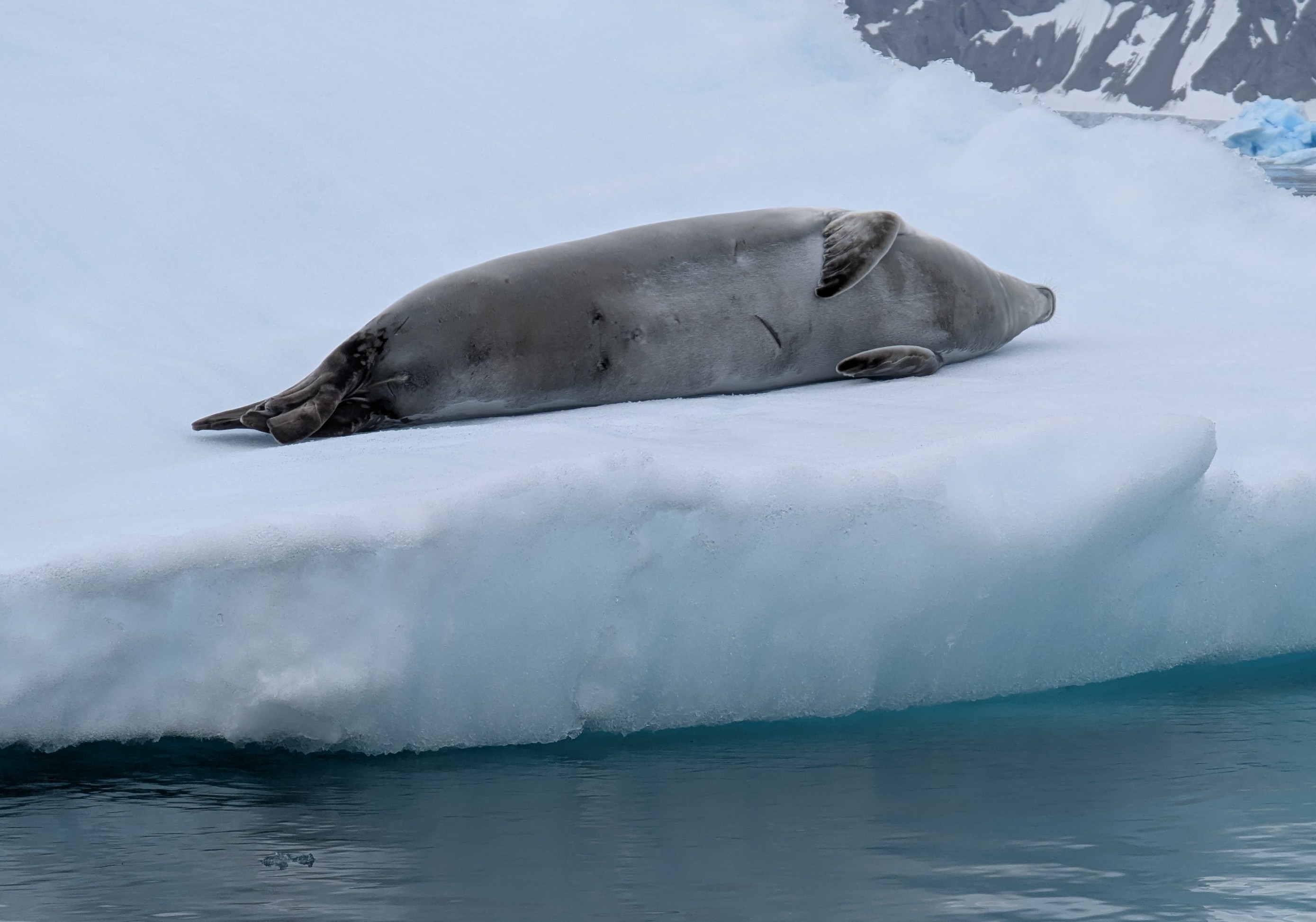
Crabeaters are the most abundant seal in Antarctica at an estimated three to eight million. They are evenly distributed around the continent. They like to be on open pack ice that is moving and breed there. Despite their name, Crabeaters do not eat crabs. Rather, they eat krill, small crustaceans, and sometimes fish and squid. When they molt, they come back a silvery white color.

The scars on this Crabeater are likely from a leopard seal. They spin to get away. 60% of the population has scars. The amount of scarring helps indicate their age. Crabeater seals grow to seven feet long. Leopard seals reach ten feet and are a couple of hundred pounds heavier.
Minke whales are countershaded. Countershading is a method of camouflage in which an animal’s coloration is darker on the top or upper side and lighter on the underside of the body.

Yellow spots appear on the underside of this minke whale. They are caused by diatoms which are algae that are yellow or golden brown. It’s so cold here that there isn’t enough blood flow to the whale’s skin to heal over the diatoms.
There are many different types and shapes of diatoms.

Minke whales grow to 25-30 feet long and weigh about eight tons. There is a type of killer that feeds on minkes.

Weddell seals can be identified by spots on their snout. They are the southern most breeding mammal on the planet. They mostly feed on Antarctic Toothfish (aka Chilean Sea Bass) which is like cod. Weddell seals are relatively solitary and can dive down to 2,000 feet.
Seals and other marine mammals don’t suffer from “the bends” because their lungs can collapse under pressure when they dive deep. This effectively eliminates the air space in their lungs where nitrogen could be absorbed into their bloodstream, thus preventing the formation of gas bubbles when they ascend rapidly. Also these animals don’t breathe at depth like human divers do.
Weddells’ heads seem small in comparison to their bodies. These seals are docile. Researchers are able to walk over, pick up a pup, and the mother doesn’t object.
Pack ice killer whales who hunt cooperatively prefer Weddell seals because they are docile, fat and juicy, and the seals can’t open their mouths very wide.
The yellow stain on the ice below is caused by the diatoms. Krill feeds on them. Diatoms are single cells that can form long chains.

The murkiness of water varies depending on whether a certain species of algae is growing in it. The water is less murky today so we can see whales and seals just below the surface. Our guide said that he has been able to see down as far as 70 feet on a few days.

Crabeaters are a gregarious seal. How do you distinguish male vs female? Look between their fins. Two dots means a female. One dot for the male. If you see a group of seals from a distance, they will be Crabeaters.


Leopard seals have a reptilian smile. They can open their mouths 180 degrees. They can flare their nostrils. Leopard Seals are predators of animals including other seals vs. seals that eat fish.

Leopard seals have spots on their underside.

Polar Plunge
About 6:00pm they organized a polar plunge from the area of the ship where the Zodiacs depart. Edward and I both took the plunge along with about half of the ship, one-by-one. Each person stayed in the water for about 5 seconds.


In Antarctica, diversity tends to increase with depth primarily because deeper waters offer a wider range of habitats and food sources, leading to greater niche availability for different species to occupy. You won’t see big schools of fish down here. Most of the fish in the depths will ambush their prey.
Our Zodiac guide for the afternoon said that he has never been this far south. The captain later commented that it was the furthest south a Lindblad vessel like this has ever been.

Here are some more waterscape views as we leave Lazarev Bay.


Here is a link to the daily report from our cruise – https://www.expeditions.com/expedition-stories/daily-expedition-reports/lazarev-bay-ed-2025-02-15?hmc_lid=3&utm_source=Triggered&utm_medium=email&utm_campaign=DER.SELF&email_md5=323649af63a8215a85f9923f6a86435f&mi_u=323649af63a8215a85f9923f6a86435f


Leave a Reply