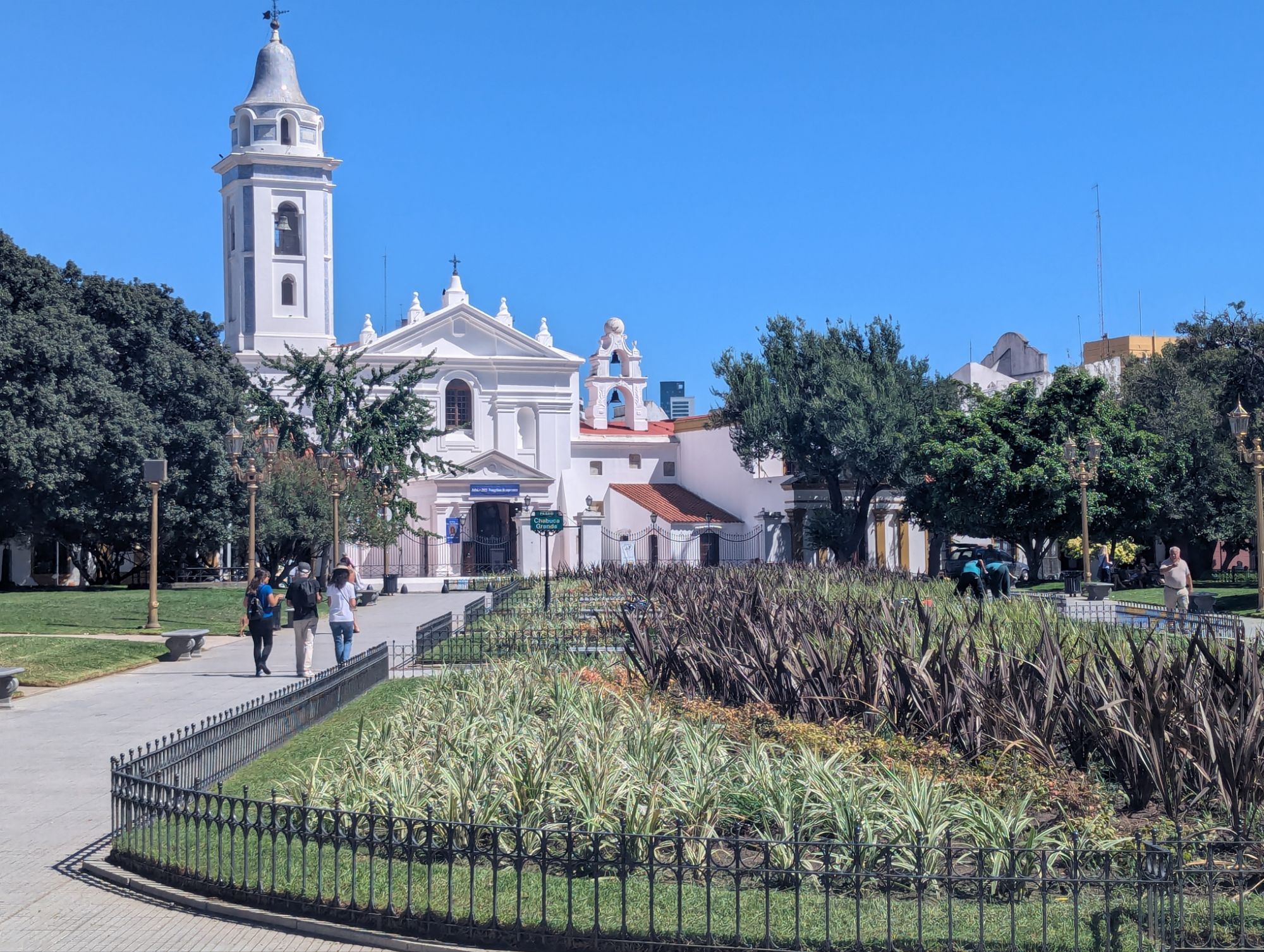
Buenos Aires is located where the Paraná River delta widens into the Río de la Plata and about 40 miles from the border with Uruguay. The city was founded twice, first by Pedro de Mendoza in 1536. It was destroyed in 1541 by its own citizens. In 1580, Juan de Garay founded it for the second time, again under the auspices of Spain. 17 million people total live in the Buenos Aires area, including 3 million in the center city and 14 million in the suburbs. It’s the second largest city in South America after Sao Paolo, Brazil.
Our guide Martin is recovering from the flu. His voice is a bit raspy. I hope we don’t catch it from him. He told us that he met his girlfriend of six years through Tinder. Then on Facebook he discovered that he already knew her sister.
Our first stop is at this 75-foot-tall sculpture called Floralis Genérica (Flower of All Kinds) in the United Nations Plaza. It used to open during the day and close at night like a real flower. However, the sculpture has been broken for months with no date set for repair.


We strolled through Paseo del Rosedal (Rose Garden Walk), a park that has 93 different types of roses and 18,000 flowers in total. A few plants had blooms, but most will bloom the next time in November when spring starts here in the southern hemisphere. There are numerous statues of poets in this garden, even one of William Shakespeare.

Buenos Aires has one of the highest number of bookstores in any city in the world. The most famous bookstore here is called “El Ateneo Grand Splendid.” A theater closed in this building in 1980. Twenty years ago it was converted to a bookstore. In 2019 National Geographic voted it the most beautiful bookstore in the world.

According to Guiness World Records Avenida 9 de Julio in Buenos Aires is the widest avenue in the world. It is 110 yards wide and stretches two miles long. There are six side-by side sections with some narrow green areas in between. The avenue runs from the French embassy in the north to Plaza Constitución in the south.

We have entered Plaza de Mayo. The square is named after the Argentine revolution which began on May 25, 1810.
Casa Rosada (Pink House) is like our White House, except the Argentine president, Javier Milei, doesn’t live here. He lives in Olivos, an area of Buenos Aires about 10 miles from here. Today the president can only serve only one term of four years.
The president’s offices are located at Casa Rosada. The building is used for special meetings, treaty signings, receptions, cultural exhibitions, and official ceremonies. Evita made a speech on the balcony which inspired the song “Don’t Cry For Me Argentina.” The Evita movie with Madonna was partly filmed here. I have never seen that movie and want to watch it when I get home.


With a typically-Italian facade and large interior spaces, the Mercado de San Telmo opened in 1897 to cater to the needs of the new wave of immigrants arriving from Europe. The stalls have since been updated but the internal structure of the market remains the same, with metal columns and beams, so stepping inside is still like stepping back in time. The building was declared a national historic monument in the year 2000.

People here don’t trust the banks. In 2001 the economy collapsed, and the government devalued the currency. Today people hold dollars – in their houses – rather than keep Argentine pesos. Big transactions, such as buying houses, occur in dollars. There are three main exchange rates between the peso and the dollar. The official rate is about 1000 pesos per dollar. The currency is pegged to the dollar. The MEP (Mercado Electrónico de Pagos) rate is about 1150. My credit card uses that rate. There is a Blue Market rate (think Black Market) at about 1,250. Our guide said other rates exist. People get salaries and wages paid as pesos into their bank accounts.
The inflation rate in Argentina is one of the highest rates in the world. This causes the value of the Argentine currency against the dollar to drop quickly and local prices to change often. During the highest periods of inflation some prices changed daily.
According to the source, World Data, during the period from 1980 to 2022, the average inflation rate was 206% per year, and the peak year was over 3,000%. Overall, the price increase was 902.38 billion percent. An item that cost 100 pesos in 1980 cost 902.38 billion pesos at the beginning of 2023.
So as an Argentinian how would you deal with that inflation. You would spend your pesos as fast as you can, or you would try to hold dollars instead which can be difficult to get. In the past individuals could legally exchange pesos at a bank at the official rate for no more than US$200 a month, but I was told that the limit has been relaxed. They can purchase more dollars on the blue market. A tour guide informed me that she is able to hold dollars in her bank account.
The Argentine peso is pegged to the dollar. The official rate has been automatically adjusted down by 2% per month. That adjustment will decrease to 1% per month since 2024 inflation was only 118% and about 40% annual rate in December.
At the end of the day we visited the Museo Nacional de Bellas Artes. They have a collection of about 13,000 works of art including paintings, drawings, statues and sculptures. We saw a few hundred of them
Paintings done by artists such as Degas, Monet, Toulouse-Lautrec, Gauguin, and Velázquez hang on the walls.


I expected Argentine Spanish to be very difficult to understand because I was told that they pronounce some letters and words differently than other Spanish-speaking countries. For example, saying “ll” and “y” more like “j” in some areas and like “sh” in others, or sometimes aspirating an “s” at the end of a word. Apparently they also generally use “vos” instead of “tú”. Other than hearing people pronounce Plaza de Mayo as “Plasa de Masho”, I rarely have noticed these differences and generally feel that I have been able to understand them in our limited Spanish conversations.
Someone complimented my Spanish, I think because I successfully strung together a number of words and pronounced them well. But then I ruined the moment when I responded to him, “Merci!”

Leave a Reply