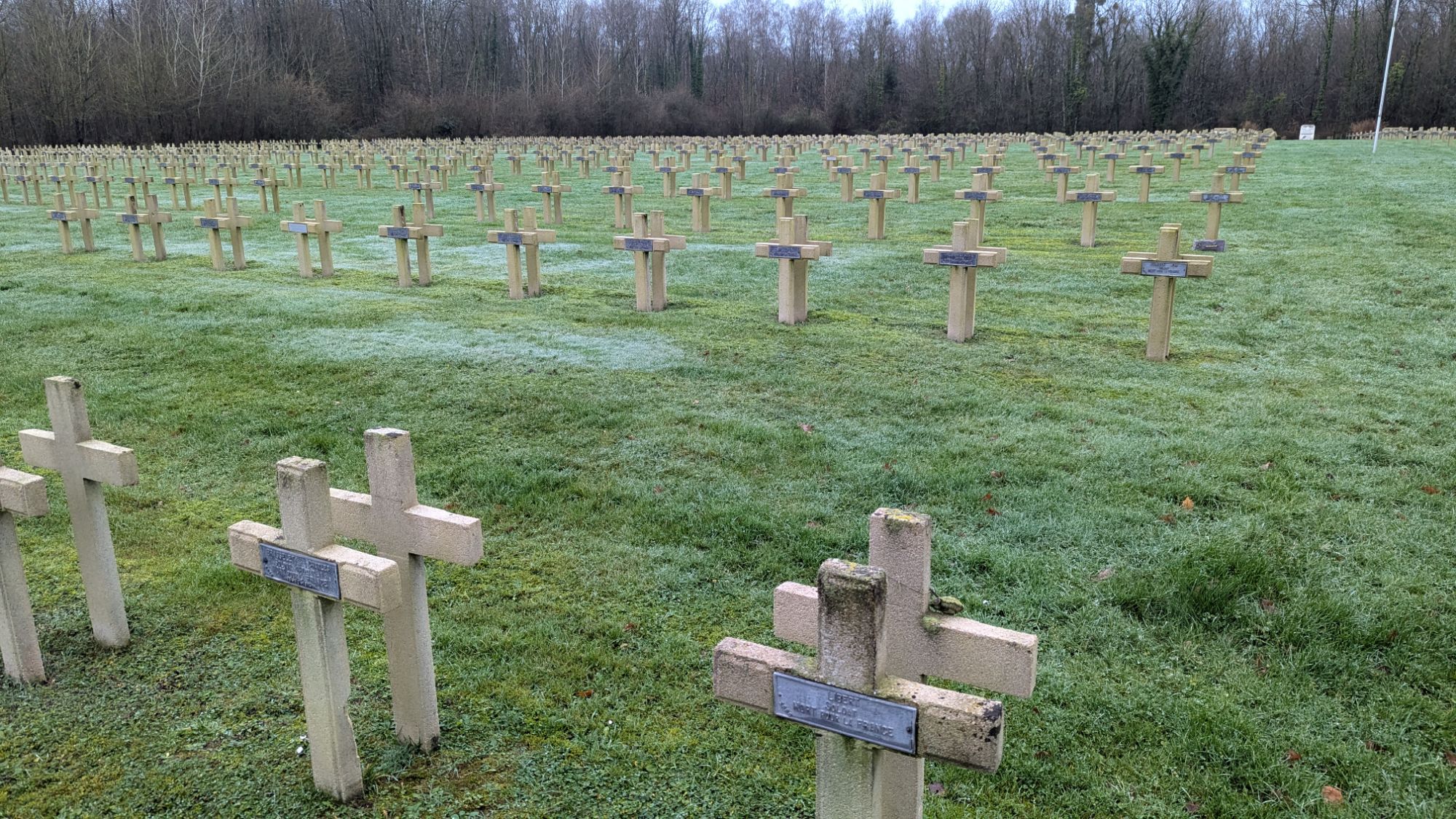
Verdun was declared a city of peace after WWI. They wanted no more war. However, the Treaty of Versailles could actually be considered the beginning of WWII.

Verdun dates back to Roman times. The train station is small but built by famed builder, Eiffel. Quiche Lorraine is a specialty that originated in Verdun.

In the Battle of Verdun, one thousand people died per day.

The fighting took place for 300 days with a total of 300,000 lives lost with many more wounded. The Battle of Verdun had the Germans fighting the French for 10 months.
On February 21, 1916, the first nice day after a snowy winter was considered a reason to start the fight. One thousand cannons shot two million shells on the first day. The French didn’t think that Verdun could be captured since it was fortified. However, there were ten German soldiers to each French soldier.
The city was relentlessly bombarded even though no fighting occurred in the city.
We arrived at Fleury-devant-Douaumont, a village with an original population of 422 inhabitants. A total of twelve villages were impacted and no longer exist today. They are given the distinction of “villages that died for France”.
Today the villages are in an uninhabitable red zone so only new forest can grow. One cannot build or farm as there are too many shells. There are 16 shells per square meter, some spent and others unexploded in the mud. It is estimated that 12 million unexploded shells still lie in the soil around Verdun.

Trench foot was prevalent in WWI as they were standing in water in their trenches.
Verdun was the most fortified city in France and was part of the Holy Roman Empire.
In 1885 after the Franco Prussian War, France felt that they needed protection from Germany and began building two concentric rings of forts around Verdun. The result was 40 forts spaced about 2 1/2 miles apart on the rings.

The largest and most famous fort around Verdun, called Douaumont, was finished in 1914. It was built for 500 soldiers, but it housed 2,000 at one time. It changed hands many time during the Battle of Verdun.

.
This memorial is erected in memory of the victims of the Battle of Verdun (1916). It contains the remains of more than 130,000 unidentified French and German soldiers who fell in this battle. There are 80,000 still missing and it will take 400 to 500 years to get all of them


The carnage of WWI was unimaginable. Shrapnel caused deformations, amputations, and lifelong pain. The field surgeons were unprepared for the tragic results of war.
Gangrene was prevalent. The microorganism that causes gangrene is found in horse manure which was present in WWI. Once gangrene takes hold, amputation is sure to follow.
“Broken Faces” is a term that came out of WWI due to horrific facial deformations caused by shrapnel and burns. In fact, this might be considered the beginnings of plastic surgery.
The Great War was a four-year laboratory with a measurable impact, as perfectly illustrated in the words of a surgeon:
- In 1914, when a soldier was wounded in the knee, he was lost. He stayed for hours on the battlefield and the inflammation spread to the lower stomach and he eventually died.
- In 1915, a multiplication in the number of stretcher bearers enabled the wounded soldier to be evacuated and saved. But his leg needed to be amputated.
- In 1916, we managed to save the man and his leg, but he remained crippled and walked with a stick for the rest of his life.
- Finally, in 1918, we saved the man and his leg, which could bend once more.
Americans hear a lot about the end of WWII in Japan aboard the USS Missouri but not much about the events surrounding the end of the war in Europe known as VE Day.
Eisenhower headquarters was in Reims, France, and Admiral Dönitz succeeded Hitler on May 1 after the April suicide of Hitler.


He would later be tried and hanged as a result of the trials in Nuremberg.
Leave a Reply