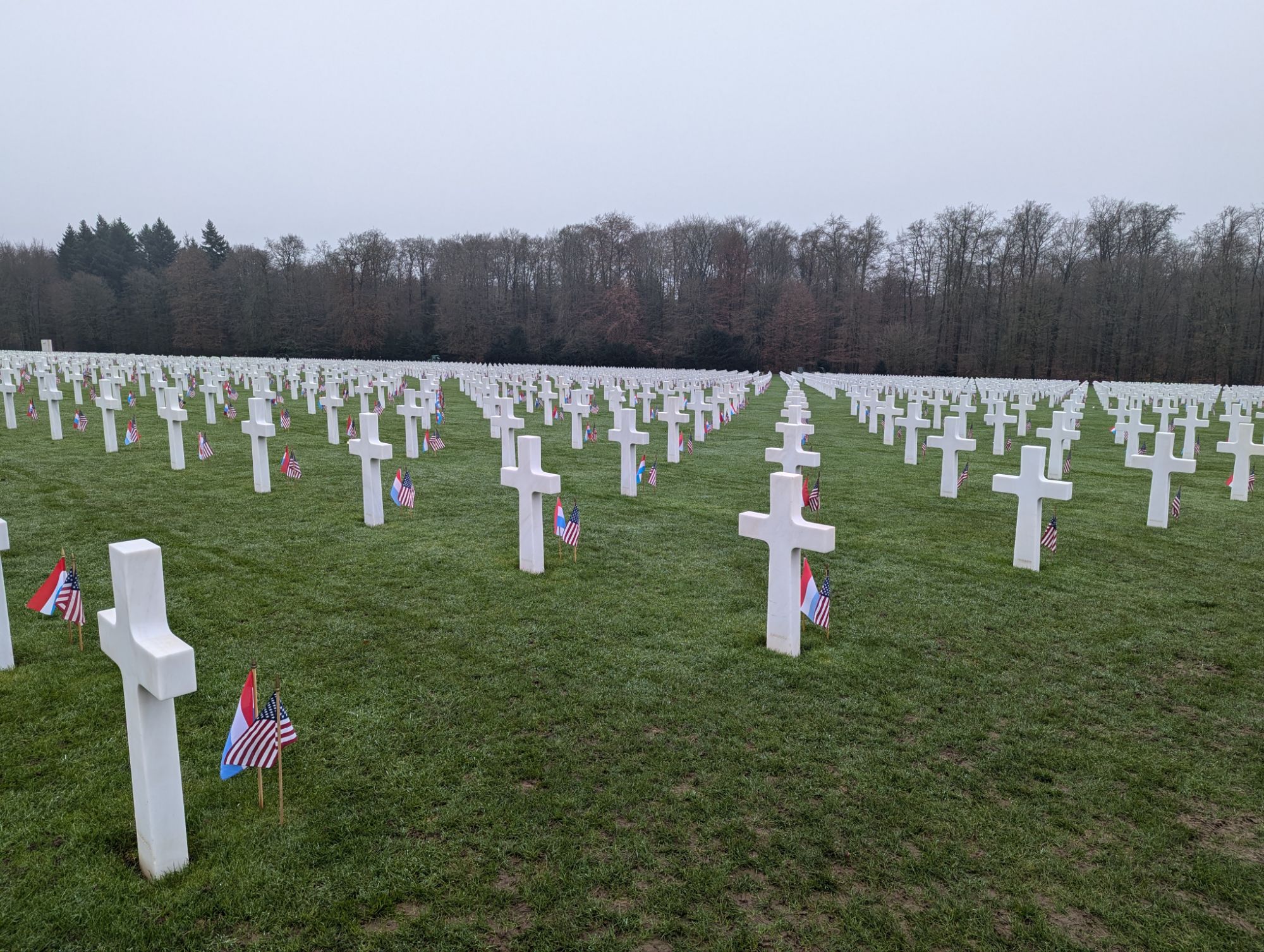
Stewart’s life would change forever on this day in 1944. Read about it here:
AFTER AN UNEVENTFUL NIGHT CAME ANOTHER WARNING FROM CAPTAIN COBB. “HURRY UP TO THE MESS TRUCK AND HAVE YOUR BREAKFAST AND THEN PACK UP YOUR GEAR, BED ROLLS (MUMMY BAGS), BARRACKS (DUFFEL) BAGS, WEAPONS, ETC., WE’RE MOVING BACK”. BY THE TIME I RETURNED FROM BREAKFAST TO MY RESIDENCE, THE GERMAN PANZER TANKS WERE DRIVING DOWN THE STREET IN FRONT OF OUR HOUSE. I STEPPED TO THE DOOR TO OBSERVE WHAT WAS HAPPENING AND GERMAN MACHINE GUN FIRE SHATTERED THE DOOR IN FRONT OF ME. MIRACULOUSLY I WAS UNTOUCHED.

LET ME PAUSE HERE TO SAY THAT THE PERSONNEL OF SERVICE BATTERY RANGED IN AGES FROM 19 TO 38. THE OLDER MEN WERE MARRIED WITH FAMILIES AND PERHAPS THAT EXPLAINS THE VARIOUS ATTITUDES EXPRESSED WHEN OUR LIVES WERE THREATENED. THE FAMILY MEN MOSTLY SAID “WE HAD BETTER SURRENDER OR WE’LL ALL BE KILLED” WHEREAS SOME YOUNGER ONES FELT LIKE THERE MIGHT BE ANOTHER OPTION.
WE HAD HEARD REPORTS OF TROOPS BEING MASSACRED SO SURRENDERING HAD ITS UNKNOWNS. PROBABLY 50 OF OUR UNIT WERE CAPTURED.

HERE WE MIGHT PAUSE TO EVALUATE THE AGES OF FIGHTING MEN. SOLDIERS FROM AGE 18 TO 25 SEEM TO TAKE ORDERS AND RESPOND TO CIRCUMSTANCES MUCH BETTER THAN THOSE 26 TO 38. YOUNGER MEN WITH THE PROPER TRAINING ARE MORE RESOURCEFUL AND SEEM TO DEAL WITH THE SITUATION IMPROVISING AND RESPONDING AS REQUIRED.
OTHER CONSIDERATIONS HOWEVER CAME INTO PLAY FOR OUR OLDER MEN:
IF I AM KILLED I WILL NEVER SEE MY WIFE AGAIN. IF I AM KILLED MY CHILDREN WILL NEVER KNOW THEIR FATHER. I WANT TO LIVE. SO I WILL SURRENDER AND HOPE FOR THE BEST.
SO IT WAS THAT FATEFUL MORNING. THE OLDER GUYS WANTED TO SURRENDER. MANY WERE CAUGHT IN CIRCUMSTANCES WHERE THEY HAD NO OTHER CHOICE. GALLANT STAND DELAYING THE GERMAN ADVANCE. A FEW OF US WANTED TO MAKE THE BEST OF THE SITUATION AND EXPLORE SOME OTHER ALTERNATIVES.
This was not an attack, it was an all out offensive!!
National Museum of Military History in Diekirch, Luxembourg, was an unexpected gem. Our museum guide Frank was a walking, talking library of interesting stories that went beyond statistics and talked about the people who were impacted here and in America.
For example, there was a collective memory in Europe able to grieve loss of life, property and way of life. But those who went back to the States were not able to share their grief. Cemeteries and memorials were made to honor sacrifices of war.
They were rebuilding their lives in Europe: No water, no electricity. Everything was destroyed. All equipment that was left behind was standardized so parts from one jeep could be used on another and they made use of it.
Americans had a 40 % better chance of survival than the Germans who were carried off in horse drawn carts. Paths were narrow so many horses were used in supply lines. Americans had penicillin. However, people with infections died in America due to penicillin going to the military. The war effort sometimes cost American lives at home.
One sad example was having a buddy get hit 15 feet away and not able to get to him due to sniper bullets. He died alone still calling out til the end. The next day, buddy was covered with snow … and one still had to fight in that foxhole with his mound in view. What does one tell his family?


V1 and V2 missiles were used. Hitler promised more wonder weapons were coming. After seeing eight Jets along the front lines, German troops were encouraged by these never seen before aircraft. The jets served to scare Americans (it did) and give hope to Germans!

There are 10,000 foxholes still existing in Luxembourg. In Belgium they have preserved foxholes in Hasselpath.


common on the front line. It’s depth allowed the occupants to fire in standing position and was large enough for them to sleep.


Tree bursts and shrapnel caused many deaths and injuries. The soldiers would cover their foxholes with branches and even logs so it became like a log igloo. Soldiers became as close as brothers or moreso to keep warm.
Luxembourg City was liberated in September, 1944, amidst much celebration only to learn that in December 1944, the Germans were back in full force in the dead of winter. Over 80,000 pictures were taken during the Battle of Bulge.
Patton paraded his army down the street headed toward the front, and people would remove their hats and bow their heads. They viewed it like a funeral procession. They knew that half of them would not come back. The Allies only received winter equipment at the end of the Bulge in late January.
Patton was able to move three divisions in 48 hours to arrive in Bastogne. The generals didn’t think he could do it. (I would often say if Patton could accomplish this feat, I could surely get four young children ready to go in the car.)


Two Medal of Honor recipients are also buried here.


Here is a wonderful story of an individual having a large timeless impact:
Leave a Reply