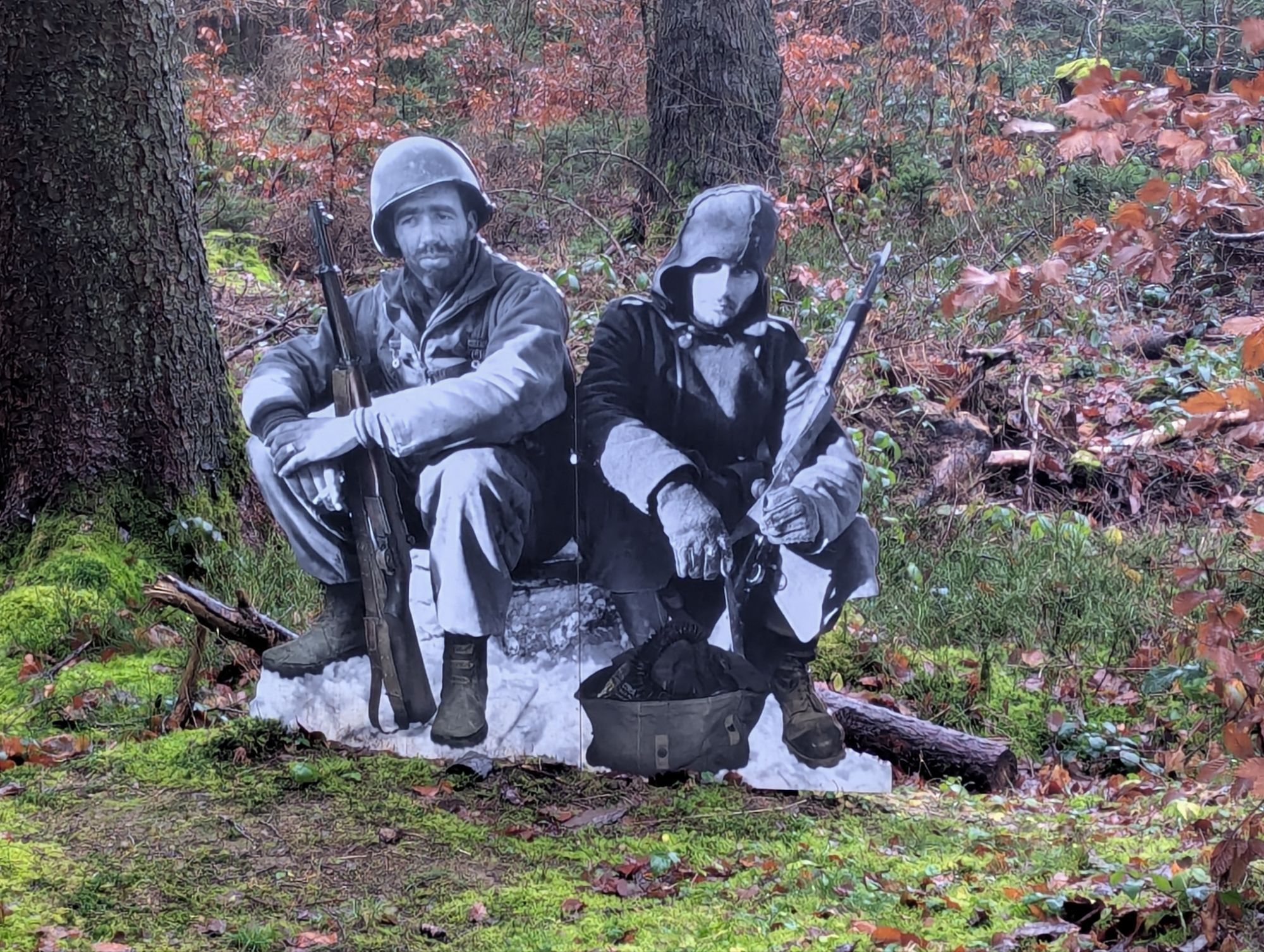
Today marks the start of the Battle of the Bulge @ 5:25am. The Germans did not reach Stewart until the next day. The following excerpt is in his own words in capital letters about where he was and what he was doing on December 16.
OUR POSITION AT THE FRONT WAS NEAR AACHEN, GERMANY WHERE OUR FORCES HAD PENETRATED THE SIEGFRIED LINE (KNOWN FOR ITS CONCRETE TANK DETERRENT STRUCTURES WHICH CAME TO BE CALLED DRAGON’S TEETH). RESISTANCE BY THE GERMAN FORCES WAS LIMITED AND WE FOUND OURSELVES PROTECTING A 30 MILE SEGMENT OF THE FRONT LINES.
OTHER THAN THE 105 MM HOWITZERS (YOU WOULD CALL THEM CANNONS), OUR ARMAMENTS WERE VERY MINIMAL. WE HAD TWO 50 CAL. MACHINE GUNS, ONE ON THE MESS TRUCK AND
THE OTHER ON THE MOTOR POOL TRUCK, A 30 CAL. MACHINE GUN ON ONE OF THE JEEPS AND A COUPLE OF BAZOOKAS. ENLISTED MEN HAD CARBINES AND OFFICERS CARRIED 45 CAL. PISTOLS. SOME OF OUR GUYS DIDN’T LIKE THIS LIMITED FIREPOWER AND FRANK LUEBEN HAD ACQUIRED A THOMPSON SUB MACHINE GUN THAT WAS LATER TO SERVE HIM WELL.
ON DECEMBER 16, 1944, THE GERMAN’S LAST DITCH (FINAL) COUNTER OFFENSIVE OF WW II BEGAN IN THE ARDENNES FOREST OF BELGIUM AND LUXEMBOURG. IT WAS A BATTLE PLAN IDENTICAL TO ONE USED 26 YEARS EARLIER BY THE GERMAN GENERAL VON RUNDSTEDT AND ONCE AGAIN CAUGHT THE ALLIES INTELLIGENCE COMPLETELY BY SURPRISE.
THE PERSONNEL ON SERVICE BATTERY WAS IN BULLIGEN, BELGIUM, BILLETED IN LOCAL RESIDENCES. BEFORE BEDDING DOWN THAT NIGHT, CAPTAIN COBB, BATTERY COMMANDER, WARNED US THAT WE WERE WITHOUT MUCH INFANTRY OUT IN FRONT OF US, SO HE ADVISED US TO DIG FOXHOLES IN THE YARDS FOR OUR PROTECTION, IF NEEDED. WELL, SERVICE BATTERY NUMBERED ABOUT 80 MEN AND I DOUBT IF THERE WERE 20 FOXHOLES DUG THAT NIGHT. THE GROUND WAS FROZEN AND DIGGING WAS PICK AXE TOUGH. THE CAPTAIN’S WARNING WAS LEGITIMATE AS WE COULD HEAR SMALL ARMS FIRE NOT FAR AWAY.
Two divisions who had just participated in the Battle of Hürtgen Forest were tired and war weary. They were looking for some rest and relaxation. There were two green divisions, one being the 99th Infantry Division. Most had not yet fired their guns in battle and were being eased into battle conditions. This “quiet sector” was certainly surprised.
There is a commemoration today in Luxembourg and, once again, being Americans gives us special access to things. We go to the head of any line, are greeted with standing ovations and are waved through any roadblocks … and it doesn’t hurt to have a 100-year-old veteran among our ranks. I am included because my father was in the Battle of the Bulge. Rob could have joined me but the rest of the group is touring the forest with our amazing guide, Joel (which rhymes with Noel).
We arrive and are ushered into a covered tent. It is foggy which is expected this time of year. And it is drizzling. Each seat has a warm blanket on our assigned chair.


The remaining threat for all of these war survivors is all of these freezing rainy commemorations. Joe was the only veteran in attendance today. Long live Joe Landry!
Into the Woods … with Joel.
Remembrance Trail 1944-1945. Schumannseck, Luxembourg, is where American soldiers fought against the German Army between December 27, 1944, and January 21, 1945.
We walked through the historic site of Schumannseck where the deadliest battle of the Battle of the Bulge took place. The German 7th Army entrenched themselves here to protect the southern flank of the 5th Army that was trying to drive toward Antwerp. It took several weeks of heavy fighting WWI style for the Americans to remove the Germans from the Schumannseck pocket. Thousands died.

Americans laid cable wire for communication from the front line to the leaders in the rear and back to the front. The soldiers often had to search for and repair breaks in the wire caused by fighting and the weather. Our 50-year-old guide said that when he was young they would find American wires in the woods and empty spools on the farms. The Germans did not have this type of communication. They had to send runners and decisions were delayed.
Both armies had equipment problems. German soldiers were more appropriately equipped for winter, but their soldiers didn’t have enough equipment. They tried to use American equipment that they captured.

We heard stories of American boots being too small for their feet making it difficult to prevent trench foot. They couldn’t wear multiple socks at a time. Soldiers had orders to remove boots twice a day and massage their feet. Trench foot took out the equivalent of 7 divisions. Winter equipment had not been delivered to them yet, remaining in a warehouse.
Their blankets were really scratchy. One of our tour members recounted that he remembers sleeping with a blanket as a child that was handed down to him by his grandfather. He said it was the scratchiest piece of fabric that he has ever encountered.


The German army had far fewer medics in the field than the American army. German wounded often were put on horse carts, and if they survived the trip, they were treated back in Germany.
Luxembourg Christmas Markets


Leave a Reply