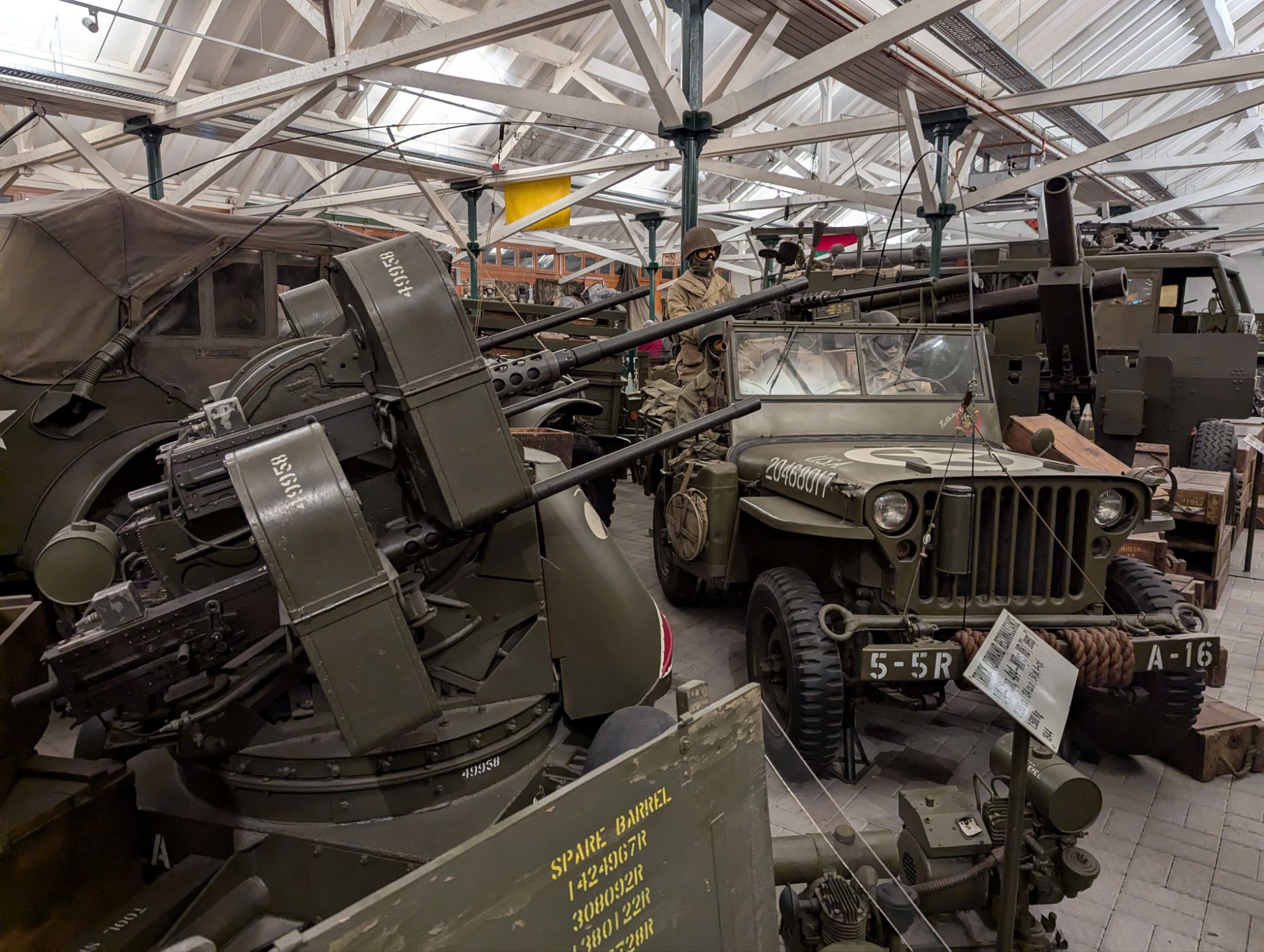
The Bastogne Barracks houses all types of military vehicles from the World War II era. Today it was packed with WWII enthusiasts. Many vehicles were on parade including the only running Tiger Tank.
At the end of the war, all equipment was left behind. It wasn’t needed any longer, and it cost too much to ship back to the USA.
In the first days of the war, the SS and the German army were better equiped. They were strong and had tanks. The American infantry had only trucks.
Tanks are not good for valleys. Big tanks get trapped. The Sherman tanks were smaller and easier to maneuver. They could hide in the fog.
Weather conditions are a part of a war strategy. From January 5 to 31 (January Campaign) the weather was -4ºF in the night and 10ºF during the day … and they were still wearing summer clothing. The winter clothing had not yet arrived.
In fact, Hitler launched his attack by consulting his meteorologist about the legendary fog that covers the Ardennes. He wanted to hinder any air support for this all out ground battle.
Sherman Tank
Throughout the war, 49,234 Shermans of all types were built in the United States of America. They weighed 30.5 tons. Its engine had 350 HP, and its top speed was about 25 mph. It was operated by a 5-man-crew. The medium Sherman tank was inferior to the German “Panther” and “Tiger” tanks. (It only became a match when upgraded with a 76 mm cannon that could defy its adversaries. Equipment evolved throughout the war.)
During WWII the U.S. produced around 50,000 Sherman tanks vs. German production of about 6,000 panzars. Americans discussed whether to make bigger tanks or more of them. It was decided to make more of the smaller one as they could transport more tanks to the front. These smaller tanks could better navigate the narrow European roads.

Tiger Tank


The next two machines were what Stewart encountered on the first day of The Battle of the Bulge.
German Panzer

German Half Track

JEEP
During of the Second World War, the jeep was as famous as Coca-Cola. Following the request of the American army for a light 4×4 vehicle being able to transport 4 soldiers and a trailer of a quarter of a ton, mass production started as soon as 1942. More than 600,000 vehicles were built during World War II, and the JEEP could be found on every theater of operation.
The name JEEP remains an enigma: either a way of pronouncing GP (for general purpose), or in reference to the character “Eugene the jeep” in Popeye, or even an acronym for “Just Enough Essential Parts”.
One of Stewart’s duties was jeep driver.


105 mm Howitzer
The 105mm Howtizers had an eight man crew and functioned as an assembly line. They could fire up to 15 rounds per minute. The shell could travel up to 7 miles.


The 105mm Howitzer was used elsewhere such as on top of Sherman tanks. Sometimes tanks would get out in front of the infantry. This is not good since they must stay buttoned up and therefore have limited visibility.


Joe Landry


Joe Landry was mostly a truck driver on the Red Ball Express. The Allies had bombed the railways to prevent Germany from advancing west. Now the Allies had to get greatly needed supplies to the front. One road went in and another road went back. No civilian traffic. This was a brainchild of Eisenhower and even was a precursor to the Interstate system in the USA which was constructed during his presidency.
Stewart always felt a great kinsmanship to Eisenhower since they were both from Kansas.
Joe had a steel cab for which he was glad as it provided some warmth. Others had a canvas cab. Drivers did not slow down or even stop. There were two drivers and they would slide across the seat. There were no heaters, no power steering, and lots of mud and snow. Many of the drivers were African Americans.
Joe told me a funny story, but he wasn’t sure of its authenticity since he didn’t hear it firsthand. African Americans told the pretty French girls that they were Night Fighters. They took pills to make them dark and they would turn back white when they returned home and stopped taking the pills! Now that’s clever!!
The Allies advanced faster across France and Belgium than was projected. They thought that it would take one year, but they reached their objective in three months. They did not have enough ammo, food, fuel, and especially winter coats. It was hard to get supplies to the front.
The Red Ball Express trucks were too big for Belgian roads. They would off load on to smaller trucks. The trucks would take a load back. Joe transported bodies back. He said that Dachau skeletons were especially horrible and can’t forget the awful smell to this day. He took pictures and had them developed at the PC but those pictures weren’t included when he got his photos back.

Joe’s other brothers were in the Navy and mechanics air corps. His sister was a secretary for the Coast Guard and the other sister worked at the USO.
The Landry family lived one mile from the army base. Joe enlisted and was discharged there. It was customary for the military to give soldiers cab fare to return home. They gave him a quarter, he put it in his pocket and walked home.

Leave a Reply