We have a day of exploring Johannesburg abbreviated to Jo’burg. Our hotel has the longest hallway that I have ever seen.

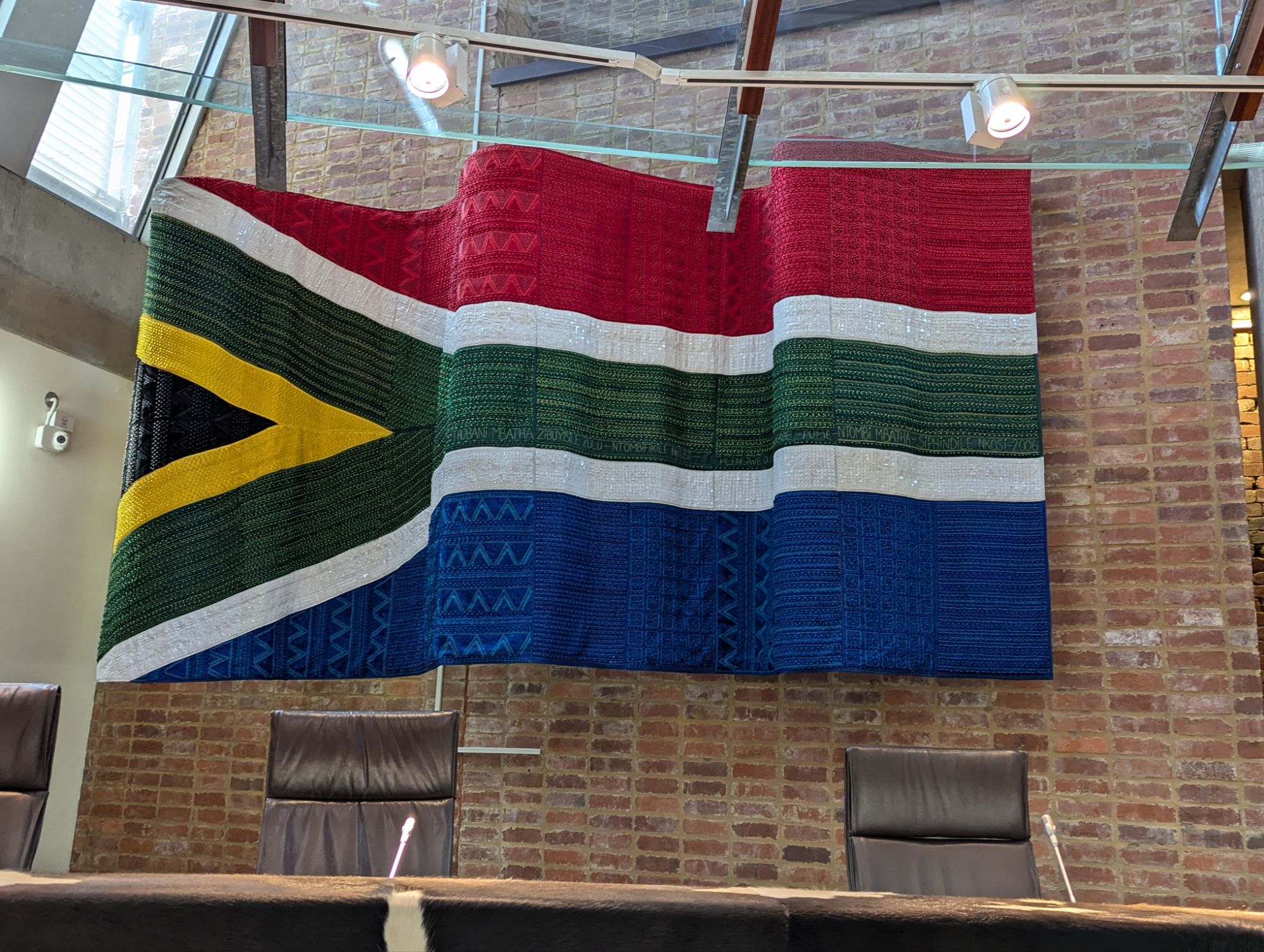
South Africa has three capitals. Pretoria is the administrative capitol, Capetown is the legislative capital, and Bloemfontein is the judicial capital. The Constitutional Court in Jo’burg, deals with constitutional matters such as freedom. Jo’burg is also considered the financial center.

Jo’burg was founded on mining. Coal is used more than nuclear. It is good electricity, but it is expensive. Load shedding has led hotels to invest in solar power to supplement.

The old downtown has been abandoned, and growth is in the outer areas in the suburbs. There was the fear of the unknown and talks of retaliatory violence after apartheid was over. Protests start peacefully yet sometimes end with violence.

Corruption and bribes are commonplace in the police force. There is 34% unemployment. Immigration control is a problem. Pregnant immigrant women come here because if the baby is born in South Africa, it will be given the status of citizen. Most immigrants are coming from Zimbabwe. Businesses hire illegals as it is cheaper. Sound familiar?
This part of the city is falling apart. No one wants to be here, not government workers, or police, or even the homeless and immigrants. It isn’t safe to walk in downtown. Our driver told us not to worry because the windows of our vehicle were tinted. Hotels had to leave because guests were being robbed.
Security is big business here and makes a lot of money. All homes in the suburbs have security fences.
Durban, about 400 miles away on the east coast of South Africa, is a port city where cargo is loaded and unloaded. The roads to Durban are inundated with trucks. Those roads were not designed for that type of heavy use by trucks.
Cargo was once transported by train, but trains are not used anymore. The cables had copper and were stolen for money. 140 miles of cable is missing from the railroads.
There are miles and miles of idle and rusting trains.

Everyone now must take small vans which are more expensive.

Even the traffic lights are not safe. They get knocked over and the wiring is stripped. Traffic lights are cut down for cables. They will come later for the pole. The majority of traffic poles in this area have been cut down so intersections are difficult to cross by car or on foot.

South Africa has a VW plant but the market is shifting to Suzuki. Everyone wants a better car at a cheaper price.
Number Four
Number Four was a prison from 1883 to 1983.
Number Four was the harsh prison in Johannesburg. Many political prisoners spent time here. The entire facility was built for 979 prisoners but had an actual occupancy of 2,207. Conditions were deplorable.


The prisoners were allowed a 30-minute cold water shower once a week.
Isolation took a toll on the mental capacity of a prisoner. They were not allowed to stay longer than 30 days in the isolation cells, but often it was longer. There were no windows and the light switch is on the outside.


Quotes from Nelson Mandela
“It is said that no one truly knows a nation until one has been inside its jails.”
“A nation should not be judged by how it treats its highest citizens, but its lowest ones and South Africa treated its imprisoned African citizens like animals.”
Seth Mazibuko was the youngest prisoner in an isolation cell, and he still lives today. He was imprisoned at the age of 16 and was in solitary confinement for 18 months!!
The National Anthem of South Africa has a very interesting back story. We were told that some of the words were written by a prisoner of Number Four.
Mahatma Ghandi was imprisoned here for 10 months between 1908-1913. Mandela was imprisoned here in 1956 and then again in 1962 before being transferred to Robben Island.

In 1962 Mandela was imprisoned with whites. He was separated from the black prisoners because they felt that he would be talking politics with his fellow anti-apartheid prisoners.

African tribe leaders would gather under the shade of a tree to discuss issues. It was referred to as justice under the tree. That same spirit is the guiding force of the Constitution Court.

In 2004, Number Four became a museum.
Soweto means South Western Township. It used to be completely a slum, but today some sections are much nicer. Many public servants were given opportunities to obtain mortgages on newly built houses. There are still some slum areas.

Today South African blacks have political freedom but not economic freedom. Many of the mines have 99-year leases that were signed during apartheid. They need to be revisited.
We visited the Soweto home of Nelson Mandela. It was an economic zone with lots of people and activities.

Xho language has the click. Mandela’s family spoke this language. Afrikaans is the language of oppression and is no longer taught in school.
Desmond Tutu and Nelson Mandela lived on the same street. They didn’t really know that until later. They were from different time periods, and Mandela was in jail more than he was home. The two of them have the distinction of being Nobel Peace Prize winners and the only ones that come from, not only the same neighborhood but, the same street.


Heading Home


Leave a Reply