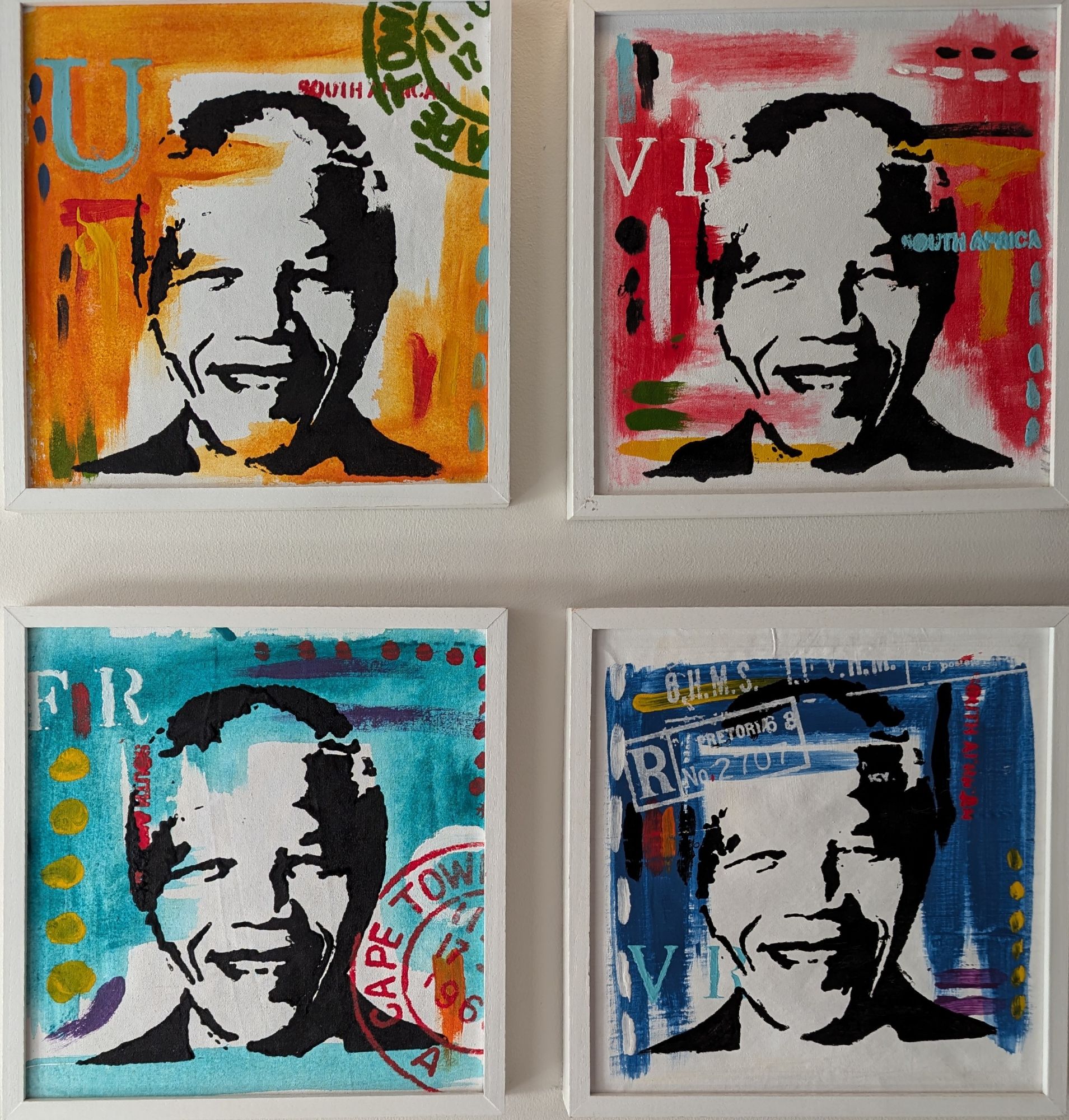

Robben Island is off the coast of Cape Town where Nelson Mandela was imprisoned.

Of Mandela’s 27 years in prison, eighteen were spent in a 2×2 meter cell in section B of Robben Island Prison.


Our trip to Robben Island started with a boat ride.

While giving the safety routine about wearing life jackets, the presenter told us that the little whistle on the life vest was for the dolphins to rescue us.

Our guide at Robben Island was Vusumzi Khube who was imprisoned at the age of 18, so he grew up in this prison. After nine years his sentence was eliminated after Mandela became president.

Even though Peter does not have pleasant memories, Nelson Mandela encouraged his fellow prisoners to come back to tell the story of Robben Island. Many are now tour guides at this UNESCO World Heritage site. Who could tell their story better than them?
A Long Way to Freedom was written by Nelson Mandela in prison. It was hidden, buried, smuggled out page by page.

Eleven different languages are recognized by South Africa. The guards know them all. No political discussions are allowed. Letters to and from the prisoners were read and redacted.
Each prisoner was allowed one visit per year. One needed to make an application, and then it had to be approved. The visit only lasted 30 minutes with a guard sitting beside the prisoner. No talk of politics was allowed.
They were encouraged to engage in sports such as volleyball, football, tennis, and cricket. Spectators could only sit around the parameter on benches as only two persons beside each other.

No hot water. One was allowed to shower for one minute. No bread. No jacket. No pillow.

The temperature was very cold. They only had short pants and short sleeves. They were not allowed to wear shoes inside. Guards had long pants and a jacket.
The prisoners wrote letters to the South African government for 3 years. They also wrote to the International Red Cross about their living conditions which eventually brought about an improvement of their conditions.
Criminals and political prisoners were separated on the island. Political prisoners generally were highly educated.
On March 21, 1960, Robert Sobukwe organized a peaceful protest by NOT carrying a dombas when he came to the city. He walked to the police station demanding to be arrested. The dombas was a pass document that was required to be carried by people of color. This act changed the course of South African history.
Sobukwe was jailed for three years for incitement. At the end of his sentence the government, fearful of his power, rushed the so-called ‘Sobukwe Clause’ through Parliament, to keep him in prison without a trial. For the next six years, Sobukwe was kept in solitary confinement on Robben Island. This Crime Against Humanity was later designated by the United Nations.
How Can a Man Die Better is a book that he wrote. He became very sick and left prison in May 1969. However, he was under house arrest until his death. This year marks 100 years from his birth and remembrances have been scheduled. He said, “I might be in prison, but I will never be a prisoner”.
This is his beautiful epitaph:
“TRUE LEADERSHIP DEMANDS COMPLETE SUBJUGATION OF SELF. ABSOLUTE HONESTY; INTEGRITY AND UPRIGHTNESS OF CHARACTER, COURAGE AND FEARLESSNESS. AND ABOVE ALL, A COSUMING LOVE FOR ONE’S PEOPLE” ROBERT SOBUKWE
Being exposed to the bright sunlight in the lime quarry and dust without any protective gear resulted in eye problems.


Leave a Reply