With their pockets full of profits, Kaintucks or the boatmen on the Trace became a target for armed bandits. These brazen “land pirates” attacked travelers, often at watering holes. The trail’s reputation for danger and lawlessness earned it the nickname “Devil’s Backbone.”
The Indians allowed safe passage through their lands but prior to that agreement, they might attack.
Choctaw were warriors and sided with the French.
Chickasaw sided with the British. Chickasaw were traders and had access to the Mississippi and traded exotic goods from coast to coast and from north and south. They traded for weapons and horses so they gained an advantage.
Chickasaw take care of each other. “If one is hungry, we are all hungry.”
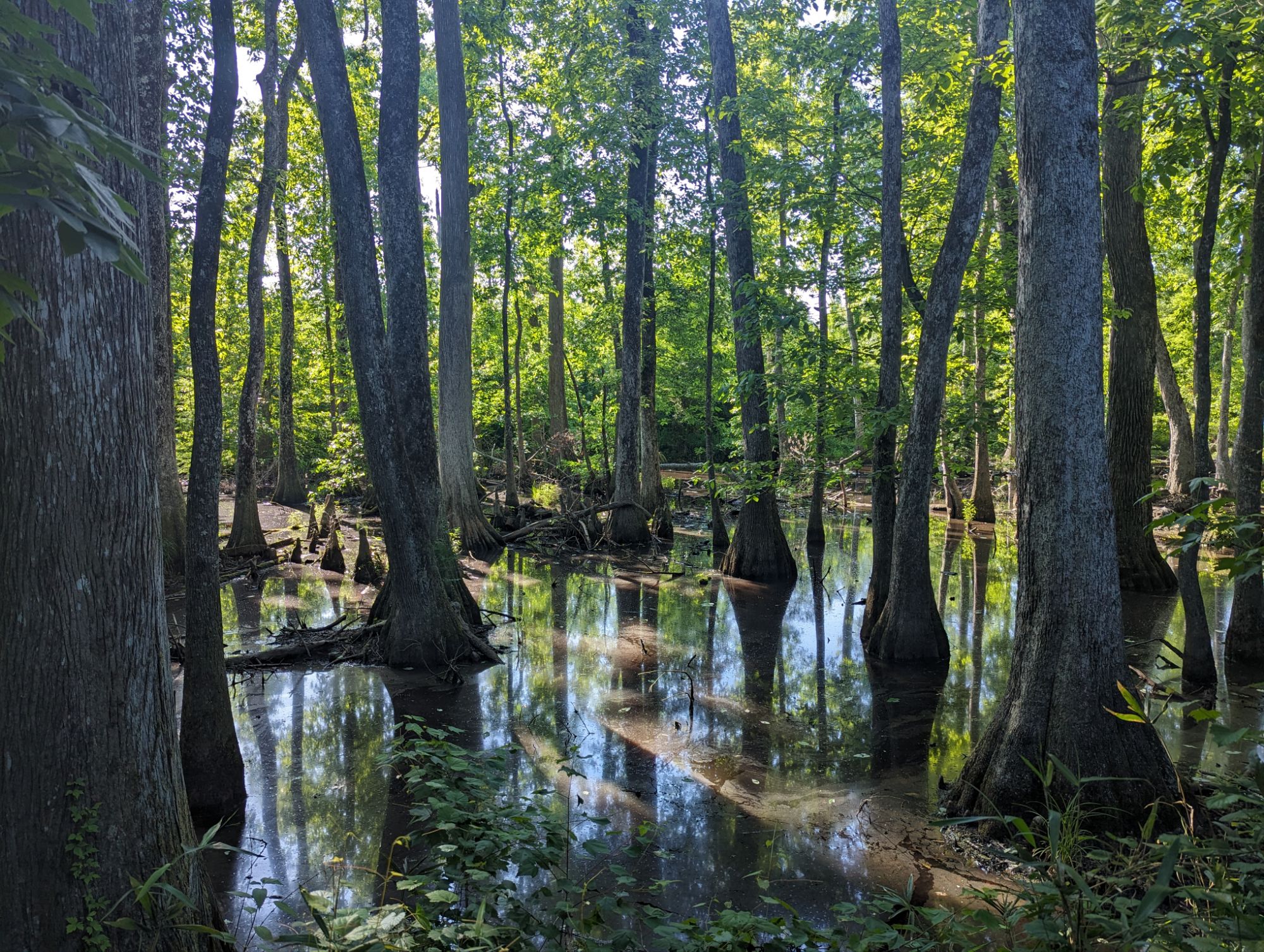
There is an endless struggle between man to alter and change the land and nature to reclaim, restore and heal it.
The Great Eastern Hardwood Forest is now gone. In the past, “A squirrel could travel from Maine to Texas without touching the ground.”
The ivory-billed woodpecker needed large stands of mature trees that provided insect food. As the trees have disappeared so has the bird.
So has our only native Carolina Parakeet, Woodland Bison, and Passenger Pigeons.


Redbud Springs was renamed to honor Tadeusz Kosciusko after the Polish soldier who was instrumental in our Revolutionary War. It’s the only city in America named after him.
Mississippi Civil Rights Museum
African American men, women, and children risked their lives to mount a courageous campaign to win their civil rights in the courts, in the vote, and in the press. They marched for freedom in the streets.
History shows us that American democracy is imperfect. It has not always been just. It has not always included everyone. And yet we struggle, each generation, “to form a more perfect Union.” The Mississippi freedom struggle reminds us that every person has the power to propel us all forward.
The Constitution
By 1776, southern landowners had grown dependent on slavery. They refused to sign the Declaration of Independence until a passage condemning slavery was removed.
In 1787, framers of the Constitution argued over how to count
enslaved people in determining representation and taxation. The North, with fewer than 50,000 slaves, did not want to award congressional seats to southerners based on a population that included about 650,000 slaves, Southerners objected to being taxed on population and property. The resulting compromise counted slaves as “three-fifths of a person. The compromise created a flaw in the Constitution. The slavery-inflated number of seats gave southern congressmen power and influence in Washington.
The Thirteenth Amendment
Congress outlawed slavery nationwide by passing the Thirteenth Amendment on January 31, 1865. The amendment passed with intense lobbying by President Lincoln, whose Emancipation Proclamation had freed Confederate slaves during the war.
After Congress passed the amendment on January 31, 1865, three-fourths of the states (27 of 36) needed to ratify it before it could become part of the Constitution. Mississippi’s economy was built on slavery and the state had the largest enslaved population in the country at the start of the Civil War. On December 5, 1865, the state legislature voted against ratification, becoming one of several Southern states that refused to endorse the Thirteenth Amendment. Ultimately, the amendment received enough votes from other states that it was ratified the following day despite Mississippi’s opposition to the end of enslavement.
Update on the Thirteenth Amendment
Almost 130 years later, in 1994, a clerk in the Texas Legislature named Gregory Watson discovered that Mississippi still had not ratified the Thirteenth Amendment. He notified each of the Black members of the Mississippi legislature and sent them a draft of a resolution that Mississippi could adopt in order to rectify the situation. On March 16th of the next year, the Mississippi legislature reached a largely symbolic vote to unanimously ratify the abolition of slavery in the U.S.—becoming the last of the eligible states to do so.
After the vote, however, Mississippi state officials failed to send the necessary documentation to the federal register, so the ratification was not formally filed as required. Nearly 20 years later, in late 2012, two Mississippi residents discovered that the ratification was not yet official and notified the secretary of state. Several weeks later, the required paperwork was filed, and Mississippi’s ratification of the Thirteenth Amendment was legally recorded on February 7, 2013.
The Fourteenth Amendment
In 1868, the Fourteenth Amendment entitled African American citizens to equal protection under the law. Southern states had to ratify the amendment to gain representation in Congress. Blacks would hereafter be counted as full citizens in determining how many seats each state would receive in the House of Representatives. But when Jim Crow racism, codified by the 1890 state constitution, illegally barred blacks from voting, the formula once again enabled white southern politicians to gain undue power in Congress.
The Fifteenth Amendment
The Fifteenth Amendment, amendment guaranteed that the right to vote could not be denied based on “race, color, or previous condition of servitude.” The amendment complemented and followed in the wake of the passage of the Thirteenth and Fourteenth amendments.
The issue of slavery was the most debated topic in Congress since the formation of our nation. And it continues today


Jacksonians, and for that matter, Mississippians, say that they are first on the list of bad things like crime. (Jackson has the highest murder rate of any U.S. city and fourth in the world behind Tijuana, Acapulco and Caracas. They are last on the list of good things like education.
A Final Word
Faith is taking the first step when you don’t see the whole staircase – Dr. Martin Luther King, Jr.
Leave a Reply