We said goodbye to over half of our mates. The rest of us will explore sites around Hobart.
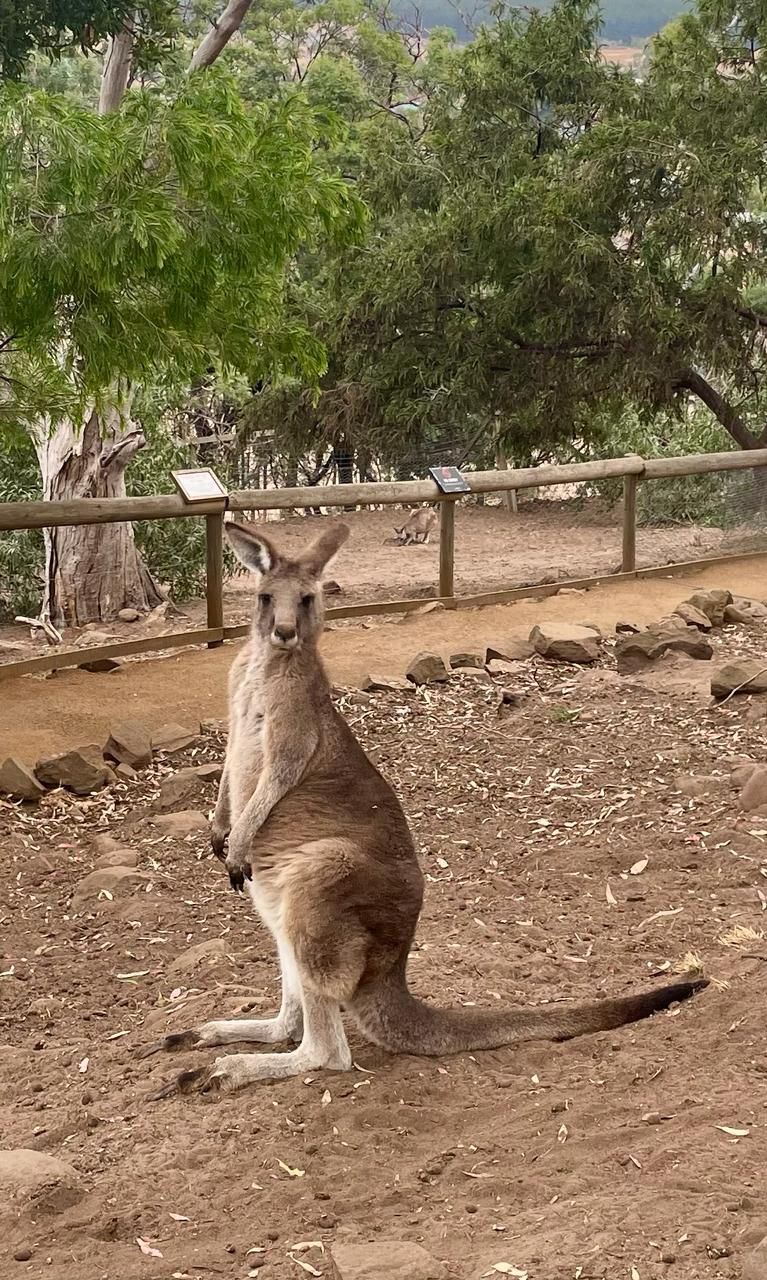
Tasmanian Bonorong Wildlife Sanctuary houses native wildlife. Bonorong is an Aboriginal word that means native companion. They rehabilitate animals and release them back to the wild unless they are unable to do so or are non-native. They get 17,000 calls per year.


There is a sulphur crested cockatoo that is 110 years old. They normally live 150 to 200 years. He came to the sanctuary as requested in his owner’s will!


Wombats are territorial, burrowing marsupials that eat dry grasses. They can run up to 30 km per hour.
There is a hard plate on their butt covered by fur. When pursued by a predator they will run into their burrow and close off the opening with their butt.
One of the problems plaguing wombats is mange. Mange is a burrowing mite that gets under the skin and takes their nutrients. They have come up with a way to apply a solution on the body by putting it at on the roof of the burrow entrance. When they enter, it is applied.
Marsupials have a hard time regulating their temperature. Their square poo is a territorial warning and is stacked up. At about two years, overnight they turn or switch or changeover and will become aggressive. Time to leave their mother and start their solitary life.
The Tasmanian Devil has a guttorial snarl. The early explorers named them because when provoked, the red blood vessels dialate in the ears resembling red devil horns. Also their eyes are red at night.

Tasmanian Devils are nocturnal but often diurnal in captivity. They have poor eyesight and can only see one meter. They have 42 teeth and a very strong jaw. They have a great sense of smell. Tasmanian devils aren’t very fast at 8 miles per hour. A chicken travels at 9 miles per hour so the devils aren’t good hunters. They are more of a scavenger.


One time a young school group was observing a Tasmanian devil here, and a big bird flew into the enclosure. The devil literally tore it apart in front of them. Some children ran away traumatized; others were engrossed in the circle of life.
Tasmanian Devils are solitary but sometimes are found in a group. The life span is 3 to 4 years, but they can live longer in captivity.
In 1996 tumors were found on the face of a Tasmanian devil that were cancerous and contagious. The tumors eventually grow so large that they cannot eat. These are only contagious to other Tasmanian Devils. Ninety percent have been wiped out due to the tumors so their status is now vulnerable.

They are hoping to develop a vaccine. Promising research came out of the COVID vaccines related to this cancer.
Looping is something that Tasmanian Devils do when distressed such as too many smells. Sometimes the loop is big and sometimes it is small. The creator of the Tasmanian devil cartoon observed one in a zoo that was obviously stressed. He thought that it was natural behavior.

Many of the rehabilitated animals are soft released on a large property to ease the adaptation. They come back to the sanctuary until they are ready to leave permanently.
Next we are off to Richmond located in the Cold River Valley. This is one of the oldest communities in Tasmania and was a place to house convicts on their way to the prison in Port Arthur.

Richmond also has the oldest post office, bridge, school, and jail all built by convicts as evidenced by large bricks. They don’t make them like that today.


Poomuseum
We went to the quirky Pooseum which is the world’s only museum about poo. The director was overly enthusiastic about her work. She talked to us for about 15 minutes. She focused on penguin poo and showed us some startling videos. She got into poo (ha) when she was looking for interesting work.
We learned that it is normal for people to poop between 3 times a day to three times a week. There is one bird that poops 50 times a day and a snake that poops annually. That is more than we needed to know about frequency.
There were lots of displays of different shapes and sizes of poops that had signs that said DO NOT TOUCH…like we needed to know that.
Here are a few other things that you might learn:
- how dung is used to produce electricity (Could this be another answer to renewal energy, right?)
- how bats avoid soiling themselves (Being upside down would create problems)
- why you shouldn’t walk barefoot on a tropical beach (We are headed to Tahiti so this is good to know)
- how driverless cars can become disabled by bird poo (Can you imagine telling your boss why you are late to work?)
- why some beetle larvae have a telescopic anus. (Ok. Maybe I didn’t need to know about the last one but I must admit that I was curious.)
When asked by our fellow travelers about our experience, I said, “It was kind of crappy.”
Here is a classic Evan joke appropriate for this post: A crocodile dad took his children out to teach them how to hunt. He said, “I know a good place where tourists go swimming.” They circled the scared tourists for a while and then ate them. “Dad, why do we take time to circle the tourists?” “Well, son, they taste better without their poop.”
In Tasman National Park, there is a spot called Devils Kitchen. Rough seas crash into the narrow rocks and produce lots of mist that looks like steam … but not today!!

Port Arthur functioned from 1830 to 1877 and processed 2,500 convicts. It had a thriving industry making over 200 boats, making bricks, and cutting stone. Quality and quantity of their wares sold at cost price. Others couldn’t compete.
Eaglehawk Neck is the name of the narrow isthmus leading into the Tasmanian Peninsula where the convicts were kept at Port Arthur. The peninsula was a natural prison. Its deep natural harbor allowed for transportation of convicts and goods. People in Hobart did not want convicts in their backyard.

A dog line was created and 18 chained up ferocious British bulldogs were ready to attack or at least warn the guards by barking. Dog houses were made from barrels. Some dogs were on rafts extended into the water lest a convict tried to wade around. Most people didn’t know how to swim … and even if they did, rumors circulated that the sea was shark infested.

A convict named Billy Hunt killed and skinned a kangaroo. He wore the pelt and hopped along the dog line. The hungry guards thought that it was a kangaroo and shot him in the butt. He was found out and received 150 lashes.
Timber was the big industry supplying everything from broom sticks to building whaling ships. The world’s tallest trees were here. Some men were on chain gangs and got the raw materials. Murders and assaults were a possibility on the chain gangs as they were swinging hammers and axes.

Other men learned a trade and made something with the raw materials. Trades were carpenter, tannery, bookbinding, and cooper. Coopering was very important and highly skilled trade since there was no plumbing.
Convicts were sent here as a punishment for refusing to work, or continuing to commit crimes.
A sentence was seven years. After that time, one was awarded a plot of land.
Juveniles were brought to Port Arthur and originally housed with the adult criminals. Age nine was the youngest. In Britain, age seven was known as the age of responsibility and carried the same penalty as adults. Pont Puer Boys Prison was built separately for them because they learned more about a life of crime from their adult peers in jail.
The Island of the Dead has 1,100 graves on it. Convict graves were not marked. They were to be anonymous. They couldn’t afford headstones anyway. The military and their families were buried on the high ground.
Life was hard for all people living in early Australia. Ironically, the death rate in Port Arthur was the same as elsewhere. TB was rampant and around 70% had scurvy. Gardens with potatoes, turnips, and cabbages brought an end of scurvy.
Penitentiary
The Penitentiary was originally a granary. Convicts actually built their own prison out of 750,000 bricks. There were no horses or oxen.

Feeding convicts was a logistical nightmare. What works in London won’t work on the other side of the world. No one can grow wheat in Tasmania. Not much water flows through for a water wheel. Prisoners had to work the treadmill instead. It was like a never ending staircase. Tread Wheels were the worst punishment.
It took 48 convicts who walked 15 minutes on and 15 minutes off for 12 hours per day. Eventually, they became incredibly fit, and it was less of a punishment.
Rooms in the Penitentiary were only for sleep. The best rooms were on the second floor. The third floor was the dining room, school and library. Crime fiction novels and trade manuals were the most popular titles.
The prison was closed in 1877. Bushfires destroyed many buildings in the 1890’s. In the 1930’s preservation began. In 2012 a stabilization project began with
HeliBar hugging the building to stabilize this structure.
There were 200 hangable offenses in England. Three fourths of the convicts had committed theft. Some convicts may have been better off than their life before. Show up for work, and keep your head down. When a convict was freed, often he would employ convicts.
Punishment is a certainty; Reward is a possibility.
Modern Prison Philosophy:
- Discipline and Punishment
- Separation or classification
- Moral and Religious Instruction
- Training and Education
This nondenominational church had 600 to 1000 convicts in attendance. There was a curtain around the non convicts so that they wouldn’t stare at the others. The Wesleyans were the first to serve. When a nice house was built, the Anglican priest came, but he didn’t want anything to do with the convicts and his sermons were about bashing Catholics. There wasn’t an uprising, but Catholic convicts were upset.
The Commandant’s House guide seemed reluctant to give us a tour because we were five minutes late despite being the only ones there! However, she finally agreed. She referred us to small detailed drawings to note changes to the house throughout the years. I would come close to see what she was pointing out. When she would turn around, she looked shocked and told me to stand back and that I was too close to her. She did this several times. I wanted to say,”Well, you keep asking me to take a look!” I think she needs to find a new profession.

In 1996, something tragic happened here. A gunman calmly ordered coffee and then opened fire at the Port Arthur Historic Site. Thirty five people died and nineteen others were injured. It was a big shock. The Prime Minister cried on TV and said no more guns. Everyone was traumatized and agreed. They had a buy back program. No massacres have occurred in Australia since then.


There is a little place on the peninsula named Doo Town. Everyone has named their home with the word Doo in it such as Doo Drop In or Doo Right. What would you name your home?


We were told that this view looked like the outline of Tasmania. Evan says No. I think that it looks more like O-H-I-O!!
Leave a Reply