We stopped in Scottsdale at the best bakery in Tasmania, according to Evan. This is the place to buy the award-winning scallop pie. Evan told us that we could buy something for lunch. I am not sure that Rob’s cream and jam filled croissant is a good candidate for that.


Aboriginals have many different tribes which they refer to as countries. There are 300 different “countries” in Australia mostly clustered around the north and Perth. There are nine in Tasmania.
The Aboriginals use firestick farming. This flushes out the game for hunting. It also concentrates the game again as they return to eat the developing new shoots. This is how they control where animals go as opposed to using fences. This practice has resulted in fire-tolerate plants. In fact, there are many plants that need fire to germinate.
Today there is no forest fire prevention. There is no back burning. A closed canopy is a recipe for fast burning wildfires. An open canopy is a slow burn. There isn’t enough manpower.
When the Europeans arrived, they brought germs, guns, and steel. The aboriginals were slaughtered in government sanctioned killing by forming a line called the Black Line that stretched across the settled districts and moved south, pushing the local Tasmanian Aboriginals onto the Tasman Peninsula where they could be rounded up. They actually just took their land from them.
There is much generational trauma for the Aboriginals. Sugar, fat, and alcohol were introduced. Prior to that time, their consumption of sugar was equivalent to a Snickers bar per year. Alcohol fetal syndrome is prevalent in newborns. They don’t have a lot of support or stepping stones to get schooling. Many dry communities exist to help combat alcoholism.
At one time the Aboriginal children were taken from their families to attend boarding schools and learn a trade. In actuality, they were slave laborers. Also, they were given religious training. This occurred until the 1960’s. They are referred to as the stolen generation. The movie Rabbit Proof Fence is a true story of Aboriginal children being taken from their homes but escaping three times.
Evan wasn’t taught anything about Aboriginals in school, only British and Australian history. I think that the same is true in the United States as we didn’t learn about American Indian history either. Today at least the schools celebrate Cultural Appreciation Day in Australia.
Uluru on mainland Australia is only sacred to about 250 people. It isn’t like an Aboriginal mecca.
They have stories about creation which draw upon their ancestors and how to look after the land. In fact, when a child is born, the mother may have had a dream or seen an animal during her pregnancy. The child was not to hunt it and make sure that it was cared for. Everything was a food source or part of an ecosystem.
Songlines were Aboriginal walking routes that crossed the country. These routes linked important sites. Songlines were used to teach kids how to survive as they traveled and gave directions on where to find water and food. Songs are a good way to remember things. As the white men spread across Australia, they established farms and put up fences. These barriers prevented Aboriginals from traveling unimpeded, and songlines were no longer used. Much of that information is lost. They BELONG to the land. Europeans OWN land.


St. Helens is famous for their gummy shark. Rob and I shared this regional delicacy. It lacked the flakiness of fish and chips but was interesting.


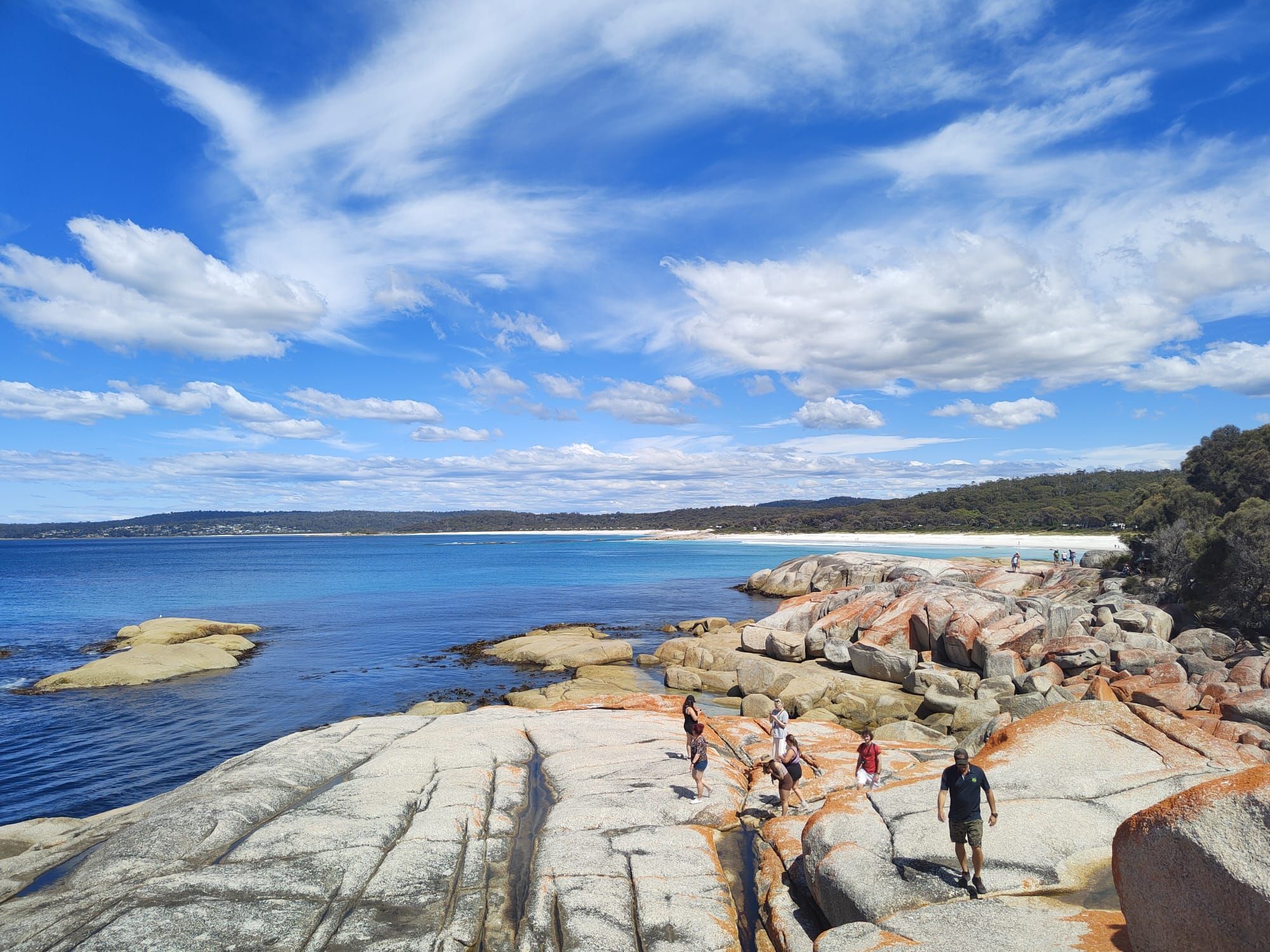
In 1773 a sea captain observed the fires of Aboriginal people on the beaches and named it Bay of Fires. Many people think that it is called that due to the red lichen on the massive rocks.


Cozy Corner North was the goal of our hike at the Bay of Fires. We packed our “swimming costumes” and frolicked in the cold waves.


Grey nomads is the term for traveling retirees. They are able to camp in designated campsites for 28 days for free. I guess that we are grey nomads minus the camping!! A sleeping bag is called a Tassie Tuxedo in Tasmania.
Aboriginal women were good swimmers. They would gather food from the sea while the men were out hunting on land.
As a teenager in the 1800’s, Wauba was one of many Aboriginal women kidnapped and enslaved by sealers and whalers for sexual partners during the European colonisation of Tasmania. She later married one of those sealers.
Three of them were on a sealing vessel when a squall appeared about 1 mile off the coast of Bicheno. The boat went under. The two men were poor swimmers. Wauba could have swum ashore, leaving them to drown, but she didn’t. First, she pulled her husband under her arm – the man who had first captured her – and dragged him to shore. Then she swam back out to the other man, and brought him in as well.


Little Blue Penguins can dive up to 100 meters and hold their breath for two minutes. They make 500 to 600 dives per day. These penguins store food in their neck so it forms a bulge. They travel 25 miles to feed.
While at sea, they are able to shut off half of their brains and take micro naps. They only sleep four minutes on land. After swimming all day, the penguins come ashore at night to their burrows. They are socially monogamous and sexually promiscuous. They sound like a squawking dog.
Little blue penguins can jump off the height of a three story building, but they don’t always land on their feet.

My favorite is when a fellow traveler asked what that red bellied bird was. And without a pause, Evan says, “Why, that’s a Tasmanian red bellied bird!!” Haha! I don’t think they eat those…they’re endangered!!!
Leave a Reply