The Sounds in New Zealand are actually misnamed. They are fiords. Fiords are carved out by glaciers, and sounds are carved out by rivers. Instead of renaming them all, they just batched the 14 Sounds into the Fiordland National Park and kept the names. Fiordland National Park was declared a UNESCO World Heritage Area in 1986 and makes up of 5% of New Zealand.
GQ photo shoot in Milford Sound
Milford Sound was named after the birth town of Milford Haven by John Grono from Wales. He was trying to escape bad weather in 1812.
Mitre Peak is the quintessential picture from Milford Sound. Some have called it the Eighth Wonder of the World. The top is slightly obscured by a cloud.
The water is very deep, up to 600 feet in places.
The fiords in the north are the most spectacular. They are in the Roaring 40’s which is experienced in the latitudes between 40-50 around the world. There are the Furious 50’s, and the Screaming 60’s. Winds become greater the closer that one gets to the poles.
Each fiord has its own microclimate. Female sand flies are looking for a blood meal. A Māori legend says that sand flies were created by the gods to prevent people from staying in this beautiful place. Keep moving!! Eucalyptus trees are not native but repel sand flies.
These are scars from tree avalanches, not waterfalls. It takes around 150 years to establish green growth once again. Trentepohlia, a red algae, begins to grow, followed by fungi, then moss and lichens. These eventually make a thin layer of soil and tree seeds start to germinate.Tree avalanches happen when a tree starts to go, and it takes the rest with it because the soil is shallow on top of rock, and all their roots are interconnected.After a tree avalanche, there is a tsunami in the water. It can produce winds up to 130 miles per hour that strip the leaves from the trees that remain standing. No more photosynthesis.
New Zealanders went to Canada to learn more about avalanche prevention. They have workers that keep roads open every day by clearing branches, rocks, etc..
Seals, dolphins, penguins, and whales can be seen in Milford Sound. We saw the first two.
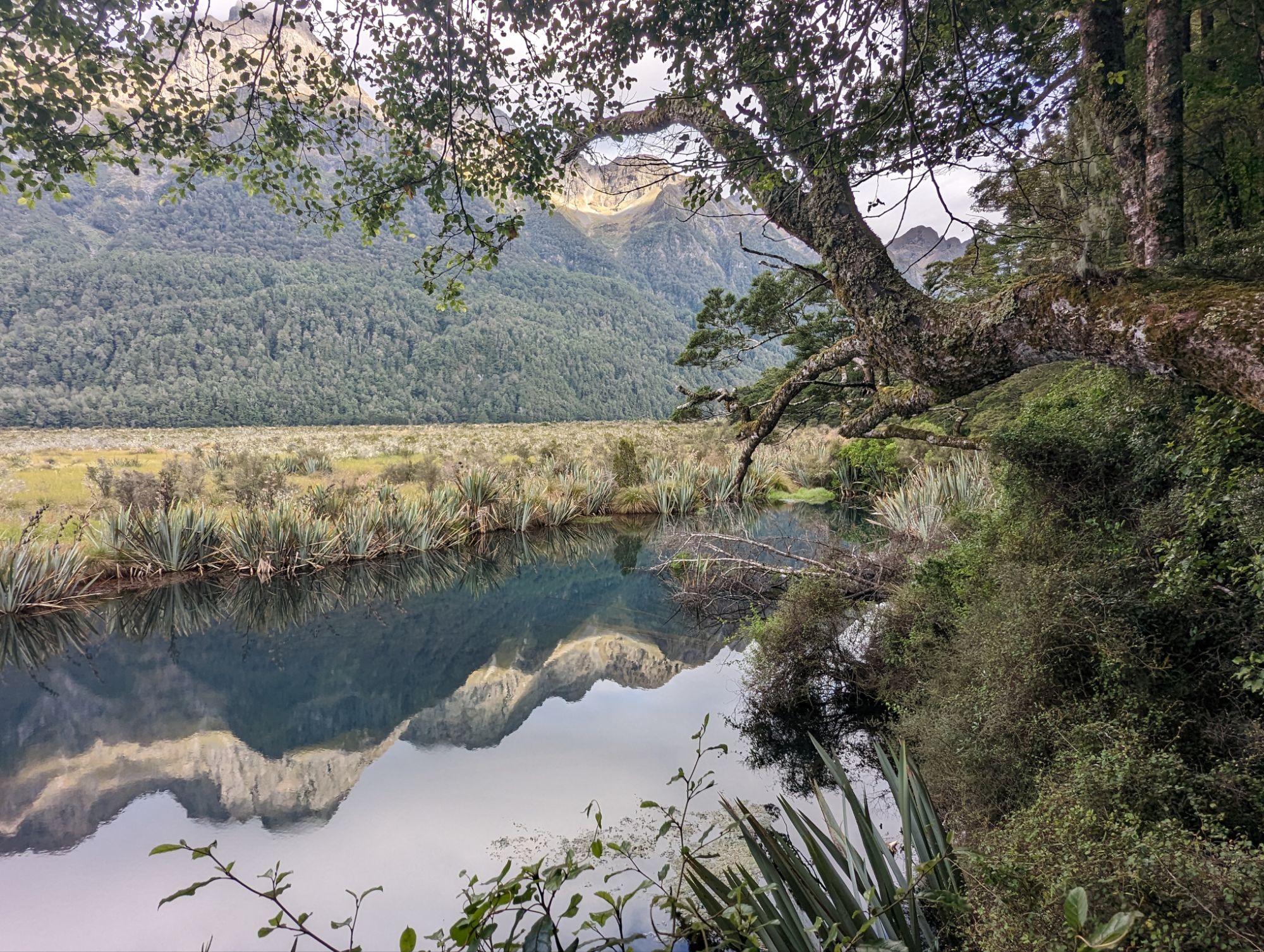
Stirling Falls is always here. After the rain, it is even bigger and there are hundreds of small waterfalls throughout the Sound.The closer one gets to a waterfall, the mistier it gets. We are prepared. The waterfalls are less this day because it isn’t raining. Which is better a beautiful sunny day with fewer waterfalls or a rainy overcast day with a lot of waterfalls? Both are amazing.Kea are very smart birds. They know wherever humans go there is sure to be some excitement. They eat crackers and windshield wipers!!A chance to fill up my water bottle with the cool crisp glacial water from Monkey Creek.Can you see why this is called Mirror Lake?
Milford Road was only built in the 1960’s. Men of the Milford Road by Harold J. Anderson was a recommended book. This road was initially built to transport sheep, now it transports tourists. Hmmm. Is there a herding analogy here?
A great illustration of vegetation growing atop what was once a rocky flat riverbed. This will be covered in forest in 100 years. The plain freezes so the seeds don’t germinate as readily.
Beech trees rot on the inside. They are heavy but weak. The thin layer of topsoil hinders root growth so it grows outward due to hitting rock. Eighty percent of the trees found here cannot be found elsewhere in the world.
There are three types of native beech: silver, mountain, and red. Many beech seedlings start to grow under the canopy. Only a few will mature.Our guide Andrés is very animated as he talks about the spongy forest floor. When rain falls, the thin soil can only hold so much water despite sphagnum moss which holds 25 times its weight in water. Excess rain is what produces the amazing waterfalls.Beech trees flower and produce large quantities of seed all at once every 2 to 6 years. This is called a beech mast. It is thought that masts are triggered by a summer that is warmer than the previous one. Populations of seed loving pests such as mice and rats explode and cause real problems for the native animals.Can you see the rifleman? It is a very small bird and rarely seen perhaps because he is little and blends in. Our guide had only seen it three times in 13 years.This bathroom notice amused me. I have seen the first and second directive before but the last one was amusing. What ambience for your meal!!!The Homer Tunnel was very steep and dark. It took 40 years to build. The Great Annual Naked Tunnel Run takes place at the end of the summer season. Workers in tourism take off all their clothes and run 1.2 km through the dark tunnel with only shoes and a flashlight.Hugging at the finish line is said to be a little awkward!!


Leave a Reply