
Volcanos are more prevalent on the North Island, and earthquakes are more prevalent on the South Island.


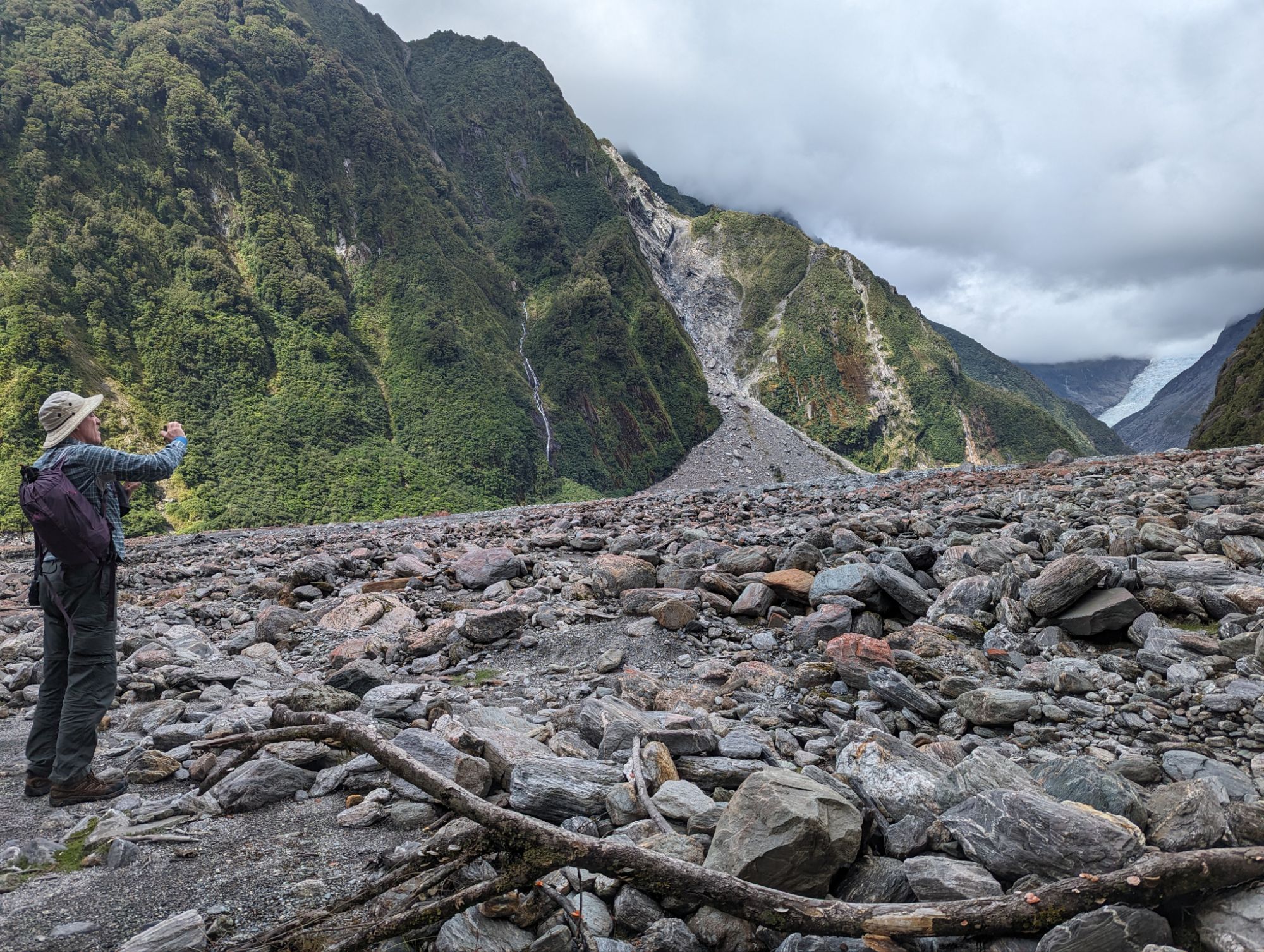
We are going to see two glaciers today: Franz Joseph and Fox. There are only two glaciers in the world that reside in a temperate rain forest.
Franz Joseph. Wait! Isn’t that a ruler from the Austria-Hungary empire? Well, yes it is. It turns out that Julian Von Haast, an Austrian explorer, named it as Franz Josef was funding his expedition. In fact, Haast named a lot of things in New Zealand but mostly after himself. There are a town, river, and even an extinct eagle that bears his name.
The Mãori name for Franz Joseph is Kā Roimata o Hine Hukatere which means “The tears of the avalanche princess”. I like that better.
The princess Hine Hukatere loved climbing in the mountains and persuaded her lover Tuawe to climb with her. An avalanche swept him from the peaks to his death. Hine Hukatere was broken-hearted and her many, many tears flowed down the mountain. Rangi the Sky Father took pity on her and froze them to form the glacier.


In the last ice age, this glacier went all the way to the Tasman Sea which is 35 miles. A glacier actually cycles back and forth between melting and forming. However, as the temperature of the world increases, melting is now greater. It is making more precipitation which used to be snow, but now it is rain. This acceleration is significant.


There are 500 types of moss. They all have interesting names: kidney, umbrella, old man’s beard, etc.
New Zealand leaders were forward-thinking during the pandemic. The Government created the Jobs for Nature Fund in 2020 in response to the impact of the Covid-19 pandemic. It was intended to tackle pandemic-driven regional unemployment and the declining health of Aotearoa New Zealand’s waterways and landscapes. Guides affected by the lack of tourism were employed for trail maintenance and collecting data for research. These nature regeneration projects included waterway replanting, weeding, maintenance, pest control and boardwalk building.

The rimu tree is a type of pine that is distributed by birds. The seeds of most trees are dispersed by the wind.

The unripe fruit of the Rimu tree triggers the reproduction of a specific bird called kererū or New Zealand pigeon. The bird assesses the amount of fruit in order to ensure that her chicks will have ripe seeds when they hatch. When there is less fruit, there will be fewer chicks which is currently the case. Pretty advanced thinking for a birdbrain!!
Leave a Reply