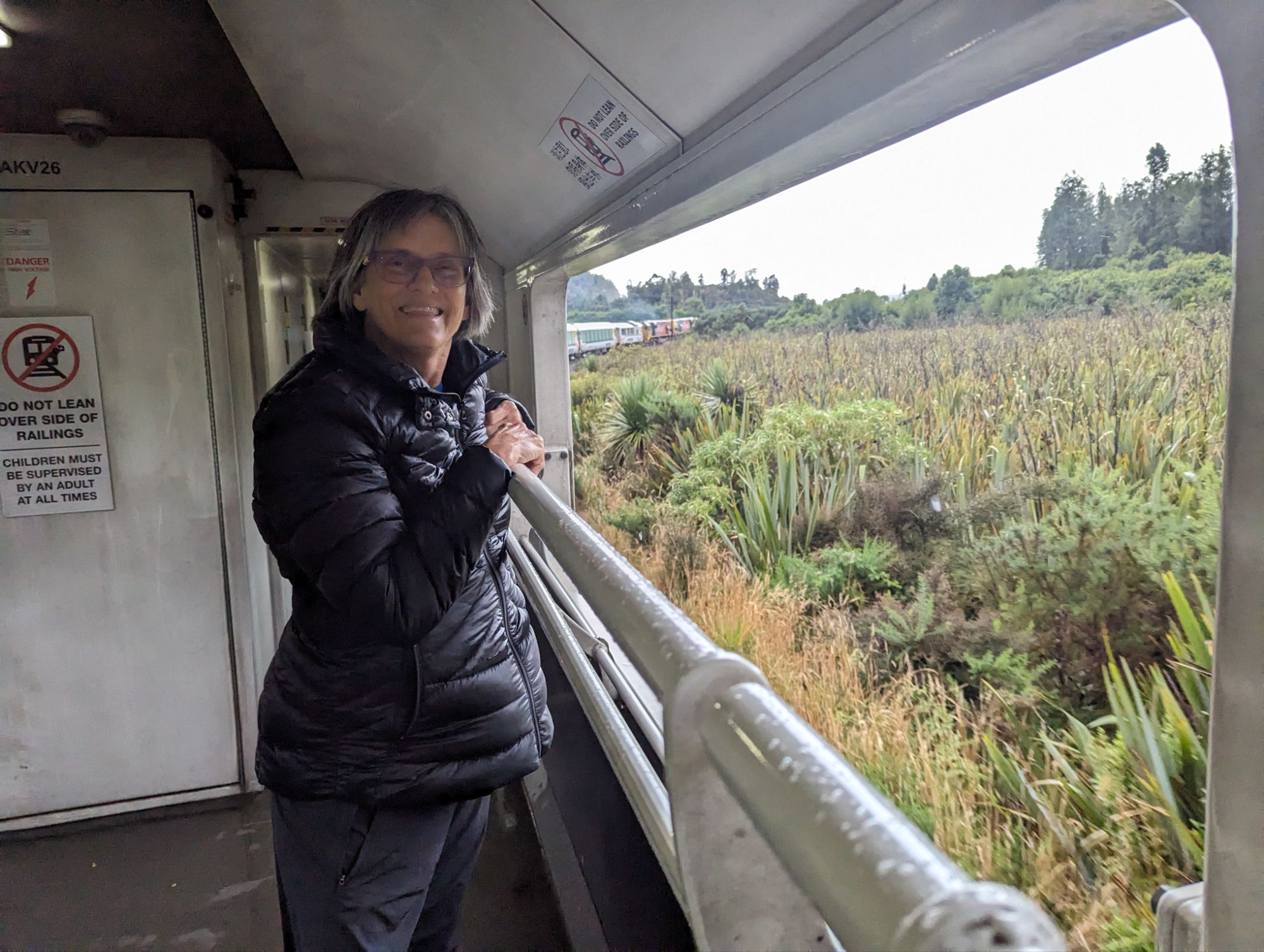
We trained on KiwiRail: Great Journeys from Christchurch to Greymouth where we then caught a bus to the town of Franz Joseph. We went through farmlands, across rivers, and viewed the Southern Alps. A couple told us that they always kissed in the tunnels, and there were a lot of tunnels!!!
We took this trip on Friday, and it was raining like a car wash. We reversed the trip on Sunday and it was sunny blue skies.


Train Commentary
In 1769 Cook circumnavigated New Zealand, and his resulting map was extremely accurate. He did not come onto land. I wouldn’t either if the Māori were doing the intimidating Haka.
Canterbury is the name for the province with Christchurch as its main city. Canterbury Plains are continuous and consist of 3,000 square miles of the most altered land in New Zealand with only 0.5% remaining untouched. Most of the land is irrigated farmland with vineyards and cattle farms.
Most people think of New Zealand as green and lush. When man first arrived 60% of the South Island was dry grassland.

Dairy is now bigger than sheep. And polyester has reduced the need for wool. Dairy is new to this area but now has a big presence. The large dairy farm processes and converts six million liters of milk per day to dry powder for the Asian market.
Big weather is caused by Nor’wester winds which is the opposite of our Nor’easter. In fact, south facing slopes are analogous to our north facing slopes and get no sun. Everything is backwards especially learning to walk and drive on the left side. The Streets struggle crossing the street.
I have heard of meandering rivers, but here in New Zealand they have braided rivers. That type of river is extensively found in the South Island and in Alaska, Canada, and the Himalayas.

In 1953 Sir William Hamilton built the first jet boat to travel up a shallow, fast flowing river. He was a self-taught engineer exploring the use of propulsion in shallow waters. The Hamilton name has been synonymous with jet boats around the world.
On July 4th, 1960, New Zealander, Jon Hamilton, the son of jet boat inventor Bill Hamilton launched the first and last successful upstream run of the Grand Canyon stretch of the Colorado River.
The run took a total of 10 days and would be the last time for an upriver run of the Colorado River through the Grand Canyon.
There were a lot of mines in the Southern Alps but methane had caused many explosions and loss of life.
Our train went through the Alpine Fault that is visible from space and likely the first to go in the event of an earthquake which is overdue. Cracks freeze and expand and produce large falling rocks.
Stockmen are analogous to the cowboy. Cattle and sheep are free range in the interior of the South Island. A herd is located by helicopter, then horses and sheepdogs such as border collies drive them in.
Deciduous trees are not native to New Zealand. Evergreens make up 99.9% of the trees. Sawmills were erected to meet the demand for railroad ties. At one time this region had seven sawmills. By the 1990s native trees were protected.
Te Araroa or The Long Path is New Zealand’s 2,000 mile that takes in spectacular New Zealand landscapes from beaches to volcanoes to forests to cities stretching from Cape Reinga in the north to Bluff in the south.
Kathmandu Coast to Coast is a Running, Kayaking, and Cycling competition that lasts 10 hours from West to East Christchurch.
ANZCO is a halal beef packing plant which employs Muslims. They export to Iraq, Iran, Indonesia, and Malaysia.
Bus Commentary
Kiwis don’t fly; they take the bus.
Bus drivers not only get you from place to place, they give commentary like on a tour. If he has time, he even drives by something that he wants to show you.

Mount Hercules was named after a Clydesdale horse named Hercules that helped people get over the mountain.
Hari Hari was the site of famous aviator named Guy Menzies who in 1931 was the first to fly from Australia to New Zealand. His flight in the plane that he built himself was from Sydney to Christchurch.
Bad weather would not allow him to get over the mountains. He crashed in a nearby swamp and instead landed in the book of records.


In 1848 the first gold was discovered. Soon the 49ers and Australians, Cantonese, and Irish arrived to pan, sluice and dredge for gold. By 1864, 25,000 miners came from the “Pacific Circuit”. However, crime soon followed. The Burgess Gang murdered gold miners.
The biggest gold nugget ever was found in Ross, New Zealand. At almost 7 pounds they affectionately called it Honourable Roddy. It was given to King George for his coronation as a gift from New Zealand. He had it turned into a gold dining set, but no one knows where it is today.


Leave a Reply