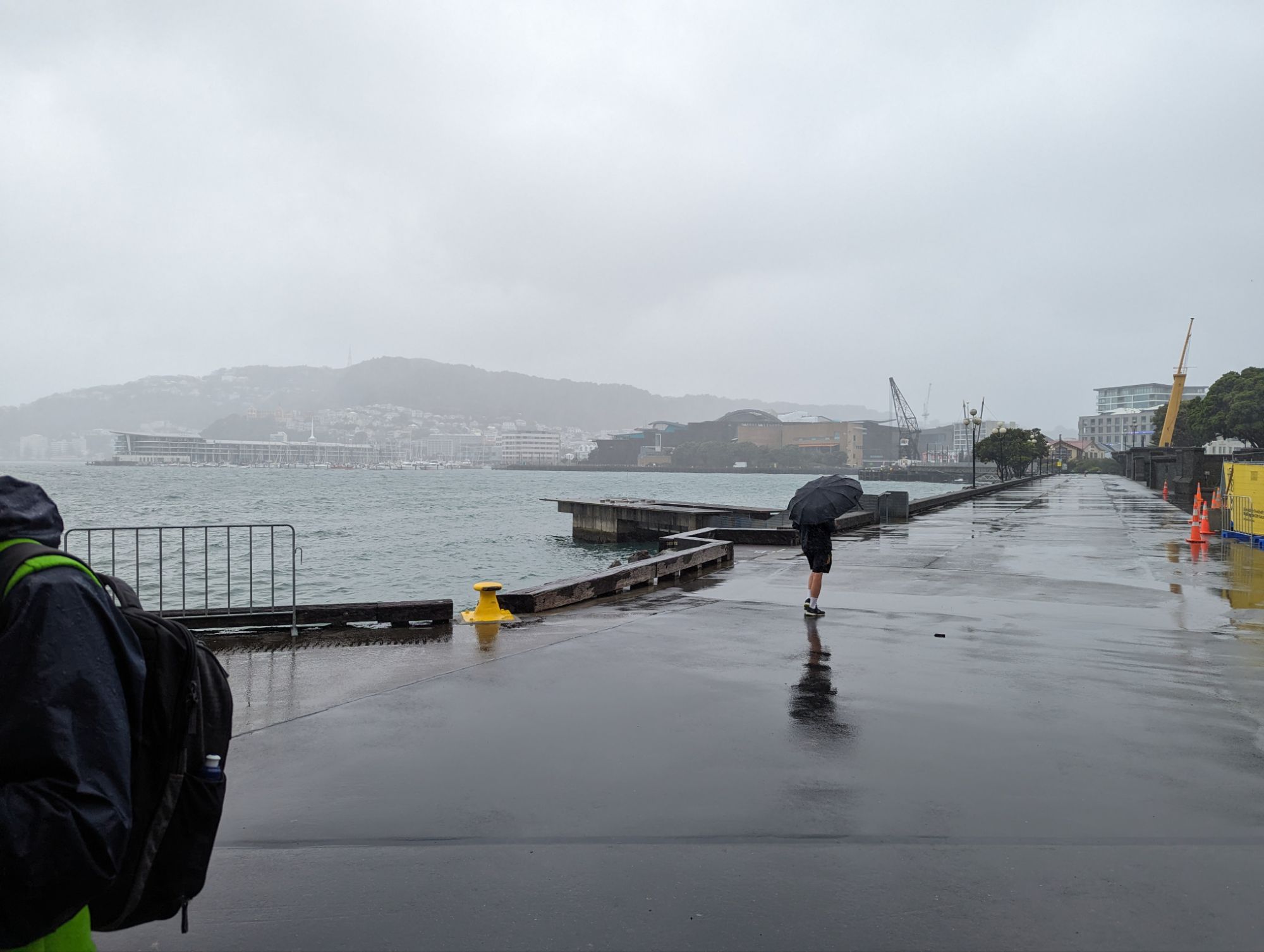
We scheduled a city tour beforehand. Forecasts indicate that the weather will be nasty. We were two minutes late and they left without us. We are running around like “ducks” with our heads cut off!!

Wellington is called Te Whanganui a Tara which means The Great Harbor of Tara in Māori. The harbor in Wellington is a depression. It is in a place of activity for earthquakes and volcanos. Even our hotel doors have instructions on what to do in case of an earthquake.
The phrase is Stop (no more than two steps) Cover (your head preferably under a table but if not, your hands) and Hold (stay there…there will likely be aftershocks). Incidentally, while we were in Palmerston North, there was a 5.1 earthquake at 3:19 a.m. We were asleep and didn’t feel it.
Little blue penguins can be found in Wellington, the only capital city to have penguins. They are the smallest variety of penguins. They are noisy and grumpy.

New Zealand is still part of England. The Crown is the head. They seem to be headed toward a republic but more slowly. Our guide commented that Americans fought hard to a quick end by revolution. The people of New Zealand have to be pushed out of the nest. It will likely happen in the near future. They were fiercely devoted to Queen Elizabeth.
There is no Constitution. The need for one will be apparent when they become a republic. The Supreme Court answers to Parliament. It is not a third separate and equal branch. It only came into existence in 2004.


There were heartbreaking recollections of many ships lost at sea: Pamir, Penguin, Delaware, Cospatrick, Wahine, Dundonald, Bluejacket, and Medusa.
Nautical expressions are in our everyday speech:
- give a wide berth – avoid
- go overboard – get carried away, enthusiastic
- hard to fathom – difficult to understand
- in the doldrums – depressed, sad
- know the ropes – know how to do something
- on an even keel – stable situation
- plain sailing – easy, straight forward
- barge in – push your way in
- steer clear – avoid trouble
Work songs, called shanties, helped the crew in the often heavy labour of sailing a ship. For example, capstan shanties were sung when hauling up the anchor. Halyard shanties were designed to get the men to pull on the halyards (ropes) on hearing a particular word or phrase. Several shanties became popular outside seafaring circles, some of the more famous being Shenandoah, Bound for the Rio Grande and Blow the Man Down.

Women who arrived in New Zealand worked right alongside the men as the land was wild.


Rob wanted a salad and asked how big the salad was. She indicated a size of her hands. He didn’t think to ask how how high was the salad!!

Leave a Reply