Happy Valentine’s Day, everyone.
Jaipur is called the “Pink City” because in 1876, Maharaja Sawai Ram Singh II had the city painted pink to welcome Prince Albert, the Prince of Wales (later King Edward VII), symbolizing hospitality, and the name stuck.

Our group traveled this morning in the backs of small trucks.

We passed by Hawa Mahal a palace in Jaipur. Built from red and pink sandstone, it is on the edge of the City Palace. Hawa Mahal is known as the “palace of winds”. Maharaja Sawai Pratap Singh built it in 1799. Hawa Mahal is considered to be unique as it has 953 small windows and balconies that seem like a honeycomb.

The Amer Step Well was built in the 16th century as a way of collecting monsoon rains to provide water to Jaipur during dry spells. The geometric staircases meant that water could be collected no matter the level of the pool below.

Amber Palace overlooks Maota Lake. Constructed of red sandstone and marble, the attractive, opulent palace is laid out on four levels, each with a courtyard. Some of its buildings show the influence of Mughal architecture. Mughal buildings have a uniform pattern of structure and character, including large bulbous domes, slender minarets at the corners, massive halls, large vaulted gateways, and delicate ornamentation. The Taj Mahal is another example of Mughal architecture.

Amber Palace was the residence of the Rajput Maharajas and their families. One ruler, Raja Man Singh, had a total of 12 queens, so had made 12 rooms for each one of them. Each of these rooms had a staircase that connected to the King’s room.


We saw this elegant couple touring the Amber Palace …

… and this woman and her child.

Peggy had art done on her arm …

… and hand.

Edward was requested for a photo with this group of young men.

Jal Mahal, which means “Water Palace”, was initially built as a hunting lodge for the local Raja (King) during a severe drought and famine in the 16th century. Damming of the river, created artificial Man Sagar Lake and submerged the lower portions of the lodge.

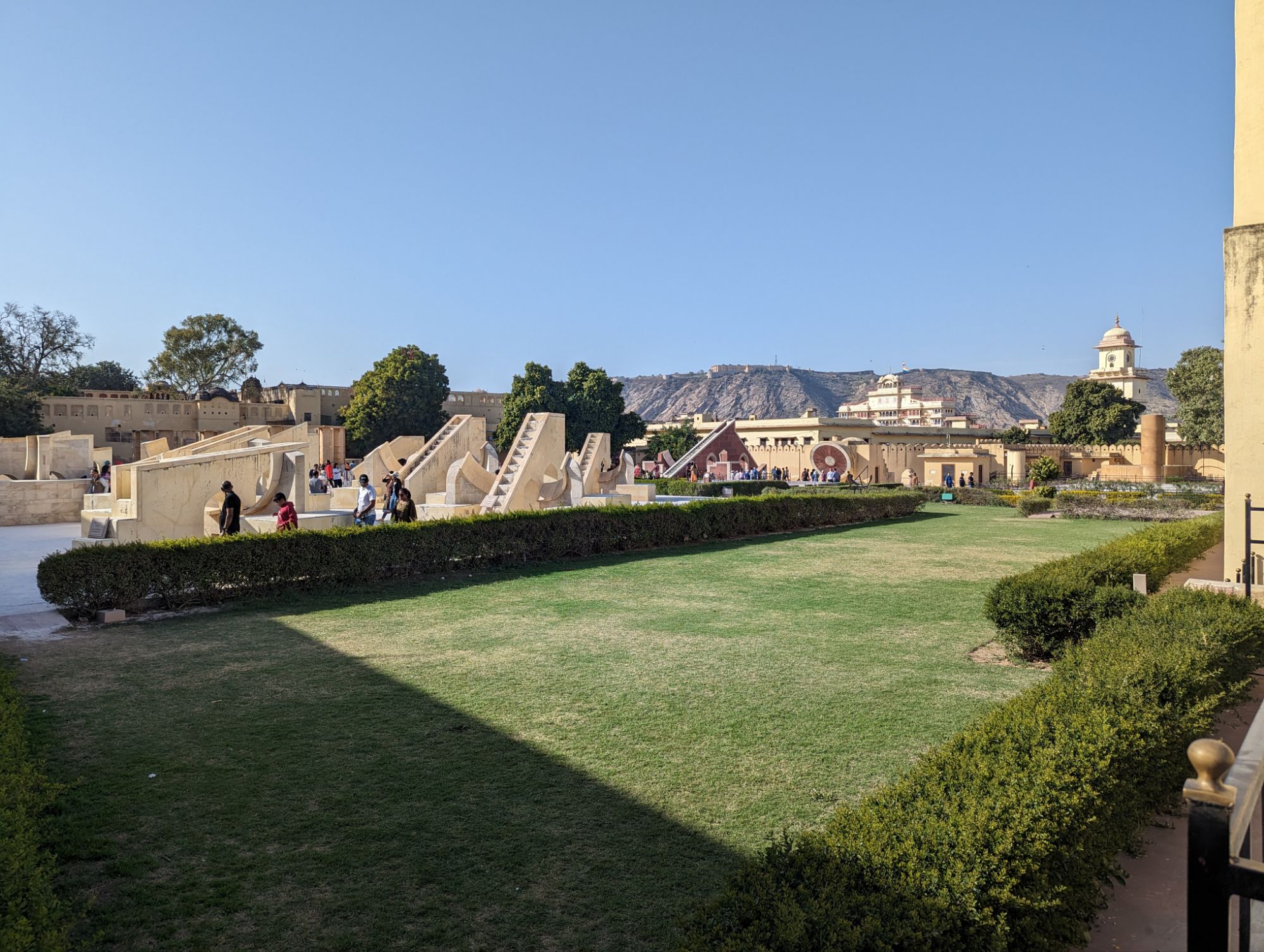
The Jantar Mantar in Jaipur is a collection of 19 astronomical instruments built by the Rajput king Sawai Jai Singh II, the founder of Jaipur. The monument was completed in 1734. It features the world’s largest stone sundial, and is a UNESCO World Heritage site. Jantar means instruments and Mantar means calculation.
The instruments allow the observation of astronomical positions with the naked eye. The observatory is an example of the Ptolemaic positional astronomy, a geocentric model where the Earth is the center of the universe, with the Sun, Moon, planets, and stars revolving around it in a series of nested spheres, using epicycles (a small circle whose center moves around the circumference of a larger one) to explain apparent retrograde motion.
The monument features instruments operating in each of the three main classical celestial coordinate systems: the horizon-zenith local system, the equatorial system, and the ecliptic system.

This large sundial is reputed to be able to measure time to an accuracy of about two seconds.

Jai Prakash Yantra is two 17-foot-diameter hemispherical bowl-based sundials with marked marble slabs that map inverted images of the sky and allow the observer to move inside the instrument. It measures altitudes, azimuths, hour angles, and declinations.
City Palace in Jaipur is a royal residence and former administrative headquarters of the rulers of the Jaipur State. Construction of the Palace was completed in 1732. The Jaipur royal family still lives here along with around 500 personal servants.

Chandra Mahal is one of the oldest buildings in the City Palace complex. It has seven floors.


Believed to be the largest silver vessels of this kind in the world, the “Gangajalis” were made to hold holy water from the river Ganga for the Maharaja during his 1902 trip to England to attend the coronation of King Edward VII.
Gangajalis were produced from silver as the metal was traditionally considered purifying. Each jar, about five feet tall, was made of approximately 14,000 silver coins. The jars each weigh around 750 pounds and have a capacity of approximately 400 gallons.


After watching them make carpets, we had a chance to shop in their showroom. Tom bought several beautiful carpets for his new vacation home.

Even our hotel in Jaipur has a fabulous mural.
Leave a Reply