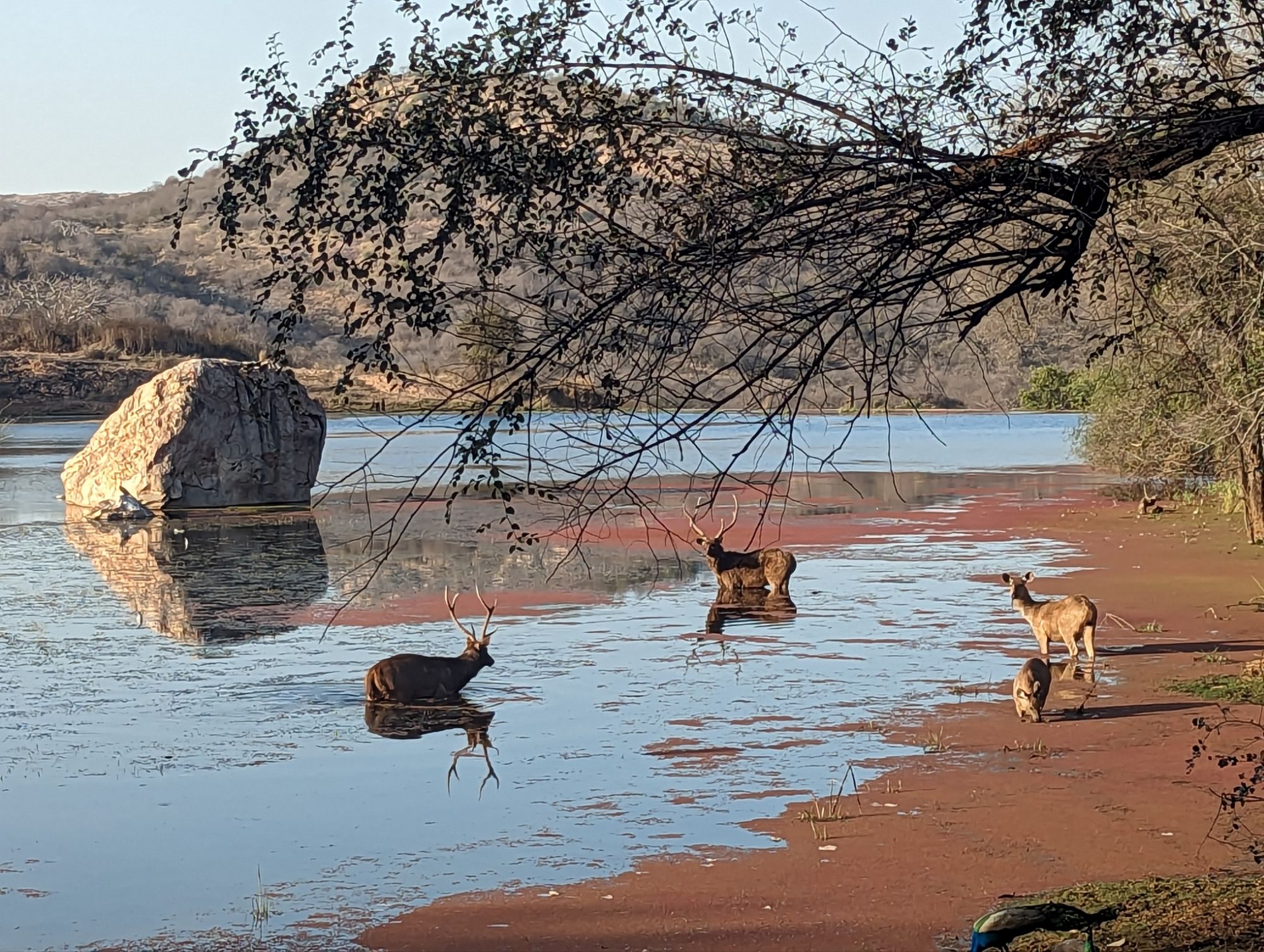
Today we went on safari in Ranthambore National Park in north central India, a wildlife reserve and former hunting ground. The park covers 515 square miles. It was named after the fort that it contains.

We did two game drives – morning and late afternoon. It was a bit crowded with various size vehicles. Our vehicle could hold about 20 people.


Like on a typical safari, we left early.

It was chilly to start the day.

We saw various animals including musters (flocks) of peacocks and peahens. None of the males spread their feathers while we were watching.

These macaque monkeys were eating and grooming.


India has 12 different types of deer. We saw two of them. The sambar deer in the photos above is the largest species.

Spotted deer is the most numerous type of deer in India. It is also known as the chital or cheetal.

The Nilgai antelope, also known as the blue bull, is Asia’s largest antelope.

I saw an eagle on a high branch. I asked our naturalist, who didn’t speak English very well, what type of eagle it was. All I got was “snake killer”.

This photo from Jai revealed it to be a crested serpent eagle.

Common Kingfishers were flitting about.

This one made a pretty reflection in the lake.

We also saw a white-throated kingfisher.

A marsh crocodile was sunning himself.

These tracks gave us hope to see a tiger. Ranthambore is known for its large number of Royal Bengal tigers.

Maybe he will look like this.

But we settled for this view instead – a tiger lying down in the brush. My photo was the best of our entire group.
On the way to the safari, we got to see India’s version of a “bullfight”.
During the afternoon we climbed up to Ranthambore Fort. Here’s where we were headed.


This plaque describes the history of Ranthambore Fort.

There were many stairs to climb.

And doorways to pass through …

… and long passageways.

Eventually we reached a broad plateau …

… then more stairs.

Hammir Kachaheri was built by Hammir Singh, and it faces Delhi gate on the north side of the fort. The kachaheri is built on a raised platform. The structure has a central chamber that measures 64 feet by 39 feet. There are two more chambers, one on each side of the central chamber. The pillars in the central chamber support the ceiling and are arranged in two rows.

Nestled within Ranthambore Fort, the Dargah of Kazi Peer Janab Sadrud-Din is a serene sanctuary steeped in centuries-old tradition. Built between the 13th and 14th centuries, this sacred site reflects a harmonious blend of Sufi mysticism and Rajasthan’s royal heritage.
Three Hindu temples to Ganesha, Shiva, and Ramlalaji were built inside the Ranthambore Fort in the 12th and 13th centuries from red Karauli stone. Additionally, there is a Jain temple dedicated to Lord Sambhavanath and Lord Sumatinath (the fifth Jain Tirthankar).

Here are the remains of Ganesh Temple.

We were rewarded with a beautiful view.

We stayed for two nights at Ranthambore Heritage Haveli, a very nice safari lodge.


At night the lodge entertained us with music from this group.

That led to dancing.
Leave a Reply