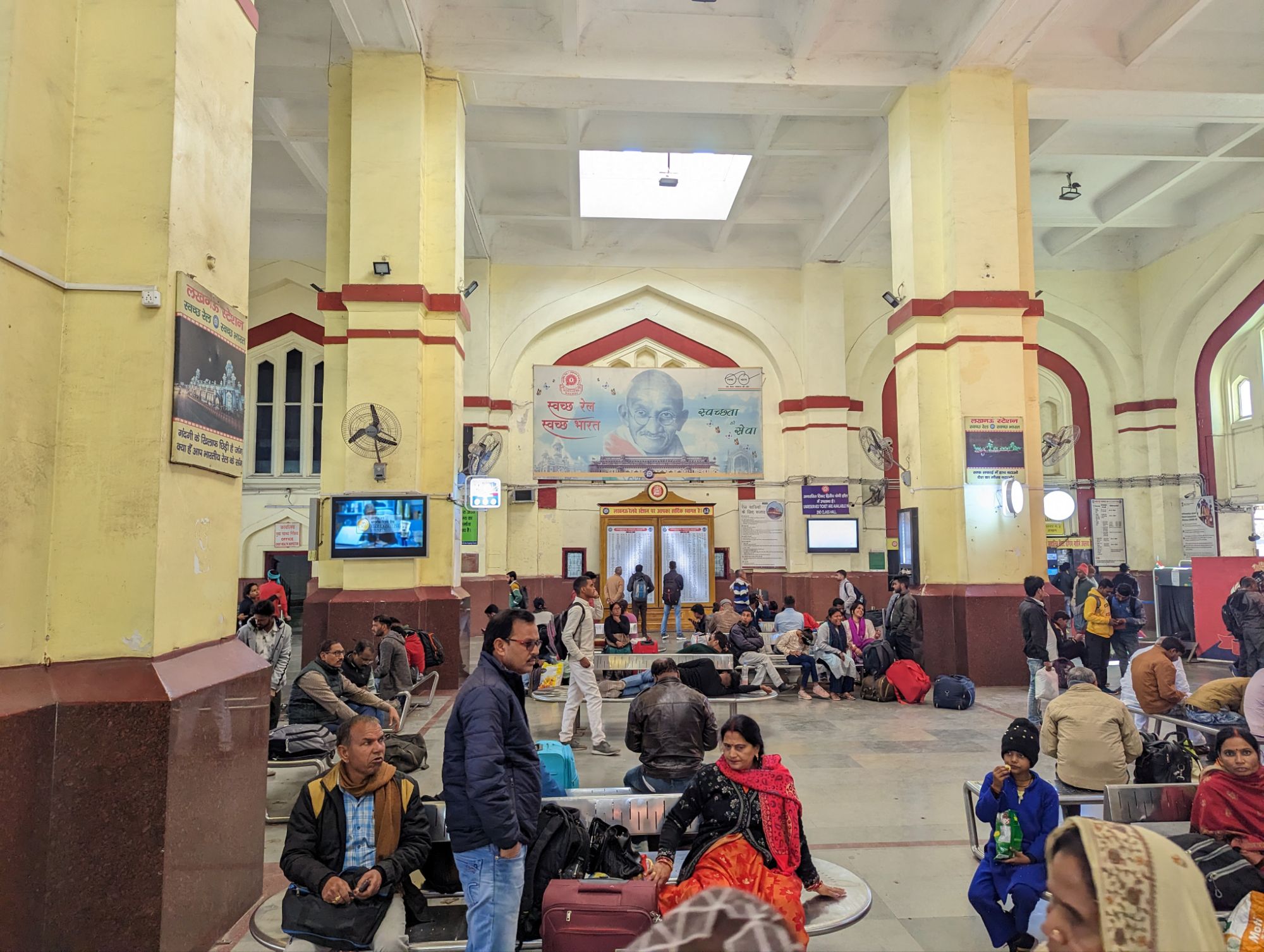
In the morning we traveled by train to Lucknow, the capital and the largest city of the Indian state of Uttar Pradesh. Four million people live here.
Lucknow is situated at the junction of numerous roads and rail lines and has an international airport. The city is a marketplace for agricultural products such as mangoes and melons. Various grains are grown locally. Its industries include food processing, manufacturing, handicrafts, and railroad shops.


Arriving at the Lucknow train station, we discovered it to be quite an architectural masterpiece. It was built by the British in 1926. We are told that from an aerial view it looks like a chess board.

Now in the city, this impressive gate leads to Chota Imambara, a spectacular and ornate monument.

It took 54 years to build Chota Imambara. Imambara means congregation hall. This structure was created for Shia Muslims, by Muhammad Ali Shah, the Nawab of Awadh in 1838. It was to serve as a mausoleum for himself and his mother, who is buried beside him. A Nawab was a native governor during the time of the Mughal empire.
Entering the building through gates called Naubat Khana, we see a beautiful hall filled with chandeliers and clocks from Belgium and Paris. Every corner of the hall glitters with these lovely lanterns. The British called it “Palace of Lights.”


Off to the side stands a whitewashed domed building, vaguely reminiscent of the Taj Mahal and surrounded by four minarets.
In the evening our group went on a food tour. Many of the items were new to us, but most were delicious.


Six of us were each given a spoon so we could share this dish.


Leave a Reply