We left Delhi and traveled to Varanasi by plane.
Varanasi is a city in the northern Indian state of Uttar Pradesh dating to the 11th century B.C. Regarded as the spiritual capital of India, the city draws Hindu pilgrims who bathe in the Ganges River’s sacred waters and perform funeral rites. Along the city’s winding streets are some 2,000 temples, including Kashi Vishwanath, the “Golden Temple,” dedicated to the Hindu god Shiva.

Varanasi sits along a stretch of the Ganges that flows north. On the east bank of the river is an area of ghats. Ghats in Varanasi are riverfront steps leading to the banks of the Ganges river. The city has 84 ghats. Most of the ghats are bathing and puja (Hindu worship ritual that involves offering devotion to deities) ceremonial ghats, while two ghats, Manikarnika and Harishchandra, are used exclusively as cremation sites. Hindus believe that bathing in the Ganges River washes the sins away. They put mustard oil on their bodies and then swim in the Ganges.
There are three principal Hindu gods: Shiva is the god of destruction. If the soul meets Lord Shiva, you don’t come back for another life. Vishnu is the god of preservation, god of time, the protector of good, bestower of karma. Brahma created the universe. Hindus also believe in many other lesser gods. Some would say that in Hinduism there is only one god Brahma and that the other gods are just Brahma in different forms.
Our guide told us that Hindus believe that all the Hindu gods and goddesses live in the stomach of a cow, so that is why people feed and protect stray cows.

See the swastika on the wall above. In the ancient Indian language of Sanskrit, swastika means “well-being”. The symbol has been used by Hindus, Buddhists and Jains for millennia and is commonly assumed to be an Indian sign. The Nazis reversed the direction of the ancient swastika and lost all of the good karma.
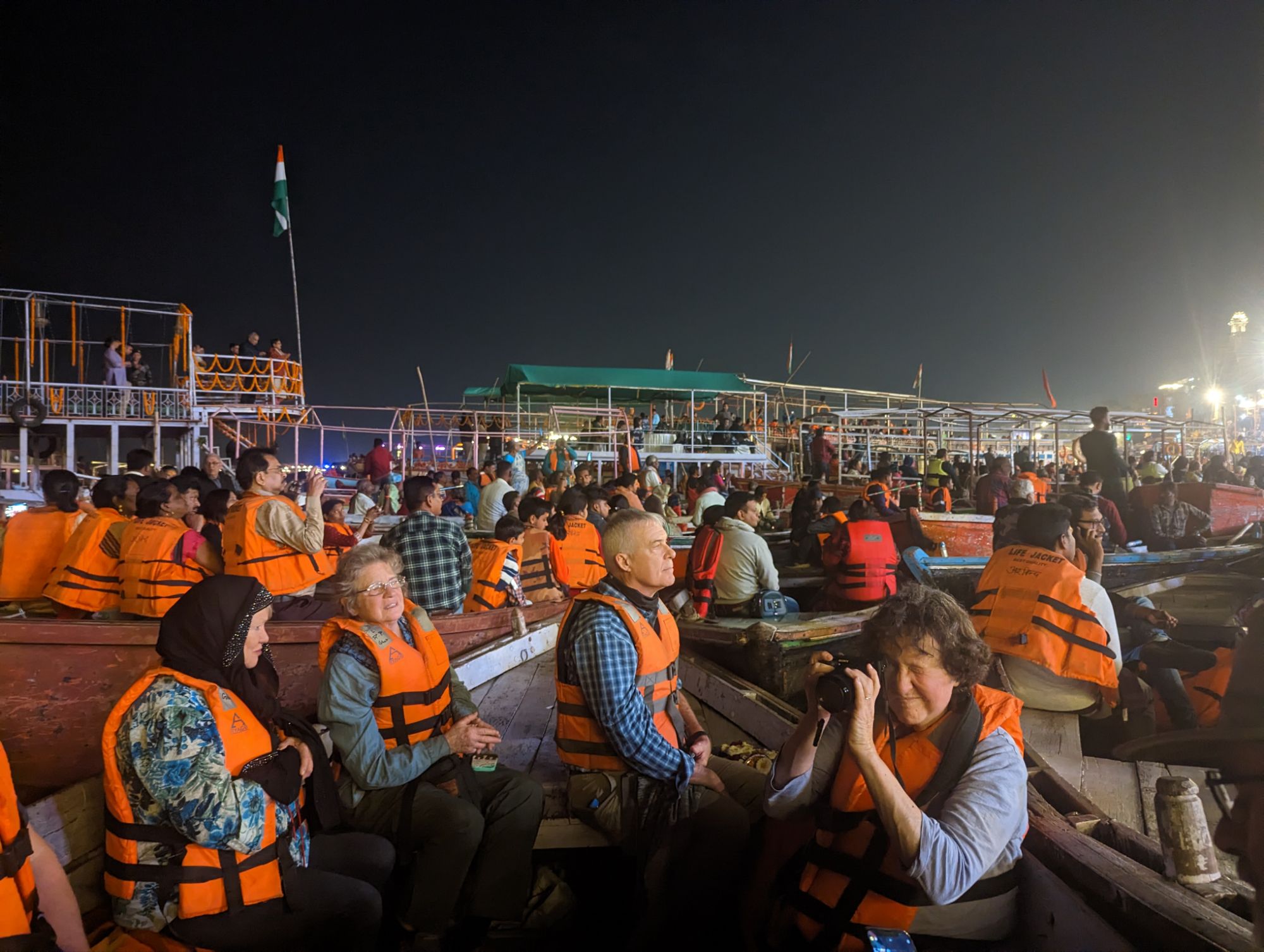
As night fell, we took a boat ride on the river and observed cremation fires in the distance and a big prayer ceremony.

Families bring the body of their loved one, buy wood, and set the body on fire. They stay at the cremation site until the body is completely burned. It might take three or four hours. Then the ashes go into the river along with any bones that didn’t burn. The Ganges is one of the most polluted rivers in the world.

See the cremation fires. Each fire is a body.

Seven Hindu priests officiated during a prayer ceremony.

There was a chaos of boats tied together watching the ceremony from the river.

As you know, there are a lot of beggars here, and people trying to sell various services. Edward got marked by one of those sellers. Then he became a target for others. He sat by our guide who could chase them away.

We each lit a candle surrounded by flowers and placed it in the river to float away.
Hindus believe that the soul of the deceased stays attached to its body even after its demise, and by cremating the body, it can be set free. As a final act, a close family member forcefully strikes the burning corpse’s skull with a stick as if to crack it open and release the soul.
Leave a Reply