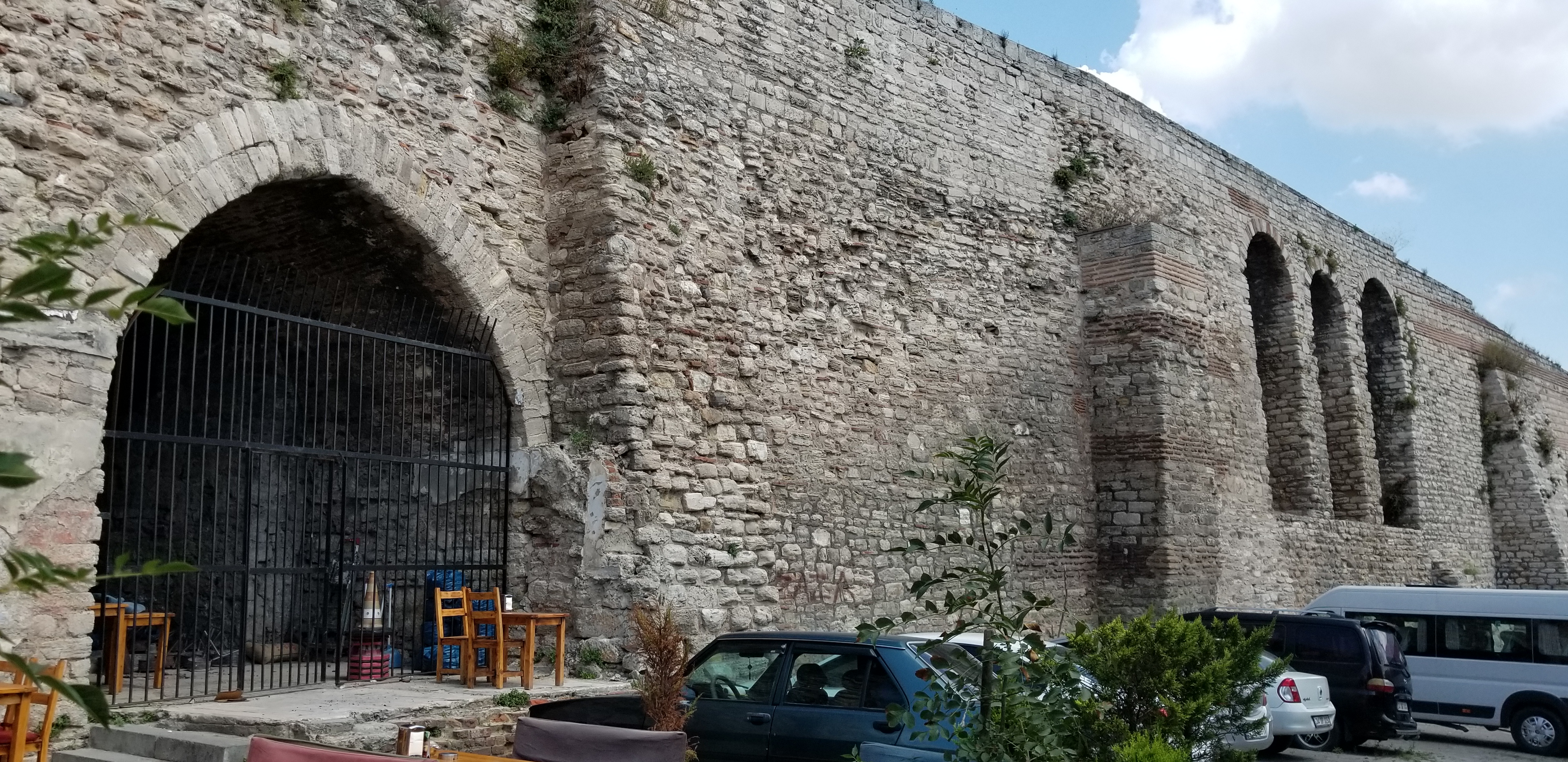
Theodosus II built walls around the European land section of Istanbul from 408 to 413 A.D. This wall was farther out from the city center than Constantine’s walls because the population had grown and land use had increased. The inner wall was 40 feet tall and 5 feet thick. It had 96 towers. A second smaller wall was 60 yards farther out. It’s towers were staggered with the inner wall towers. A smaller third wall lay 60 yards farther out. Beyond the third wall was a moat. These walls were breached only twice in over 1,000 years, first in 1204 when a door was carelessly left open as the 4th Crusade approached, and second in 1453 when Mehmet II inflicted severe damage to the wall with cannons. Gunpowder had made its way from China to Europe. Mehmet conquered the city and the reign of the Ottoman Empire began. This depiction shows the design of the wall.


Edward and I walked alongside the walls for a couple of hours. Some of the walls are no longer well preserved or are gone completely.


At one place we were able to climb on top of the wall and look down into one of the towers.

Notice our brave Turkish friend behind us. His comrade took this photo of us.

At one point in the 7th century, Attila was headed to Constantinople with his Huns. Since Istanbul is on a fault line, an earthquake had destroyed half of the towers. The citizens of Constantinople were able to rebuild the wall in 60 days and turn Attila away.

Many clocks are stopped at 8:45 and 5 seconds because Ataturk, founder of modern Turkey in 1923, died at that time on the morning of Nov 10, 1938 in Dolmabahçe Palace. Each year everything stops on Nov 10 at that time for 1 minute of respect.

Next we walked through the Balat district and ate lunch at Tevafuk Balat. Our meal: Hamburger, French Fries, and a Coke – Istanbul style.

This Muslim graveyard is located by the wall. All of the gravestones are pointed toward Mecca.

Once again we walked across the Golden Horn Metro Bridge.

In Istanbul shops of a similar type often are clustered together in a section – lighting, kitchen wares, auto parts, etc. On Korok Street, a few blocks south of our hotel, Edward commented that it was like walking through an outdoor Lowe’s hardware store.

Simit is a circular bread, typically encrusted with sesame seeds or, less commonly, poppy, flax, or sunflower seeds. Simit bread is sold by street vendors in Turkey, who either have a simit trolley or carry the simit in a tray on their heads.

In the evening we took a ferry across the Bosporus to the Kadıköy district on the Asian side. One of the symbols of the Asian side is a bull statue. It is located in Kadıköy Altıyol (which means “six roads” in Turkish), in the middle of an intersection that connects six roads, and it makes the Kadıköy Bull Statue one of the busiest meeting points in Istanbul.

There is a bustling nightlife on many of the streets in Kadikoy.
You can listen to two minutes of music on the ferry back to our hotel area.
Leave a Reply