Our 6-day tour was designed to take us around the city for the first three days on a guided tour and leave the last three days open for us to explore on our own.

The incredible Hagia Sophia was built between 532-537 A.D. by the Byzantine emperor Justinian I as the Christian cathedral of Constantinople. It remained the world’s largest cathedral for nearly a thousand years until it became a mosque in 1453. Minarets were added at that time. Now this amazing building is a museum. Hagia Sophia is a Greek term, that combines “Hagia” (meaning “holy” or “saint”) and “Sophia” (meaning “wisdom”).

At completion the Hagia Sophia was the world’s largest interior space and among the first to employ a fully pendentive dome (circular dome over a square room).

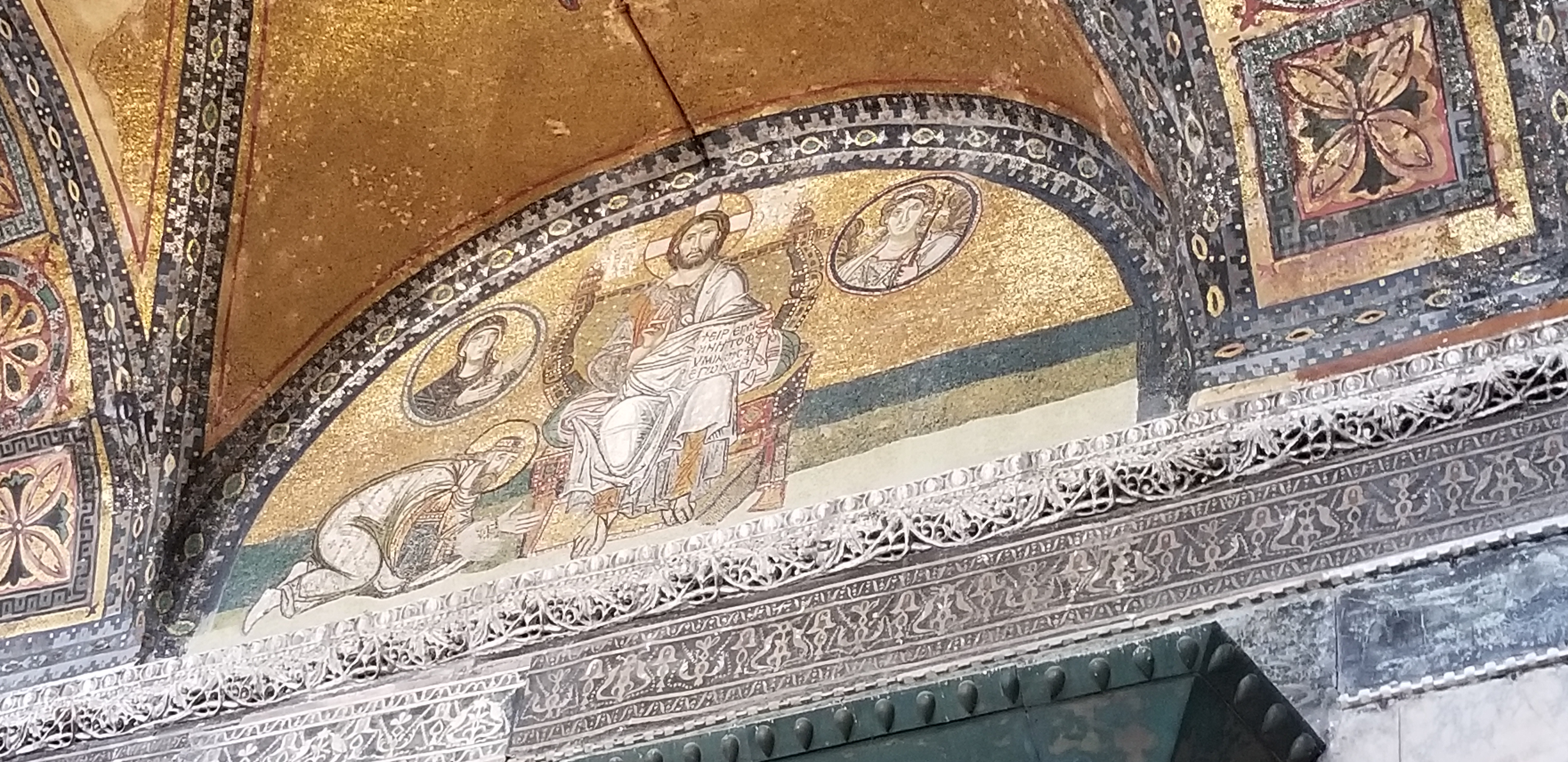
Look at this amazing lifelike tile mural of Christ in Hagia Sophia.

Topkapi Palace served as the residence and administrative headquarters for sultans for over 400 years until 1856. The building housed up to 4,000 inhabitants, including as many as 300 in the harem.


Vast hallways connected the many courtyards.

Hagia Irene is located in the outer courtyard of Topkapi Palace. It is the oldest known church structure in the city and one of the only Byzantine churches in Istanbul that was never converted into a mosque.

The underground Basilica Cistern in Istanbul was commissioned by the Byzantine Emperor Justinian I in 532 A.D. to supply water to the Great Palace of Constantinople. The cistern is so named because a basilica stood on the public square above in the 4th century. With 360 columns that were brought from many places, it is the largest of several hundred ancient cisterns that lie beneath the city of Istanbul. Potentially holding 20 million gallons, the cistern could be flooded and used as a reservoir in case the city was besieged.

The Obelisk of Theodosius in the Hippodrome is the Ancient Egyptian obelisk of Pharaoh Thutmose III, first erected during the 18th dynasty of Egypt in the temple of Karnak. It was re-erected in the Hippodrome of Constantinople by the Roman emperor Theodosius I in the 4th century AD.

The 25-foot-tall Serpent Column is an ancient bronze column at the Hippodrome. It was relocated from Delphi, Greece to Constantinople by Constantine the Great in 324. The column was built to commemorate a Greek victory over the Persians.
Today the shoe shine boys discovered us for the first time. As Edward was standing, one walked up and started polishing his shoes. Edward allowed it to continue. Of course, at the end the shoe shiner expected a tip. It was obvious that they would “polish” or clean any shoes. My hiking boots were a target. Later we were walking across a bridge. Another shoe shine boy passed us. Suddenly a brush dropped out of his valet box. Knowing his trick, we just walked past and kept going, never looking back.
Leave a Reply