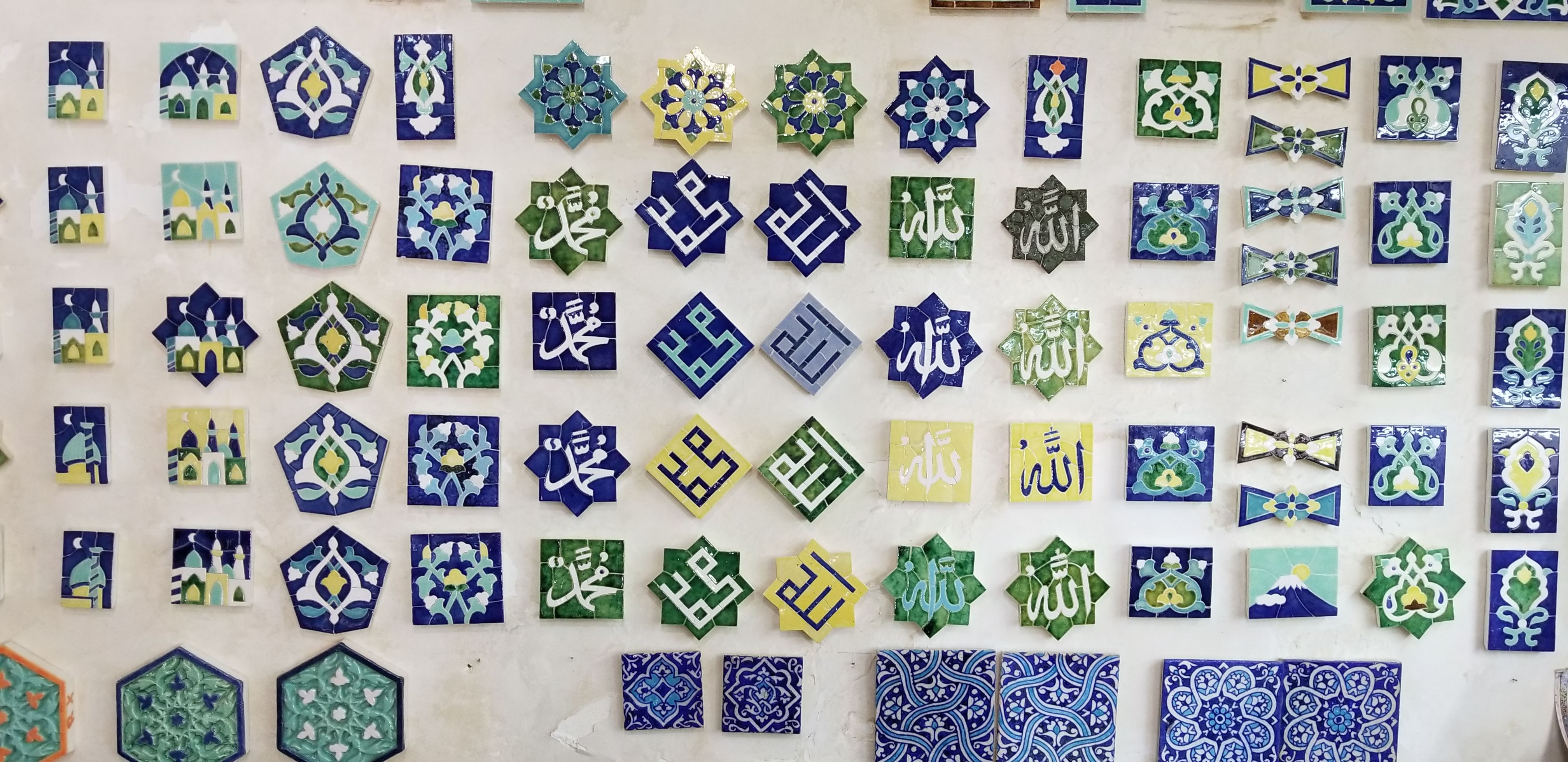
Fantastically beautiful Samarkand became the center of world civilization, culture and science, literature, and crafts. A huge cosmopolitan city, Samarkand was inhabited by people from all over the world. At that time, being located in the center of the Great Silk Road, it was also the center of world trade. Timur devoted much effort to the development of his city, erecting monumental and architectural complexes. Amazing architecture architecture and unique monuments still attract tourists from all over the world.

It’s 7:45 a.m. in Samarkand, and we have encountered The Registan for the first time. In the old days it was a public square where people gathered to hear royal proclamations, heralded by blasts on enormous copper pipes called dzharchis. In addition, public executions occurred here. The Registan is framed by three madrasahs, or Islamic schools, of distinctive Persian architecture. The square was regarded as the hub of the Timurid Renaissance. The name Registan means “sandy place” or “desert” in Persian. It was built in the 15th century.


The sun is up now.

Of course, I had to climb this minaret.

Here is Elle on the way up ahead of me.

This is what The Registan looked like after centuries of decline and neglect.

Here is the view today from the top of the tower.

The interior of Tilya Kori Mosque and Madrasah has beautiful tile work.

There were lots of photo opportunities.

Elle made another friend.

Our guide affectionately calls the local police “cucumbers” because of their green uniforms.


I liked this landscaping where the flowers appear to flow out of the jug.

This 60-foot-long sarcophagus reputedly holds the remains of the Old Testament prophet Daniel. He is revered by Muslims, Jews, and Christians alike, although only Christians regard him as a prophet. This is not the only place that claims to be Daniel’s final resting place. It is not known for sure if his body is inside.

Near the tomb this blue dome covers a natural spring. Immediately after Daniel was alleged to be buried here, a natural spring started to sprout, which, of course, is regarded to have healing powers.

Who is hiding in this costume?

It’s Elle, of course!

She wasn’t the only one that dressed up. This is the only beard I’ve ever grown.

After so much sightseeing, Elle and Mirzah decided to rest.

This terracotta mousetrap in the Afrasiab Museum worked by using a terraced structure with a bait-filled chamber and a trapdoor, which would collapse when triggered, trapping the rodent.

Also in the museum is depicted a procession, possibly the arrival of a king and a princess to some country church. The best preserved are two characters on a camel and a string of possibly sacrificial birds. Sometimes this scene is interpreted as the arrival of the royal bride.

Later we got a birds-eye view of a large market.

Elle enjoyed a Central Asian apple from the market.

The Catholic Church of St. John the Baptist was built in 1916 to serve Polish, Austrian, and Hungarian prisoners of war that began arriving. It is the only Catholic church in Samarkand.

The Russian Orthodox Church of St. Alexius Metropolitan of Moscow was built a few years earlier in 1912. It looked beautiful in the late afternoon sun.
Leave a Reply