
Another day, another ride through a desert. We are headed to Shahrisabz and then on to Samarkand.

When we stopped for lunch, Mirzah dutifully prepared the vegetables for us. Since we can’t drink the tap water in Central Asia or eat salad washed in the local water, Mirzah washed the vegetables with bottled water and sliced them for us.

Kuk Gumbaz Mosque was built in 1435 by Ulug Beg Mirzo for his father. Historical inscriptions with the names of the Timurids and the time of construction have been preserved in the porch of the mosque.

Another view of Kuk Gumbaz Mosque.

Dorus Saodat means “House of Power”. It consists of mausoleums of Jahongir, Omar and Tamerlane as well as the mosques of Hazrati Imam.

This is another view of the mausoleum of Jehangir. It is richly decorated with gold, azure and tiles. Jehangir was the eldest son of Timur, but in 1376 he suddenly died.
Amir Timur, also known as Tamerlane, was a great military leader and statesman of the 14th-15th centuries. Timur created a huge empire during his 35-year reign. His possessions stretched from the Volga to the Caucasus, from Central Asia to India. He made Samarkand the capital of his empire. Timur revitalized the area which had become deserted in the 13th century after the devastating invasion of the Mongol troops led by Genghis Khan.

Shahrisabz translates as “Green City” in Persian. Current population is about 140,000. Historically known as Kesh or Kish, Shahrisabz was once a major city of Central Asia. It is primarily known today as the birthplace of Timur.
Alexander the Great chose to spend his winters here and met his wife Roxanna in the area around 328 B.C.

We walked toward the Ak-Saray Palace, built between 1380 and 1404 under the reign of Timur. In 2000, the palace was declared a UNESCO World Heritage Site.

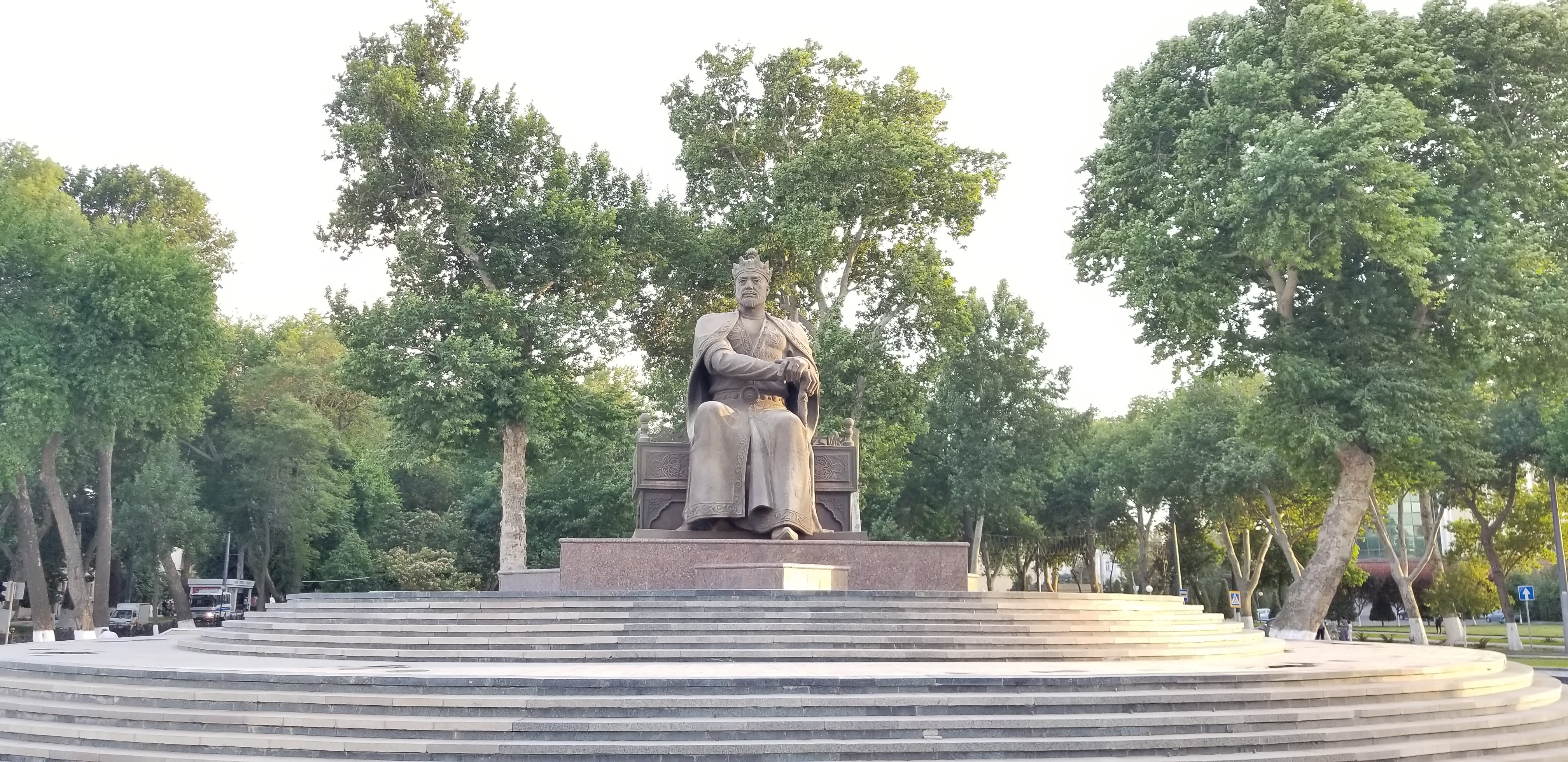
This statue of Amir Timur keeps watch over the area.
Later Elle had fun weaving a carpet.

She made a friend.
In the afternoon we traveled through the mountains and over a high pass called Tachtakaratcha to reach Samarkand. It was about a 5-hour drive.


There was an interesting roadside market of fruit and spices along the way that served travelers.

At the market we sampled the round, condensed food called “kurt”. It sustains Uzbek travelers, particularly during travel and as a long-lasting snack. Kurt is made of salted, dried balls of condensed sour milk, sort of like cheese.

Elle was interested in these wild apples that look a lot like our crab apples.

After arriving in Samarkand, we visited the Gūr-i Amīr mausoleum of Amir Timur. It occupies an important place in the history of Turkestan’s architecture as the precursor for Mughal architecture tombs, including the Gardens of Babur in Kabul, Humayun’s Tomb in Delhi, and the Taj Mahal in Agra. The mausoleum has been heavily restored over the course of its existence.

The inside of the mausoleum.

I’m enjoying Samarkand after a long day’s journey.
Leave a Reply