The ancient Silk Road was a network of Asian trade routes that was active for 1,700 years until the 15th century. Stretching over 4,000 miles, it played a central role in facilitating economic, cultural, political, and religious interactions between the Eastern and Western worlds.
Mirzah, Elle, and I ventured out together into Bukhara.


The Kalon Tower is one of the most prominent landmarks in Bukhara. Built in 1127 the tower so impressed Genghis Khan that he ordered it to be spared when all around was destroyed by his men. It is also known as the Tower of Death, because until as recently as the early twentieth century criminals were executed by being thrown from the top.

Miri-Arab madrasah was built in the 16th century. The Kalon Tower stands next to it as a minaret. Madrasah means “school”. Miri-Arab madrasah was the only spiritual educational establishment in the USSR that had begun to function after WWII. It still operates as a religious school today.

The interior of the madrasah has a beautiful columned area.

The Tim Abdullah Khan is one of the domed bazaars in the Bukhara Khanate. This UNESCO World Heritage site was built by the Bukhara Khan Shaybanid Abdullah Khan II in 1577.

Our guide, Mirzah, is very skilled at getting Elle involved in various activities as we travel. He is friendly and seems to know a lot of local people that we encounter.
He asked one of the weavers if Elle could help her for a bit. So today Elle wove a few strands of a carpet. Several dozen weavers work in this area. The work requires sharp eyes and nimble fingers to weave their creations on their looms. Eight-finger movements are required to make one proper knot on the loom!

Hidden among the labyrinthine lanes and by-lanes of the Bukhara’s Old Town on Khusainova Street is Bukhara Synagogue, the oldest synagogue in the city. It’s actually one of only two remaining Jewish houses of worship in Bukhara. The city’s Jewish population has dropped drastically since the relaxation of Soviet emigration controls in the 1970’s and even more after Uzbekistan became independent from the Soviet Union in 1991. Only 300 Jews were left in the city as of 2010. Beyond the carved, wooden doors of this 16th-century house of worship, you’ll find a beautiful courtyard and chambers with 20-foot ceilings and intricate chandeliers and Hebrew inscriptions, menorahs, and Stars of David on its walls. But the centerpiece of the synagogue is a 500-year-old Torah, which you’ll find behind embroidered black-and-gold curtains!

Puppet-making is an ancient tradition in the region, and performances using puppets date back as far as the 1st century AD. The practice was effectively banned when Islam first took over the region, but was reinstated in the 9th century. Puppets were used to put on plays, share funny anecdotes, and even parody politics.

The lively owner, Iskandar Khakimov, will happily walk you through his process, which begins with a sketch of what he wants the puppet to look like. Then, they make a mold of the puppet’s head and craft it out of flour and water, like paper-maché. The puppet is then hand-painted and dressed in traditional, hand-stitched outfits.

His puppets are arranged all around the shop, so you can get an up-close look at the painstaking work that goes into creating them. They’re both beautiful and quirky and observe visitors from the walls, shelves, and windowsills. There’s even a small, makeshift stage set up with several puppets inside it.
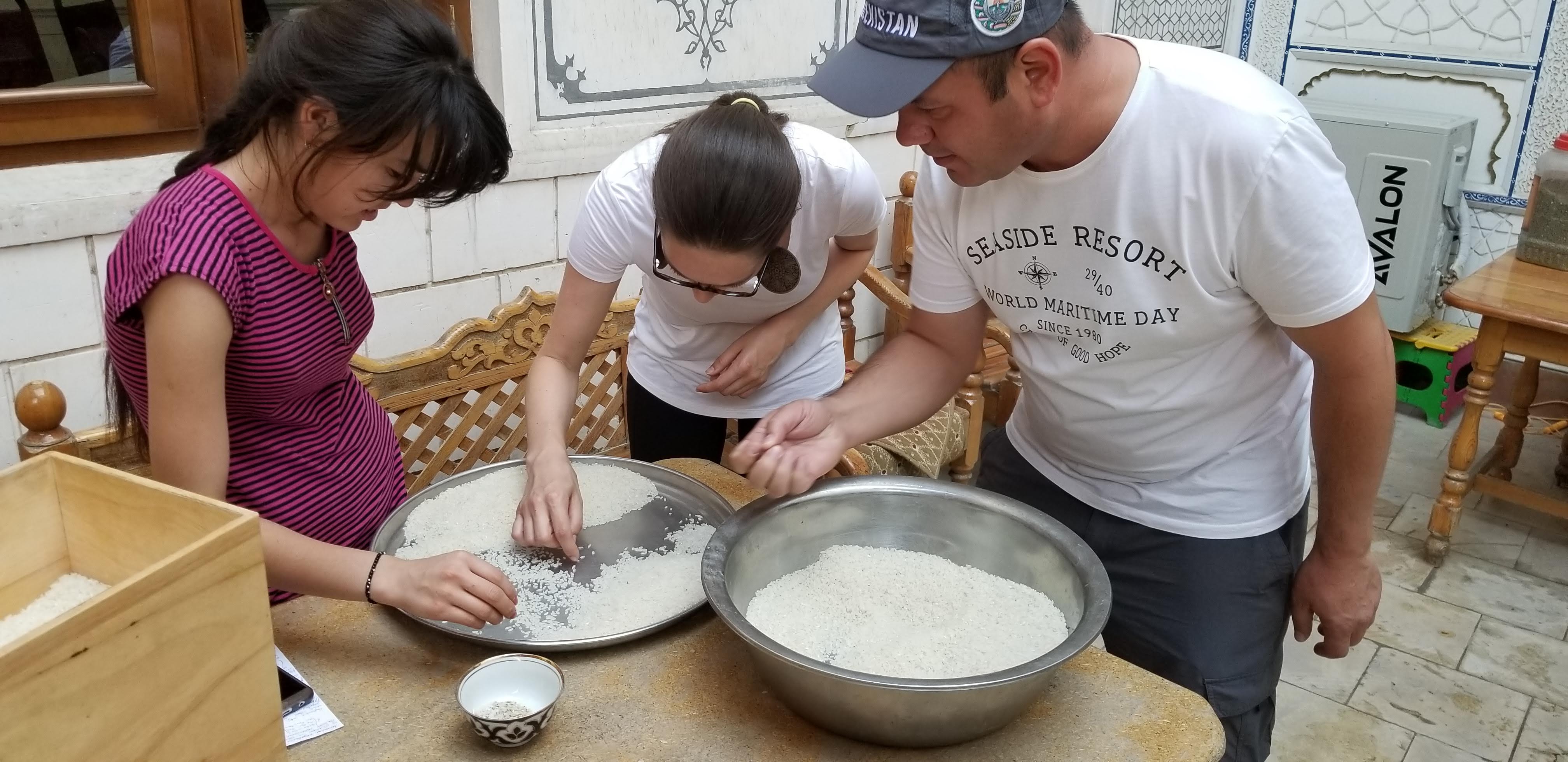
Then it was lunchtime. Here’s Elle sorting rice for the national dish of Uzbekistan called plov.

The rice was combined with other ingredients including lamb or beef, carrots, onions, spices like cumin and coriander, chickpeas, and raisins.


Delicious!

After lunch Mirzah donned a traditional kaftan sultan outfit.

Later we enjoyed a nice setting for our dinner meal.

They light up the Kalon Tower after dark.
It’s important to make bread at night so it is ready in the morning. Elle helped.
Of course, the bread had to come out of the oven.

The bread is finished. Elle is tired now from a hard day of work. Time to sleep.
Hayrli tun (good night).
Leave a Reply