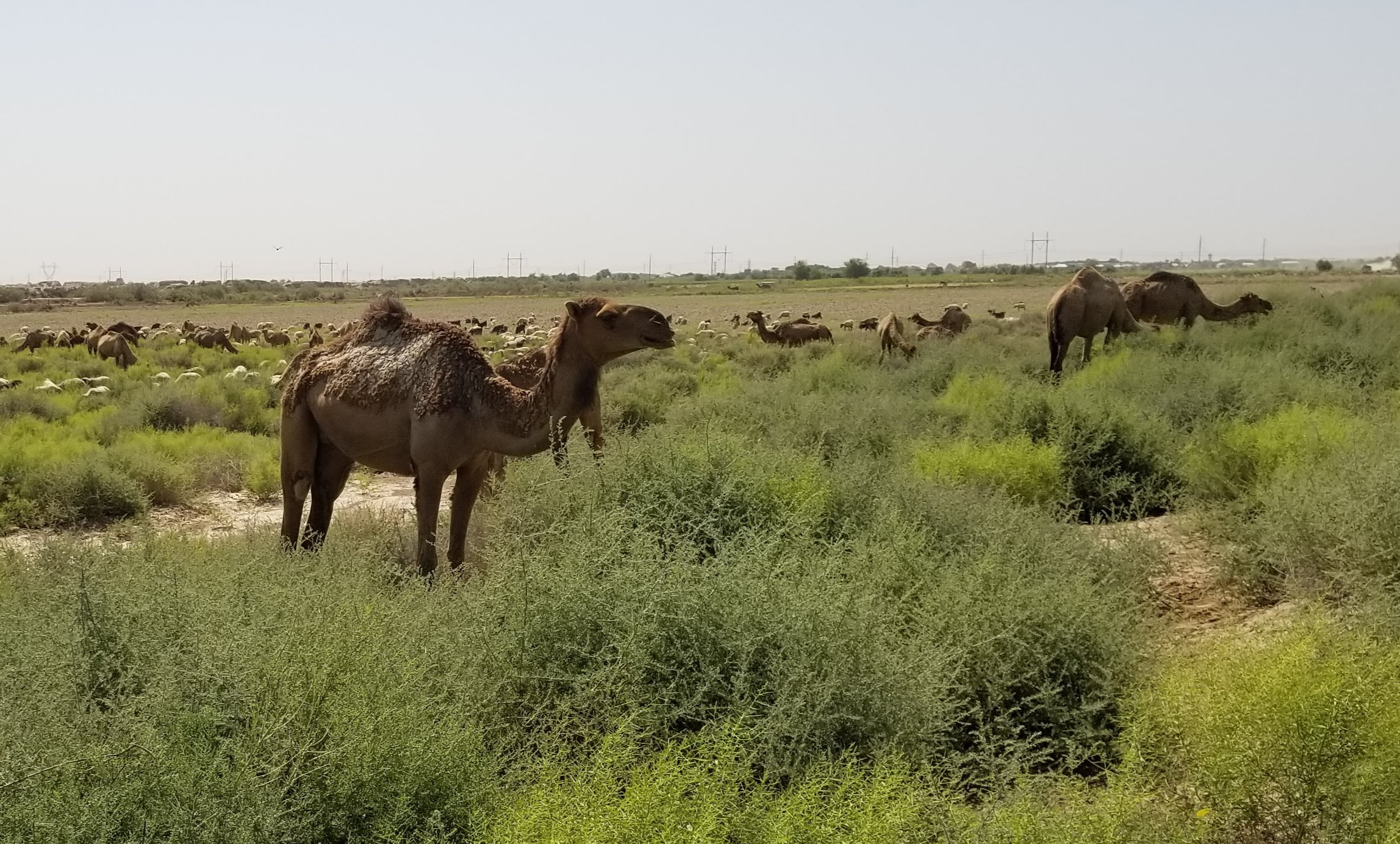

We got an early start with the sun rising at about 5:30 a.m. After breakfast we drove into the Karakum desert which covers 70% of Turkmenistan. Karakum means “black sand”, referring to the shale-rich sand beneath the surface.
The road was so bad that we frequently had to swerve into the left hand lane to avoid huge potholes.

Soon we encountered the Tomb of Ahmad Sanjar, a mausoleum commemorating a Seljuk ruler of Khorasan. It was built in 1157 in the medieval city of Merv, which is in the desert. Believed to be the largest city in the world at the time, Merv boasted a population of over one million. It was a prominent city on the ancient Silk Road.
After being sacked by the Oghuz, Merv declined and in 1221, the Mongols attacked and burned down the mausoleum. It was later restored by Soviet, Turkmen, and Turkish architects during the 20th and 21st centuries.

Under the turquoise-tiled outer dome are three-tiered open galleries in the form of alternating laced arches. The dome symbolically represents the firmament.

Yusuf Hamadani was a Persian Sufi of the Middle Ages. This is his tomb.

We stopped for lunch and enjoyed this central Asian rice dish, palaw. Rice, lamb carrots, and onions, along with aromatic spices like cumin, coriander, and saffron are typical ingredients.
Our afternoon featured visits to ancient sites around Merv.

Erk-Kala, which means ‘free fortress’ in Turkmen, is the oldest of Merv’s citadels. It was built into the northern face of the fortress walls of the Gyaur kala settlement and covers a 50-acre area.

We found pieces of pottery scattered around the site.

This underground reservoir appeared on the side of the road.

Here’s what it looked like from below.

The Askhab Mausoleums are a Timurid-era shrine in Merv dedicated to two of the Prophet Muhammad’s earliest companions who were among the first converts to Islam.

The Lesser Kyz Kala, probably built in the 7th-9th centuries, is one of two semi-fortified homes located southwest of the Sultan Sanjar Mausoleum. It likely served as the home of a high-ranking official.

The Great Kyz Kala is a large ruined fortress in the ancient city of Merv. The date of construction is unknown. It is an example of a köshk type of fortress, an earthen building built on a raised platform. The exterior walls are formed of large vertical connected columns. It might have been used by the governor of Merv as a suburban residence.
Border Crossing from Turkmenistan to Uzbekistan
After driving five hours along another bumpy road, we reached the Turkmenistan border crossing near Turkmenabat. Murad delivered us to a checkpoint, and he could go no farther. We had to proceed on our own.
Ahead lay a 1/4 mile crossing of the last section of Turkmenistan, then a 1-mile no-man’s-land, and finally the first 1/4 mile frontier of Uzbekistan. Murad said that it was allowed for people to walk the roads that cross these desert frontiers, but we didn’t see anyone doing that. Instead our luggage was loaded into the back of a small white van, and we climbed inside with about four other passengers. Near the rearview mirror I observed a postcard that said, “Welcome to New York.” We paid three dollars each, and off we went to the next checkpoint.
In a short time, maybe five minutes, we arrived at a small building and exited our van. A number of other vehicles and people were here. Everyone was crossing through this checkpoint on foot. There were two windows where people were being processed through. The window on the right had a long line of local people transporting food and dry goods of various kinds for import into Uzbekistan. Fortunately they motioned us to the other window that had almost no line. It seemed that they gave preference to foreign tourists, but since no one spoke English, we proceeded without explanation. They filled in forms for us and stamped our passports.
After clearing this checkpoint we walked a short distance to where we were to wait for the next conveyance. No one was around except two Japanese tourists. Ten minutes passed and still no one had come. Then a small truck towing a six-foot-square open trailer pulled up. We put our suitcases into the trailer, paid the driver three dollars each, and off we went. The Japanese tourists joined us.
We crossed no-man’s-land, another bleak patch of desert and arrived at the next checkpoint.
After another conveyance and three dollars each, we arrived at the final checkpoint. There we passed through a building where two women casually searched our luggage and asked strange, random questions. “Do you have any coins?” I produced a couple of American quarters. “What food are you carrying?” None. Then after looking in the air for inspiration, one of the women asked, “Do you have any drones?” Really? Finally they released us to walk down a 50-yard-long fenced sidewalk. At the end we passed through a door and standing on the other side was our Uzbekistan guide, Mirzah, to greet us. We were glad to see him.
Away we went to the city of Bukhara (the “k” is silent), inhabited for a few thousand years. The name Bukhara conjures up images of the exotic Orient. The old town has been well-preserved and is crammed full of minarets, mosques, and madrassas. After arriving in Bukhara, it was a pleasant walk to our hotel, Lyabi House Hotel.

Our receptionist in Bukhara, Uzbekistan was Christian. That was a surprise among all of the mosques we had seen.

Look at this round oven for making loaves of bread. There are tandoor ovens of various types scattered across the country.
Regardless of size, shape, or region of origin, all tandoor ovens operate on essentially the same principle. They are made of clay with some sort of insulating material like concrete or mud on the outside. The ovens are cylindrical and often curve inward toward the top like a jug or beehive to concentrate the heat. An opening is left in the top or side to allow access and ventilation.
A fire is built in the bottom, which heats both the walls of the oven and the air inside to upwards of 900° Fahrenheit! Like a barbeque grill, the fire is allowed to die down to coals before cooking so that the temperature remains consistent while food is cooked.

A pretty display.
Everyone is out in the evening enjoying the pleasant weather. We are glad to be among them.
Leave a Reply