My daughter, Elle, and I are traveling to four countries in central Asia that end in “stan”. I have taken each one of my daughters on a big trip to a destination of their choice. What fun it has been!
We had a layover in Istanbul and then flew on to Ashgabat, the capital of Turkmenistan. Ashgabat is located about 10 miles from the border with Iran. Approximately 800,000 people live in the city. Turkmenistan’s total official population is about 7 million.


We arrived about 2 a.m. and eventually made our way to our hotel.

Here’s what the airport terminal looked like when we drove by it the next day.
Turkmenistan is one strange place, especially compared to the norms of what we’re used to at home. It is the least visited by far of the five Central Asian stans. The country is remote and insular, with fewer than 10,000 tourists visiting each year.
Much of the city was destroyed by the 1948 Ashgabat earthquake, but has since been extensively rebuilt under the rule of Saparmurat Niyazov’s “White City” urban renewal project, resulting in monumental projects sheathed in costly white marble.
Two Presidents
Turkmenistan, a former Soviet satellite, was formed as a separate country in 1989 when the Soviet Union broke up. The first president Saparmurat Niyazov was a Turkmen politician who led Turkmenistan from 1985 until his death in 2006.
In his time, Niyazov was one of the world’s most totalitarian, despotic, and repressive dictators. He designated himself as “Turkmenbashi,” or father of the Turkmen. He promoted a cult of personality and imposed his own eccentricities upon the country, such as:
- Renaming Turkmen months and days of the week to references of his autobiography, the Ruhnama, as well as to Turkmen heroes, poets, historical events, and family members.
- He made it mandatory to read the Ruhnama in schools, universities and governmental organizations. New governmental employees were tested on the book at job interviews, and an exam on its teachings was a part of the driving test in Turkmenistan.
- Niyazov introduced a new Latin-based Turkmen alphabet to replace Russian Cyrillic. The Latin Turkmen alphabet consists of: Aa, Bb, Çç, Dd, Ee, Ää, Ff, Gg, Hh, Ii, Jj, Žž, Kk, Ll, Mm, Nn, Ňň, Oo, Öö, Pp, Rr, Ss, Şş, Tt, Uu, Üü, Ww, Yy, Ýý, Zz.
- Niyazov banned the use of lip syncing and sound recordings at public concerts in 2005.
- He also abolished the Turkmen word for bread and replaced it with Gurbansoltan, his mother’s name.
- Niyazov prohibited news reporters and presenters from wearing makeup on television. He also ordered that each broadcast begin with a pledge that the broadcaster’s tongue would shrivel if he/she slandered the country, flag, and/or president.
- Niyazov banished dogs from the capital Ashgabat because of their “unappealing odor” and barred citizens from owning more than one cat or dog.
- In 2005, he closed down all rural libraries and hospitals outside of the capital city Ashgabat, in a country where at that time more than half the population lived in rural areas, once stating that, “If people are ill, they can come to Ashgabat.”
Gurbanguly Berdymukhammedov (I’m glad I didn’t see those words in grade school spelling competitions) is a Turkmen politician and former dentist who is currently the chairman of the People’s Council of Turkmenistan. He previously served as the second president of Turkmenistan from 2006 to 2022, when he entered into a power-sharing arrangement with his son, Serdar, the current president.
Upon taking office, Berdimuhamedow eased travel restrictions and reopened libraries in rural areas. As reported in Wikipedia, he also took steps to curb Niyazov’s extensive personality cult. He called for an end to the elaborate pageants of music and dancing that formerly greeted the president on his arrival anywhere, and said that the Turkmen “sacred oath”, part of which states that the speaker’s tongue should shrivel if he ever speaks ill of Turkmenistan or its president, should not be recited multiple times a day but reserved for “special occasions”. He also gave up his right to rename any landmarks, institutions, or cities, restored the traditional names of the months of the year and days of the week, and announced plans to move the gold rotating statue of Niyazov from Ashgabat’s central square. Despite these changes, Berdimuhamedow’s regime remained rigidly authoritarian.

A few months ago Berdimuhamedow ordered the confiscation of black cars in the capital because he considered the color white to be “lucky”. Police seized dark-colored vehicles in Ashgabat, and their owners were told that they must pay to have them repainted silver or white. It was later reported that the ban extended to vehicles of all colors except white.
Getting into Turkmenistan is not straightforward. At least a month before you come, you need to submit to the Migration Service a proposed detailed itinerary along with an application form in order to generate a Letter Of Invitation. Then, you get a Visa On Arrival at the airport or border. Within twenty-four hours of entering the country, you must have your passport registered with the Ministry of Culture to receive a Travel Pass for permission to move around. Foreigners are not allowed to generate any of this paperwork themselves. An authorized travel agent is required. He must also serve as your guide, accompanying you throughout your journey. Our tour provider, Kalpak Travel, provided this assistance.

Oguzkent Hotel is new and modern. The lighting system in our room was so advanced and confusing that we couldn’t figure out how to turn the lights off. The staff had to explain it to us the next morning.


Here is the view from our hotel room in the morning.

They served us a delicious breakfast.

Turkmenistan is mad about bicycles. The United Nations had declared June 3 as World Bicycle Day. According to the source Eurasianet, a bike race in Ashgabat on June 1 with 3,246 participants set a Guiness Book of World Record. Turkmen President Gurbanguly Berdymukhammedov participated in the event.
The remnants of the bike race in Ashgabat shut down the city during our first morning. We saw lots of white cars as we modified today’s itinerary and left the city.

Out in the countryside we viewed a large holding pen for sheep. Lamb and mutton are the primary meats consumed in Turkmenistan.

In the distance we could see the Walk of Health. It is a 22-mile-long concrete walkway that runs alongside the Kopet Dag mountain range in south Ashgabat, border with Iran. Saparmurat Niyazov constructed the path in 2000 with the intent to encourage citizens to be healthy. Until Niyazov’s death, he required his ministers to walk the walkway once every year while he traveled by helicopter to meet them at the end. He feared that his own heart condition would render him unable to walk the entire length. On August 30, 2004, over 10,000 people walked the walkway, including members of the government.

This curved roadway leads to an ancient settlement called Nisa. The city of Old Nisa was located on the northern slopes of the Kopet Dag mountain range, near modern day Ashgabat. Founded in the 3rd century, Nisa was one of the early capitals of the Parthian Empire, a powerful empire in ancient times. It became a hub of trade and commerce on the Silk Road.

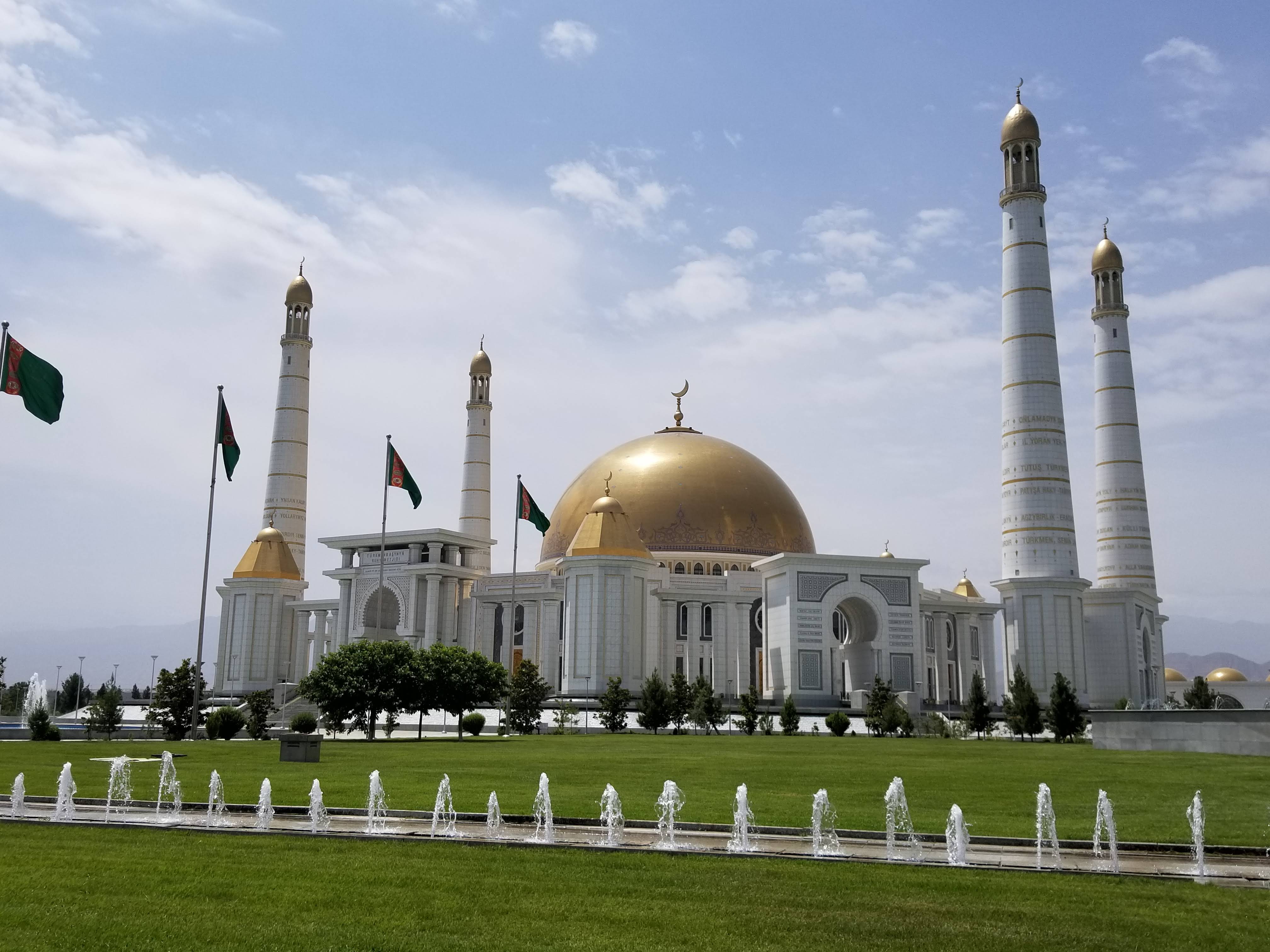
A few miles west of Ashgabat is Turkmenbashy Ruhy Mosque. Saparmurat Niyazov is buried here.

The Wedding Palace covers more than 400,000 sq. ft. It has three tiers, each side of which has the form of an eight-pointed star. A cube towers over large columns and forms its upper stage. This cube holds a ball with a diameter of 100 feet, a symbolic planet Earth with the image of Turkmenistan. Four entrances to the building symbolize the four directions.
The interior of the palace has six rooms for registration of marriage. Three are wedding halls for events, two of which hold 500 people and one which holds 1,000.
The Palace hosts seven banquet rooms, 36 shops and two cafes, providing all the necessary items of wedding services, including dress shops, decorations, car rental, ethnic jewelry, photo studio, beauty salon and 22-room hotel. Perhaps one of my daughters would like to have a destination wedding here. Yikes!

In 2015 Gubanguly Berdymukhamedov unveiled a statue of himself – riding a gold horse.

The three-legged Monument of Neutrality arch, which became known locally as “The Tripod” is 250 feet tall and was built in 1998 on the orders of President Niyazov to commemorate the country’s official position of neutrality.
Neutrality Day of Turkmenistan, celebrated annually on December 12, is the second most important state holiday in Turkmenistan after Independence Day.

Our guide Murad, is pointing to an open area where roads are ready for more white apartment buildings.


The design of the Independence Monument was inspired by traditional Turkmen tents and the traditional headgear worn by Turkmen girls.

The State Library of Turkmenistan holds about 5 million items.

Near the Independence Monument stands a golden statue of former Turkmenistan president Niyazov. It appears that birds like this statue.

Ruhnama Monument celebrates the bizarre book of that name written by Niyazov.

Ashgabat looks beautiful at night.

Oguzkent Hotel as we viewed it after dark.

Elle posed in front of the monument in Altyn Asyr Park.

The capital, Ashgabat, holds the world record for the highest concentration of white-marble buildings. Our guide, Murad, told us that a lot of people live in these buildings, primarily government officials, foreign businesspeople, and some citizens who have connections or made deals to purchase them. However, most of the windows were dark at night, making the buildings seem vacant.
Some jokingly refer to it as the “City of the Dead” due to the apparent emptiness of the new districts, especially in the central areas.

I was amused by this phone booth. I wonder if it still works.
Here is a good, comprehensive article about Turkmenistan – https://broaderhorizons.com/turkmenistan-adventure-travel/
Leave a Reply