We are now on our own and will spend the morning on an in-depth walking tour of Belfast. We want to learn more.
Our guide with DC Tours, Miley, is an American that received her Doctorate in Northern Ireland History. She was excellent, and our tour, History of Terror, impacted her as she related these stories to us. Her thesis was about gaining insight into the politics of “peace babies”, those born after the Peace Agreement of 1998.
The Troubles took place from 1969 to 1998. It wasn’t a religious conflict. It was about identity and territory and became an us-vs-them mentality on both sides. Peace walls do not keep the peace. It keeps people apart and not able to interact.
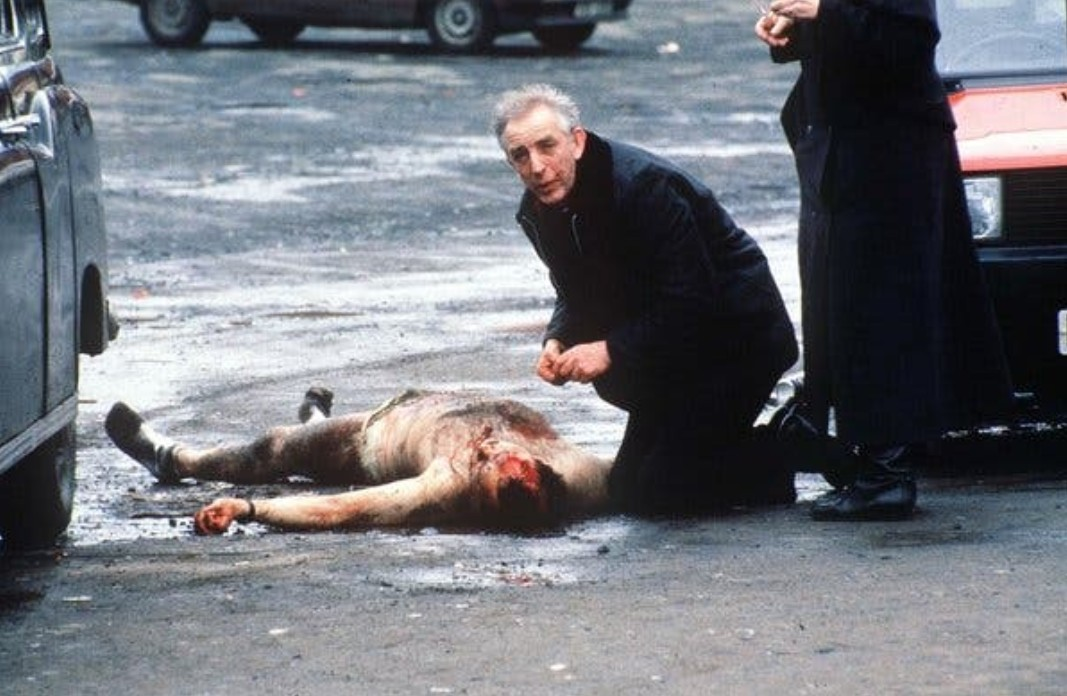
Terry “Junior” Enright was a 28-year-old cross-community youth worker from West Belfast who was shot and killed by loyalist paramilitaries while working as a doorman (bouncer) in January, 1998.
The supreme court building was bombproofed. Kids would be enlisted to sit in cars while parents shopped because an unaccompanied car might have a bomb.
The City Center is a shared space. Troubles plaques are not allowed in a shared space since it would cause more trouble.


When did the Troubles start? Seeds were planted long ago. Civil war was imminent over the issue of Home Rule, but WWI tabled the issue. The British didn’t want home rule by the Irish.
In the province of Ulster, three counties had a majority of Catholic/Republicans, and, therefore, any election would overpower the Protestants/Unionists. They didn’t want them included in an election so these counties are in Ulster but part of the Republic of Ireland.
In August 1969, Operation Banner sent British military to keep peace, and it was supposed to be over by Christmas. They were finally gone in 2007.
There were 8 bombs in 1969 and 1,500 bombs in 1973. Fifty-five percent of those killed or injured were everyday citizens.
Economic bombs were the first bombs. Buildings were targeted. They were not intended to harm people. Bombs are difficult to control. Often a phone call was received to evacuate but rarely was there enough time to evacuate everyone.
By 1972, bags needed to be patted down. Eighteen cages were built around the city called Rings of Steel. The city center was closed at 8pm so that killed the nighttime economy. No one would be in the city center after dark.
People from Northern Ireland just assumed all cities have security checks. When they would go into a store in another country they would hold their hands up expecting to be searched. TV reporters became hardened and numb to the frequent bombings. There were no-go zones and armored trucks.
There were many attempts to kill Margaret Thatcher. “One bomb in England is worth 100 in Belfast.” Many people fled the violence so there was a huge brain drain in Northern Ireland.
On March 4, 1972, the Abercorn Restaurant bombing happened in the shared space so there is no commemoration. It is considered the most horrific bombing.
A handbag containing a five-pound bomb was left under a table. No one claimed responsibility. They still don’t know who did it. It was the first time that there were deaths. Two young Catholic girls were killed and 130 to 140 people were injured, some seriously.
Anesthetist Fred Beeren was treating the horrific results of the bombing never knowing that his daughter, Janet, had been killed.
On March 10, 1971, three young British soldiers had six-hour passes. They met three girls who asked them to a nearby party. They were abducted and murdered by the Irish Republican Army (IRA) in Belfast. This is called a honey trap.
In response, the UDA loyalist paramilitary group put 40,000 people on the streets. Opposing them, Tartan gangs would burn down Catholic homes and establishments.
Tit-for-tat killings were commonplace and families of victims would beg for no retaliation.
In an effort to get things under control, an interment law said that people could be arrested without trial. It had the opposite effect.
Of 342 interments of Catholic men, only 35 had IRA connections. This boosted recruitment for the IRA. “If they are going to put me in jail anyway…”
Loyalists started harassing the Irish to look for the culprits. In Northern Ireland, signs would say “Catholics need not apply.” They needed jobs, education, etc. Unemployment was high.
If one wanted to enter a bar, someone would have to know them before they could enter.
Punk rock originated in Belfast. They were anti-everything instead of choosing sides. Stiff Little Fingers from the Murder Triangle is still performing today.

There was a ban against Irish organizations broadcasting in order to prevent groups from using the media for political advantage. So they used voice actors. There is currently a comedic play entitled I Was the Voice of Gerry Adams.
In 2019, a peace baby named Lyra McKee was killed by a remnant of the paramilitary. Although they condemned the attack, politicians benefit from keeping things separate, but that isn’t the way of peace.
People with PTSD are common in Northern Ireland. Even children of those who lived through the Troubles have what is called secondary PTSD. The medical community is only beginning to study this. Mental Health trauma can be transferred to the next generation. Suicide rates are high.
For 23 years people would not come to the city. Residents are just starting to see progress. Separation didn’t create peace. It fostered us/them hatred.


It took a very long time for both sides to meet and discuss peace with the U.S. under Bill Clinton who became involved in the process. On April 10, 1998, the Good Friday Agreement or Belfast Agreement was signed and approved.
The 66-page Peace Agreement was mailed to everyone. If one voted yes, everything was agreed to, no exceptions. There was an 81% turnout, and 71% agreed to the terms.
The Peace Agreement doesn’t fix things, but they are less angry now. How is peace maintained? All these events are within living memory. It will take time.
Miley recommended this book: Pedagogy of Conflict and Color of Compromise.
There is a statue of Frederick Douglas. The city strives to use public spaces to show visitors that Belfast has a shared past and not only violence. Frederick Douglas was in Ireland in 1845 just as the famine was starting. Even then he was distressed about the poor farmers.

We finished our tour and decided to spend our last afternoon in Belfast having a proper British tea complete with scones and clotted cream.

For dinner, we went to the famous, historic Crown Liquor Saloon with its beautiful woodworking and stained glass. Skilled Italian craftsmen who were working in local churches agreed to “moonlight” to supplement their income. These craftsmen used their expertise in tiling, glasswork, and woodwork to give the Crown its unique, ecclesiastical character. Today, the sun-drenched stained glass and nine carved “snugs” still evoke the atmosphere of a baroque church or confessional box.


Before we leave the Republic of Ireland and Northern Ireland, I would like to give some observations.
- Our food was always steaming hot.
- GREAT story tellers
- Music is a way of life.
- Fiercely proud of being from the Emerald Island no matter the politics, religion or status. They have Tidy Towns and Pride of Place.
- Water from faucets, toilets, tubs, shower has LOTS of volume.
- Half ten is how the Irish say 10:30.
- Slog is the Gaelic word for goodbye and that is where we have the term “so long”.
Leave a Reply