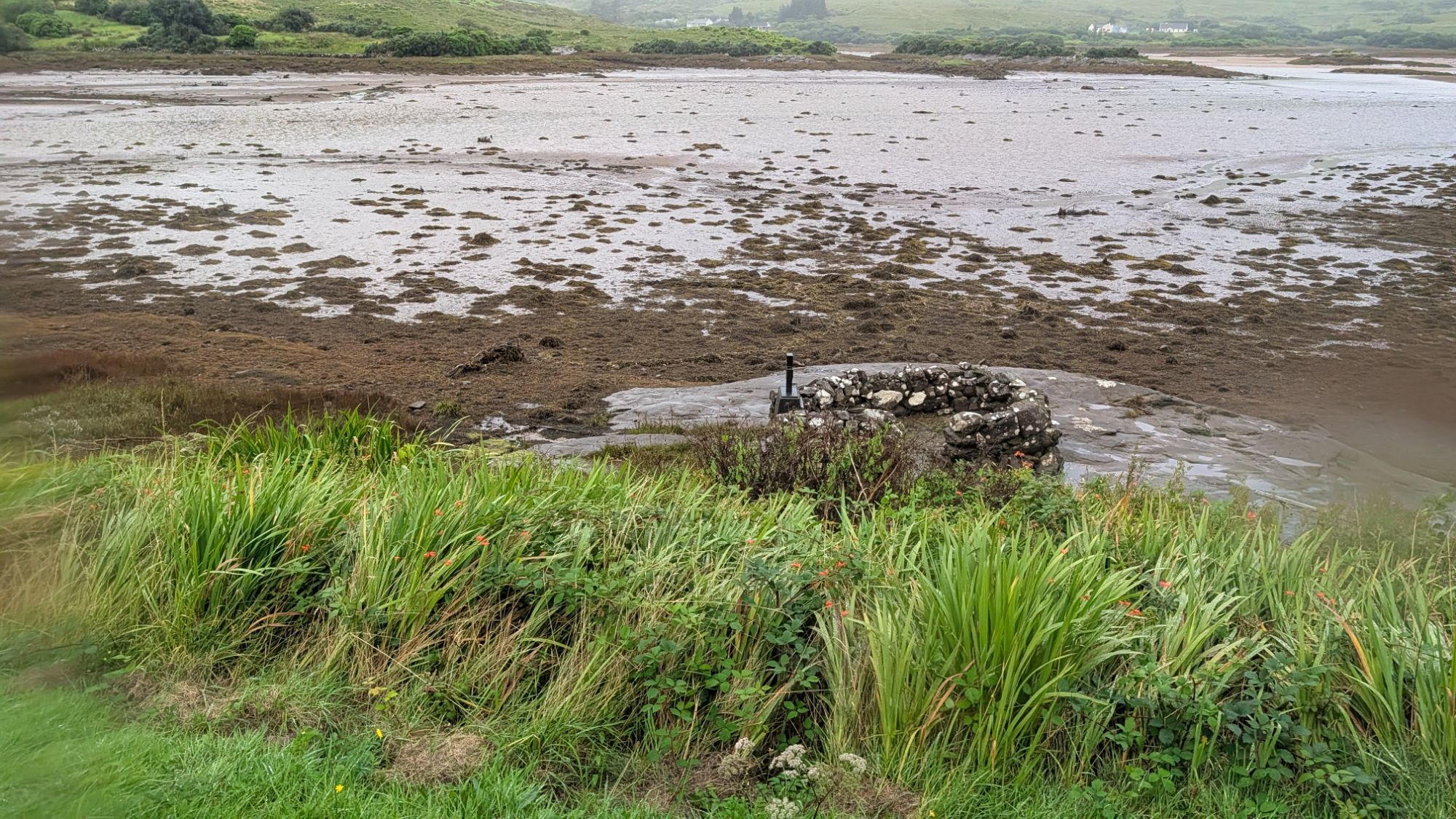
We continued driving along the Connemara. Cong is where Maureen O’Hara and John Wayne filmed The Quiet Man in 1951.


It remains the longest fight scene in Hollywood history. While making the movie they had to stop and have a beer before continuing.

Pierce Bronson is Irish, and he held his Wedding Reception at Ashford Castle. Rory McElroy is from Northern Ireland. He was married here.

Irish Travellers
Irish Travellers are not gypsies, but they are nomadic. They live in big social communities and are often discriminated against. If Irish Travellers settle in your community, they will be there for 6 weeks. After that, the law will make arrests. The paperwork takes four weeks. The communities that they occupy experience petty crime and trash. They can be seen at markets and go door to door looking for work.
Irish Travellers have traveled to other countries. Murphy Village, South Carolina is the largest settlement in the USA. They have big family occasions for weddings and funerals. Irish Travellers are very religious. They marry young around the age of 16. Most home school their children yet education is not a priority.
Historically, Irish Travellers were a valued workforce for the farmer. They were tinkers who could fix anything and were good with horses.
In Ireland, “halting sites”, designated areas for Irish Travellers, were built in 1983. People were no longer allowed to camp beside the road or in car parks. Officials soon found that they needed two halting sites because fights broke out.
Many people thought that they started traveling in response to the famine but it was way before that … perhaps during the time of Oliver Cromwell?
King of the Travellers (2012) is an Irish Traveller version of Romeo and Juliet. Many of the extras are actually Irish Travellers.
Snatch by Brad Pitt. He had the Irish Traveller accent down pat. Also The Field has Travellers in the movie. Richard Harris stars in it and was up for an Oscar for Best Actor.
The Fureys is a musical band of Irish Travellers. They are credited with bringing traditional Irish music and instruments to global audiences.
Up Mayo!
In the US we would say Go, Mayo! In Ireland, they say Up Mayo!
County Mayo failed to win an All-Ireland football final between 1951 and 2026. Legend has it that a priest became furious when the Mayo team bus returning home from the 1951 final passed by a funeral without showing respect as they celebrated their All-Ireland win. The priest supposedly put a curse on Mayo, that they would not win another title until all of the team had died. All remaining members of the team had died by 2023.
On 26 July 2026, Mayo defeated Kerry, ending a 75-year wait to win the Sam Maguire Cup. Former President Biden has ancestors from Mayo. He tweeted Up Mayo!

School of
Falconry at Ashford Castle

The first raptor that we saw was a Gray Owl which is not nocturnal.


Falconers trace the phrase “fed up” to falconry. When a trained hawk or falcon has eaten its full fill of food, it loses all interest in cooperating, flying, or hunting for the falconer.
When raptors are released to the wild, they will come back to get an easy meal. The handlers have to practice a type of air traffic control.
Each of us had an opportunity to be a falconer.
More History
Charles Cunningham Boycott was an unscrupulous land agent in County Mayo trying to collect rents from the tenant farmers in the mid 1800’s. The tenants convinced his field hands and domestics to walk off the job … and no one in the town would do business with him. This ostracism was soon called a boycott, a word now in our dictionaries.
The Industrial Revolution was in full swing in England, and Ireland was the bread basket. Much food and meat was sent to England during the famine.
A cottier in Ireland (c. 1700–1850) was a person who rented a simple cabin and land between one and one and a half acres of land upon which to grow potatoes, oats, and possibly flax. The ground was held on a year-to-year basis and rent was often paid in labor. Usually, the land available to the cottier class was land that the owners considered unprofitable for any other use. There was no incentive to improve a land because it prompted a rent increase. By 1850, the cottier class almost completely disappeared.
In 1740 in Ireland, the population was 2.4 million. A hundred years later in 1840, Ireland had experienced a population explosion to 8 million. During the famine, one million people died, and two million people left. There was continued emigration and low birth rates, and the population reached an all time low of 2.8 million in 1961. Today the population of the island of Ireland which includes the Republic of Ireland and Northern Island is 7.2 million, still below its pre-famine peak of over 8 million.
The famine started in 1845 with a heavy stench in the air. The potato looked okay, but when it was squeezed, it turned to mush. The first year, deaths occurred in the very old and very young. They sold everything like tools and fishing nets to get money. They had no idea that it would last for five years.
The lakes, rivers, and the sea belonged to the landlords. If people were caught fishing or hunting, they would be imprisoned for poaching.
The potato blight went all through Europe, but nowhere did the poor only have potatoes to eat except in Ireland.
In 1846, panic set in. They thought that the potato blight was behind them. Work camps were established by the British. They built roads that went nowhere. They worked long hard days and got pennies. These were called penny walls.

In 1847, workhouses were established by the British. They were overcrowded and overrun. Diseases such as typhus and cholera were prevalent. This year was called Black ’47. The government closed the workhouses because they were too expensive to run.
The British wanted to wash their hands of the famine. They decided that the landlords must look after and care for their own tenants. Some of the landlords were poor as well.

Many Irish chose or were asked to emigrate. The family sent their strongest who would find work abroad and send money back.
However, when they arrived in America things were not good. Many business signs said, ” No dogs, no Irish”.
This song tells the tragic story of a fictional man named Michael from County Galway who was deported to Australia for stealing food to feed his starving family.
Every county has at least one mass grave. There are many ghost villages from the hunger times.
Copper sulfate was sprayed on potatoes, different hardy varieties are grown, and crop rotation is used to combat the blight. Today few large scale potato farms exist in Ireland. Potatoes mostly are grown in personal gardens.

County Mayo was the county most affected by the great hunger and has not recovered. The population remains only about one-third of the 1840 level.
Tony Blair, Prime Minister of the U.K., announced that they should have and could have done more to help the Irish. This admission by Britain was the first. The British and the Irish have good communication now.
The Irish helped the Choctaw during the Trail of Tears. The Indians sent money to the Irish during the famine. The Choctaw Cultural Center in Durant, Oklahoma, has a full wall about the Irish Famine.


Leave a Reply